
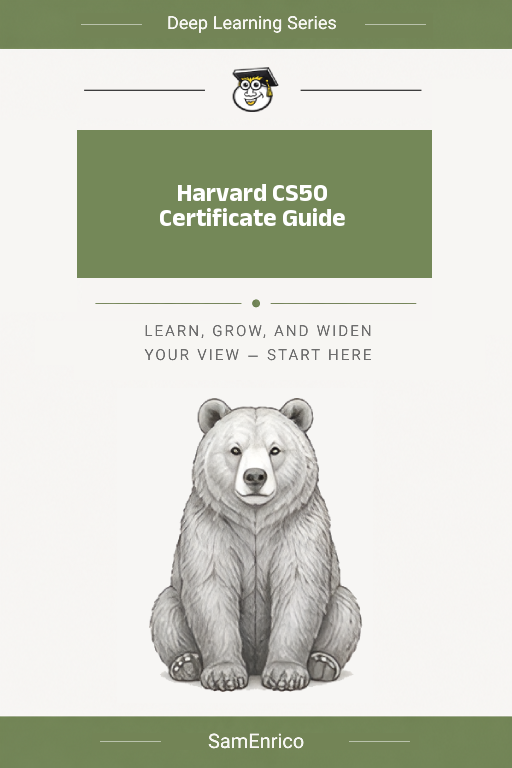
Non-FictionStudent's ShortcutHarvard
Harvard CS50 Certificate Guide eBook
Complete Harvard's CS50 Introduction to Computer S
Complete Harvard's CS50 Introduction to Computer Science for foundational programming credibility.
Formats
Free sample
Chapter 1: The 60% Lie--You have been told that you need 70% to pass Harvard's CS50. That is false. The verified certificate requires only 60%. But the real lie is not about a percentage. The lie is that you need to be a genius, a math prodigy, or a child who started coding at age seven.
None of that is true. What you actually need is a map. This book is that map.Every year, more than one million people start CS50. Fewer than forty thousand finish with a verified certificate. That is not because the material is impossible.
It is because most students make the same three mistakes before they ever write a single line of code. They watch lectures like Netflix, passively absorbing information without ever pausing to type. They open problem sets without a plan, staring at a blank editor until panic sets in. And they isolate themselves, believing that asking for help is cheating.This chapter will dismantle those mistakes. You will learn exactly where the CS50 certificate fits in the eyes of employers, why your final project matters more than the certificate itself, and how the next sixteen weeks of your life will be structured.
By the end of this chapter, you will have a complete roadmap, a self-assessment of your current level, and a clear understanding of what the next four months demand from you. There is no fluff here. Only what works.The Credibility Hierarchy: Where CS50 Actually Sits Let us begin with honesty. A verified certificate from Harvard's CS50 is not a degree. It will never replace four years of computer science education in the eyes of a traditional hiring manager.
But you are not competing against computer science graduates for every role. You are competing against the other one million people who started CS50 and quit.Employers rank credentials in a predictable hierarchy. At the top is direct experience. A candidate who built a shipping product for two years will almost always beat a candidate with a degree but no real code. Below experience comes the traditional degree, specifically a Bachelor of Science in Computer Science from an accredited university.
Below the degree comes verified MOOC certificates from prestigious institutions, and CS50 sits at the very top of this pile. Below that comes audit track completion, which most employers ignore entirely.Why does CS50 sit above other MOOCs? Three reasons. First, the Harvard brand carries weight that ed X or Coursera alone cannot match. Second, the project-based curriculum forces you to build real things, not just click through multiple choice questions.
Third, the automated grading system (check50) enforces correctness ruthlessly, which means a CS50 certificate actually proves something.Here is the critical distinction that most guides get wrong. The certificate alone is worth very little. The final project, hosted on Git Hub with a clean README.md file, is worth everything. The certificate says you completed a course. The final project says you can build software.
Employers hire people who build software. They do not hire people who complete courses.Your resume should list the verified certificate under either "Education" or "Certifications" depending on your background. If you have no degree, put it under Education. If you have a degree in an unrelated field, put it under Certifications. In both cases, include a link to your Git Hub profile prominently at the top of the resume, right next to your email and phone number.The Portfolio Effect: Artifacts as Evidence Every problem set you complete in CS50 is an artifact.
An artifact is a piece of evidence that demonstrates a specific skill. The mario problem set shows that you understand loops and nested iteration. The filter problem set shows that you understand image processing and memory manipulation. The speller problem set shows that you understand hash tables and performance optimization.Most students complete these problem sets, submit them, and never look at them again. That is a catastrophic waste.
Every single problem set belongs in a portfolio folder on your local machine. Every single one. When you finish the course, you will select the three strongest artifacts to feature prominently on your Git Hub profile.The Artifacts Log is introduced here and will be referenced throughout this book. On page twenty-four of this chapter, you will find a printable template. For each problem set, you will record three things.
First, the problem set name and week number. Second, the single hardest technical challenge you overcame. Third, one sentence that explains what this artifact proves about your abilities.Here is an example for the speller problem set. Problem Set: Speller (Week 5). Hardest Challenge: Implementing a hash function that distributed one hundred forty-three thousand words evenly across five hundred buckets.
Proof Statement: "This artifact demonstrates my ability to optimize memory usage and achieve O(1) average lookup time for a dictionary of one hundred forty-three thousand words."When you finish this book and the course, you will return to this log in Chapter Twelve to select your portfolio pieces. Do not skip the log. Future you will be grateful.How Computers Actually Work: The Conceptual Foundation Before you write your first line of C code, you need to understand what happens inside the machine. This section synthesizes the core insights from Ron White's How Computers Work, distilling four hundred pages into the ten concepts you actually need for CS50.Binary Representation. Computers do not understand decimal numbers.
They understand two states: on and off, one and zero. Every number, letter, and instruction is represented as a sequence of these binary digits, or bits. Eight bits make a byte. One byte can represent two hundred fifty-six possible values, from zero to two hundred fifty-five. Four bytes can represent over four billion values.
This is why data types have size limits. An int in C is typically four bytes, which means it cannot store a number larger than approximately 2.1 billion. When you try, it overflows and wraps around to a negative number, one of the most common beginner bugs.Random Access Memory (RAM). RAM is a giant array of lockers. Each locker has a unique address, starting at zero and going up to whatever your computer has installed.
When you declare a variable in C, the compiler assigns that variable to one or more of these lockers. The lockers are volatile, meaning when power is lost, the contents disappear. This is why you must save your work to a hard drive or solid state drive.The Central Processing Unit (CPU). The CPU is the factory floor of your computer. It has three main jobs.
First, the fetch step reads an instruction from RAM. Second, the decode step figures out what that instruction means. Third, the execute step performs the instruction, which might involve arithmetic, moving data between lockers, or jumping to a different instruction. Modern CPUs can perform billions of these fetch-decode-execute cycles per second. Each cycle is a clock tick.
This is why algorithm efficiency matters. An O(n²) algorithm on a list of one million items might require one trillion cycles, which could take minutes or hours instead of milliseconds.Why This Matters for CS50. When you write C code, you are directly commanding the CPU and RAM. There is…
This is the end of the free sample. Get the eBook to keep going. Buy now
About this book
Details
- Author
- Upchurch Shawn
- Publisher
- SamEnrico
- Language
- English
- Genre
- Non-Fiction, Student's Shortcut, Harvard
- Released
- 2026-05-28
- Pages (approx.)
- 129
- Available as
- eBook, Audiobook

Read better in the ZLOADR app
Your eBooks on your phone or tablet. Sign in with your SamEnrico account and start reading.
More by Upchurch Shawn
 Loving Kindness Meditation for WorryUpchurch Shawn$11.99
 Stockholm Syndrome ShatteredUpchurch Shawn$11.99
 Online Sports Betting AddictionUpchurch Shawn$11.99
 Sexual Sobriety Daily PlanUpchurch Shawn$11.99
 Pacific Crest Trail Winter CrossingUpchurch Shawn$11.99
 Shark Tank PitchesUpchurch Shawn$11.99
 Payment Terms TighteningUpchurch Shawn$11.99
 The Spice Girls: Pop as a MovementUpchurch Shawn$11.99
 The Bone Collector’s Lament: The Jinn of the Empty QuarterUpchurch Shawn$11.99
 The Alehouse of Oxford: Where Scholars Brewed Knowledge and BeerUpchurch Shawn$11.99
 The Mineral Guide to ArmalcoliteUpchurch Shawn$11.99
 GCC B2B Sales CRM Custom FieldsUpchurch Shawn$12.99
You may also like
 Hong Kong Handover 1997Dunn Johnnie$11.99
 Zumba For Postnatal Recovery CourseNeal Christian$11.99
 Zumba for BeginnersLadner Nikia$11.99
 YouTube Comment Mining GuideHumes Pandora$12.99
 Worry Box MeditationCarlin Rudy$11.99
 Workplace Stress MeditationNguyen Lynn$11.99
 Workplace Stress and Sleep RepairHawley Ivory$11.99
 Workplace Perfectionism CureDelaney Jeffry$11.99
 Workplace Injustice Anger GuideWallen Isabelle$11.99
 Work Addiction and Burnout LinkGreenwood Ester$11.99
 Women in Yoga and WellnessBeattie Galina$11.99
 Women in Stand Up ComedyChun Evangeline$11.99