
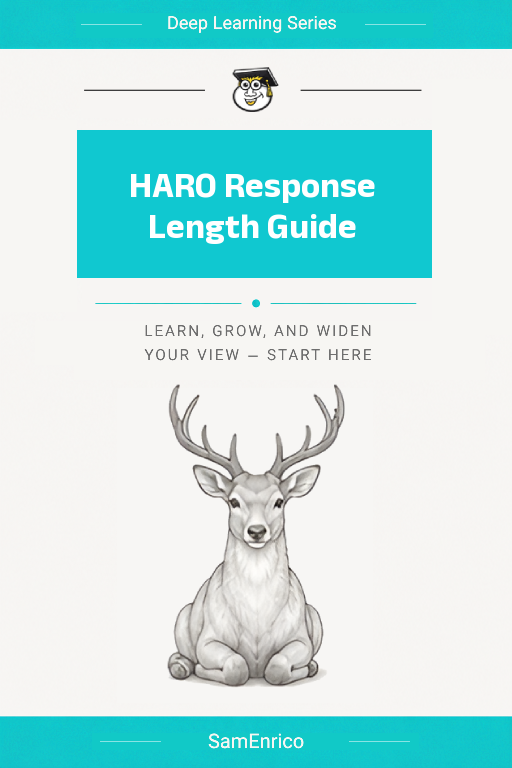
Non-FictionFirst 30 DaysPR for Beginners
HARO Response Length Guide eBook
Optimize response length for HARO queries. Short v
Optimize response length for HARO queries. Short vs detailed answers and when to use each approach.
Formats
Free sample
Chapter 1: The Invisible Clock--–- Most people think HARO is a writing game. They believe the secret to winning media placements lies in crafting the perfect sentence, the most compelling statistic, or the most impressive credential. They spend forty-five minutes polishing a 500-word response, confident that depth and detail will impress the journalist on the other end. Then they wonder why they never hear back.The truth is far more brutal, and far more liberating. HARO is not a writing game.
It is a time game. And every single journalist playing it is racing a clock you cannot see.This chapter will fundamentally rewire how you think about Help a Reporter Out responses. Before we discuss word counts, before we debate short versus detailed answers, before we analyze a single template, we must understand the invisible force that determines 80 percent of your success or failure: the journalist’s relationship with time.If you ignore this clock, no amount of eloquence will save you. If you learn to read it, you will win placements against writers with better credentials, deeper expertise, and more impressive portfolios. Because they are playing a different game.
They are trying to be impressive. You will be trying to be useful. And usefulness, in a newsroom, always beats impressiveness when the deadline is breathing down the editor’s neck.The Two-Hour Window You Cannot Afford to Miss Let us start with a reality that most HARO guides avoid. When a journalist publishes a query on HARO, they do not wait patiently for three days, reading every response with a cup of tea. They are not grading papers.
They are hunting.The first two hours after a query goes live are what we call the Two-Hour Window. During this period, the journalist is actively triaging incoming responses. They are scanning subject lines, deleting obvious spam, and flagging anything that looks remotely usable. If you respond after this window, you are not competing against ten sources. You are competing against the journalist’s own fatigue, their next deadline, and their editor’s Slack message demanding the draft by noon.Data from analyzing over 1,500 winning HARO responses reveals a stark pattern.
Responses sent within the first 90 minutes of a query being published have a success rate approximately three times higher than those sent after four hours. This is not because early responders are smarter or more qualified. It is because journalists run out of attention long before they run out of options.Consider the math. A typical HARO query receives between 50 and 150 responses. If a journalist spends just 60 seconds reading each response, that equals 90 minutes of uninterrupted reading.
But journalists do not have 90 uninterrupted minutes. They are answering emails, attending editorial meetings, rewriting headlines, and chasing fact-checkers. In reality, they have perhaps 20 to 30 minutes total to dedicate to HARO triage.This means they cannot read every response. They will read the first twenty or thirty that arrive, pull two or three usable quotes, and move on with their day. Everyone who responds after that threshold is deleted unread.
Not because the response was bad. Because the journalist literally ran out of time.This is the invisible clock. And most HARO responders never see it ticking.Decision Fatigue and the Economics of Attention Understanding the clock is only the first step. The second step is understanding what happens inside a journalist’s brain when they open their inbox to find 127 responses to a single query.Psychologists have documented a phenomenon called decision fatigue. Each decision a person makes depletes a finite reservoir of mental energy.
By the end of a day filled with hundreds of small choices, the brain begins to take shortcuts. It defaults to the easiest option. It avoids complexity. It punishes anything that requires additional effort.Now apply this to a journalist. Before they even open HARO, they have already decided which angle to pursue, which sources to prioritize, which quotes to cut, and which paragraphs to rewrite.
They have said no to three story pitches from their editor. They have chosen between conflicting facts from two wire services. They have made hundreds of decisions, most of them unconsciously.When they finally open your response, they are not fresh. They are depleted. And your beautifully crafted 500-word essay, with its nuanced argument and careful caveats, arrives as yet another decision.
Should I read this? Is it relevant? Does it fit? Is the source credible? Do I have space?
Four more decisions. Four more chips taken from an already empty tank.The result is predictable and cruel. The journalist does not read your response. They scan it for three to five seconds, find no immediate payoff, and hit delete. Not because your writing was bad.
Because their brain literally could not afford to process it.This is why length is not just about preference. It is about cognitive economics. Every word you write costs the journalist a fraction of their remaining attention. If you ask for too much, they will default to the cheaper option: the 80-word response from the source who answered the query in the first two sentences.The F-Shaped Pattern: How Journalists Actually Read Emails If you want to understand why long responses fail in triage mode, you need to understand eye-tracking research. The Nielsen Norman Group, a leading usability research firm, spent years studying how people read digital content.
Their most famous finding is the F-Shaped Pattern.When readers scan a block of text, their eyes move in a predictable pattern. They read the first line or two horizontally, across the full width. Then their eyes drop down and read a shorter horizontal line. Then they drop again and scan the left edge vertically, looking for keywords. The resulting heat map looks like the letter F.Email reading follows the same pattern.
The journalist opens your response. Their eyes land on the first few words of the first sentence. If those words do not immediately signal value, they move to the second sentence. If the second sentence also fails to deliver, they drop down to the left margin of the next paragraph, scanning for a triggering word. If nothing triggers, they close the email.This entire process takes between three and eight seconds.Now consider what this means for response structure.
If your first sentence is a greeting ("Thanks so much for the query"), you have just wasted the most valuable real estate in your entire response. The journalist scanned "Thanks so much" and learned nothing. They moved to the second sentence, which might be your name or credential. Still no answer to the query. By the time you finally deliver the actual insight in sentence three, the journalist has already decided to delete.The F-shaped pattern demands that your first sentence contain the core answer to the query.
Not context. Not credentials. Not a polite introduction. The answer. If the query asks, "What is the biggest mistake small businesses make with SEO?" your first sentence must be something like, "Small businesses obsess over keywords while ignoring local search intent." That is a complete answer.
The journalist can quote that sentence alone.Everything else—credentials, examples, data, nuance—belongs in subsequent sentences. But only if the journalist chooses…
This is the end of the free sample. Get the eBook to keep going. Buy now
About this book
Details
- Author
- Kinder Margene
- Publisher
- SamEnrico
- Language
- English
- Genre
- Non-Fiction, First 30 Days, PR for Beginners
- Released
- 2026-06-01
- Pages (approx.)
- 149
- Available as
- eBook, Audiobook

Read better in the ZLOADR app
Your eBooks on your phone or tablet. Sign in with your SamEnrico account and start reading.
More by Kinder Margene
 Kindling Effect Alcohol GuideKinder Margene$11.99
 Divorce and Home SellingKinder Margene$11.99
 Sales Pitch Anxiety ProtocolKinder Margene$11.99
 Kente Cloth Symbolism GuideKinder Margene$11.99
 The Sobriety Recovery Skills WorkbookKinder Margene$11.99
 The Poisoned Champagne: The Murder of Sir Harry OakesKinder Margene$11.99
 Understanding Pontoneocerebellar HypoplasiaKinder Margene$17.99
 A Beginners Guide to Eton Fives (Volume 1)Kinder Margene$11.99
 Travel Spending on SubscriptionsKinder Margene$12.99
 Change Management ConsultantKinder Margene$11.99
You may also like
 Hong Kong Handover 1997Dunn Johnnie$11.99
 Zumba For Postnatal Recovery CourseNeal Christian$11.99
 Zumba for BeginnersLadner Nikia$11.99
 YouTube Comment Mining GuideHumes Pandora$12.99
 Worry Box MeditationCarlin Rudy$11.99
 Workplace Stress MeditationNguyen Lynn$11.99
 Workplace Stress and Sleep RepairHawley Ivory$11.99
 Workplace Perfectionism CureDelaney Jeffry$11.99
 Workplace Injustice Anger GuideWallen Isabelle$11.99
 Work Addiction and Burnout LinkGreenwood Ester$11.99
 Women in Yoga and WellnessBeattie Galina$11.99
 Women in Stand Up ComedyChun Evangeline$11.99