

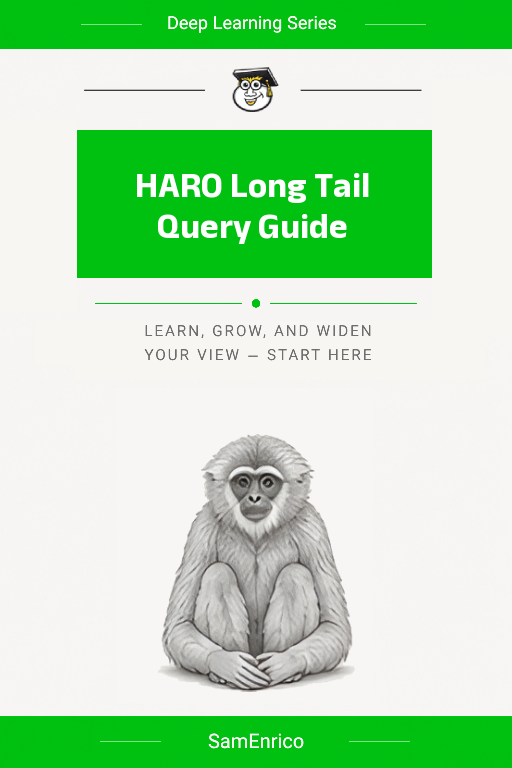
Non-FictionFirst 30 DaysPR for Beginners
HARO Long Tail Query Guide eBook
Target less competitive HARO queries for easier wi
by Blalock Man
Target less competitive HARO queries for easier wins. Industry-specific and niche journalist requests.
Formats
Free sample
Chapter 1: The Query Triage...--The daily email arrives at 5:47 AM. You open it on your phone while the coffee brews. Thirty-seven new queries. You scan the subject lines. "Business trends 2026." "Marketing advice for startups." "Personal finance tips." "Technology predictions."Your heart sinks.
You have seen these before. Everyone has seen these before. By the time you finish your coffee, five hundred other people will have responded to each of these queries. Your carefully crafted pitch will be one voice in a chorus of noise.You scroll further. Buried at the bottom, almost as an afterthought, is a query you almost missed.
"Data on carbon-neutral tour bookings in Iceland – 2024 vs 2025 comparison." The publication is a niche travel blog focused on sustainable Nordic tourism. The deadline is tomorrow.You have exactly this data. Your eco-tourism company has been tracking carbon-neutral bookings for three years. You have spreadsheets. You have charts.
You have a story.This is the query you should respond to. The other thirty-six are traps.This chapter is about learning to see the difference. About the discipline of ignoring the noisy, competitive queries that waste your time. About the five-question triage system that will transform your hit rate from frustrating to rewarding. And about why the most successful HARO users are not the ones who respond to the most queries—they are the ones who say no most often.The Discipline of Saying No Here is the counterintuitive truth that separates successful HARO users from frustrated ones: Your success is not determined by how many queries you answer.
It is determined by how many you skip.Most users approach journalist query platforms with a scarcity mindset. They think: "If I do not respond to this query, someone else will. I will miss an opportunity." So they respond to everything vaguely relevant. They spend hours crafting pitches for queries that attract hundreds of responses. They celebrate when one out of one hundred gets a placement.The math does not work.
Let me show you why.Assume you have five hours per week to dedicate to journalist queries. That is 260 hours per year.Scenario A: The volume player. You respond to twenty queries per week. Each response takes fifteen minutes (finding the query, crafting the pitch, proofreading, sending). That is five hours.
Your success rate is 5 percent (one placement for every twenty responses). You get fifty-two placements per year.Scenario B: The selective player. You respond to five queries per week. Each response takes twenty minutes (more time per response because you are selective and thorough). That is one hour and forty minutes.
You spend the remaining three hours and twenty minutes on research, tracking, and relationship building. Your success rate is 40 percent (two placements for every five responses). You get 104 placements per year.The selective player doubles the volume player's results while working the same number of hours. Why? Because they say no to the bad queries and yes only to the ones that matter.The discipline of saying no is not about being lazy.
It is about being strategic. Every hour you spend on a head query is an hour you are not spending on a long-tail query. That is opportunity cost—the hidden killer of HARO success.The Three Tiers of Journalist Queries Before you can say no, you need a framework for evaluating queries. Not all queries are created equal. They fall into three distinct tiers, and your response strategy should be different for each.Tier 1: The Head (High Competition, Low Success Rate)These are the queries that attract one hundred to five hundred responses.
They are the ones you see first in the daily email digest. They fall into broad categories like "Business," "Technology," "Marketing," or "Personal Finance." They ask general questions like "What are the top marketing trends for 2026?" or "How can small businesses save money?"Characteristics:Broad topic scope (anyone with an opinion can answer)No industry specialization Often from large publications (Forbes, Inc., Entrepreneur, Business Insider)Attracts responses from generalists and specialists alike Examples:"What are the biggest challenges facing small businesses in 2026?""How is AI changing the workplace?""What are the best practices for remote team management?"Strategy: Avoid. Unless you have an extraordinarily unique data point or a deeply personal story that no one else could possibly have, your odds of being selected are too low to justify your time. The journalist is drowning in responses. Yours will be deleted in three seconds.Tier 2: The Mid-Tail (Medium Competition, Medium Success Rate)These queries attract thirty to seventy responses.
They have some specialization but are still broad enough to attract a range of experts. They often come from industry publications or specialized sections of larger publications.Characteristics:Some industry focus (e.g., "sustainable travel" rather than just "travel")Still relatively broad (e.g., "trends" rather than specific data)May come from generalist publications with a specific beat Examples:"Sustainable travel trends for 2026""Best project management tools for remote teams""Challenges of electric vehicle adoption in cold climates"Strategy: Respond selectively. Only respond if you have specific data, a unique personal experience, or credentials that genuinely set you apart from the other thirty to seventy responders. If your answer is something the journalist could find on Google, skip it.Tier 3: The Long Tail (Low Competition, High Success Rate)These are the queries you are looking for. They attract five to fifteen responses.
They are highly specific, often geographic or industry-narrow. They ask for data, case studies, or specialized expertise.Characteristics:Highly specific topic Geographic or industry narrow Often from niche publications, blogs, or specialized sections Requires genuine expertise, not general knowledge Examples:"Carbon offset data from eco-tourism operators in Iceland – 2024 vs 2025 comparison""Challenges of pet-friendly accommodations in rural Portugal for remote workers""Data on churn reduction in mid-market HR Saa S companies"Strategy: Prioritize these. These are your easiest wins. When you are one of five responses instead of one of one hundred, your odds of being selected increase dramatically. This is where you should invest your time.Why Journalists Post Long Tail Queries Understanding why journalists post long-tail queries helps you find them more effectively.A journalist working on a general article about sustainable travel can open Google and find hundreds of sources.
They can quote a study from a major research firm. They can pull statistics from a government report. They do not need HARO.But a journalist working on an article about "How small eco-tourism operators in rural Iceland are using blockchain to verify carbon offsets" has a problem. Google will not help. There is no existing article on this exact topic.
The major research firms have not studied this niche. The government does not track this data.They need to find real operators with real data. They post a HARO query.That is why long-tail queries exist: journalists need information that is not readily available through public sources. They need your specific expertise, your proprietary data, your personal experience. And because the query is so specific, very few people are qualified to respond.This is your opportunity.The Five Signals of a Long Tail Query How do you spot a long-tail query in the wild?
Look for these five signals. The more signals a query has, the more likely it is long-tail.Signal 1: Geographic Specificity…
This is the end of the free sample. Get the eBook to keep going. Buy now
About this book
Details
- Author
- Blalock Man
- Publisher
- SamEnrico
- Language
- English
- Genre
- Non-Fiction, First 30 Days, PR for Beginners
- Released
- 2026-06-01
- Pages (approx.)
- 135
- Available as
- eBook, Audiobook

Read better in the ZLOADR app
Your eBooks on your phone or tablet. Sign in with your SamEnrico account and start reading.
More by Blalock Man
 Baule Spirit Spouse ArtBlalock Man$11.99
 The New Manager Confidence GuideBlalock Man$11.99
 Healthcare Data Breach ReportBlalock Man$11.99
 TikTok for IntrovertsBlalock Man$11.99
 Alcohol Detox Cardio MonitoringBlalock Man$11.99
 The Brooklyn Excelsiors: Baseball's First Dynasty and the Civil War Letters That Built ItBlalock Man$11.99
 Understanding Posterior Valve UrethraBlalock Man$17.99
 Clinical PsychologistBlalock Man$11.99
 Gym Membership BenchmarksBlalock Man$12.99
 How to Become a Lathe SanderBlalock Man$11.99
You may also like
 Hong Kong Handover 1997Dunn Johnnie$11.99
 Zumba For Postnatal Recovery CourseNeal Christian$11.99
 Zumba for BeginnersLadner Nikia$11.99
 YouTube Comment Mining GuideHumes Pandora$12.99
 Worry Box MeditationCarlin Rudy$11.99
 Workplace Stress MeditationNguyen Lynn$11.99
 Workplace Stress and Sleep RepairHawley Ivory$11.99
 Workplace Perfectionism CureDelaney Jeffry$11.99
 Workplace Injustice Anger GuideWallen Isabelle$11.99
 Work Addiction and Burnout LinkGreenwood Ester$11.99
 Women in Yoga and WellnessBeattie Galina$11.99
 Women in Stand Up ComedyChun Evangeline$11.99