
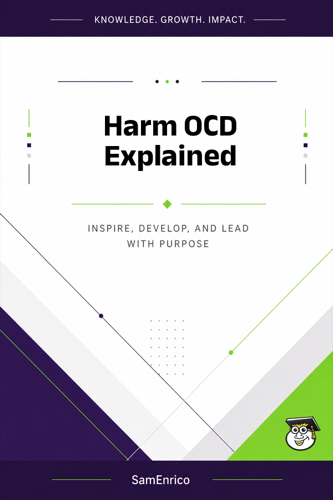
Harm OCD Explained eBook
Teaches fear of harming self or others despite no
by Leone Armida
Teaches fear of harming self or others despite no intent.
Formats
Free sample
Chapter 1: The Doubting Disease...--–- Sarah was a thirty-four-year-old pediatric nurse who had spent the last eight months secretly terrified that she would stab her own children. Every evening, when she tucked her six-year-old daughter and four-year-old son into bed, her mind would flood with images of her hands holding a kitchen knife, walking down the hallway, and ending their lives. The images were so vivid, so cinematic, that she would gasp and step backward out of the doorway. She began putting the knives in a locked box that she kept in the garage. Then she started hiding the scissors.
Then she stopped using the stove altogether, fearing that the sight of a sharp object would somehow trigger her to lose control. She stopped hugging her children goodnight because she was afraid she might squeeze too hard. She stopped reading them bedtime stories because the intimacy of sitting close to them made the intrusive thoughts worse. One night, after a particularly violent image of hurting her daughter, Sarah drove to the emergency room and sat in the parking lot for three hours, trying to convince herself to walk inside and confess. But confess what?
She hadn't done anything. That was the problem. She was terrified that she might do something, and that terror had become indistinguishable from guilt. She had become convinced that the only explanation for such horrible thoughts was that she was secretly a monster wearing a nurse's uniform and a mother's smile.Across the country, in a different city, a man named David was experiencing the mirror image of Sarah's nightmare. David was a forty-two-year-old construction foreman, six feet tall, two hundred and twenty pounds, and terrified of the subway.
Every morning, he stood on the platform and felt an overwhelming urge to push the person in front of him onto the tracks. He never wanted to hurt anyone. He had never been in a fight in his life. But his brain kept generating the same command: Push them. Do it now.
You want to do it. David began arriving at work an hour early so he could take the bus instead, adding two hours to his commute each day. He stopped standing near ledges. He avoided balconies. He asked his wife to drive him to his doctor's appointments.
When she asked why he was so anxious, he couldn't tell her. What would he say? "I think I might be a murderer"? She would leave him. She would take the kids.
She would call the police. So David suffered in silence, convinced that he was the only person in the world who had thoughts like these, and that his silence was proof of his guilt.Sarah and David are not real people, but their stories are composites of hundreds of real patients who have walked into the offices of OCD specialists around the world. They share a common diagnosis: Harm OCD, a subtype of obsessive-compulsive disorder characterized by recurrent, intrusive thoughts, images, or urges about causing violent harm to oneself or others, despite having no genuine desire to act on those thoughts. And they share a common delusion: that they are alone, that they are dangerous, and that they must hide their minds from the world or risk destroying everything they love.This chapter will dismantle that delusion. We will begin by understanding what Harm OCD actually is—and what it is not.
We will explore the neurobiological machinery that creates "sticky" violent thoughts in people who are the least violent among us. We will trace the intrusive thought loop from trigger to compulsion. And we will establish the single most important principle of recovery: the difference between thinking a thought and acting on it. By the end of this chapter, you will understand why your brain is generating these terrifying images, why that does NOT make you a monster, and how the very fact that you are distressed by the thoughts is the clearest evidence of your safety.What Harm OCD Is (And What It Is Not)Let us begin with the most urgent question: Am I dangerous?If you are reading this book, you have almost certainly asked yourself this question hundreds or thousands of times. You have probably searched online for variations of "violent thoughts meaning," "am I a psychopath," or "why do I want to hurt my family." You have likely spent hours replaying your past actions, searching for evidence that you have hurt someone without remembering it.
You may have confessed your thoughts to a partner, a therapist, or a religious authority, hoping that their reassurance would finally quiet your mind. And you have almost certainly concluded, at least some of the time, that the only logical explanation for such horrible thoughts is that you are secretly a bad person.This conclusion is wrong. And we can prove it.Harm OCD is defined by three core features:Recurrent, intrusive, and unwanted thoughts, images, or urges about causing violent harm to yourself or others. These are not daydreams or fantasies. They are ego-dystonic—they clash violently with your genuine values, desires, and sense of self.
A person who genuinely wanted to harm someone would not be distressed by the thought of harming them. They might find it pleasurable, satisfying, or neutral. The fact that you are horrified is the first piece of evidence that the thought does not belong to you.Intense anxiety, disgust, or shame in response to these intrusions. This is not a subtle feeling. Harm OCD produces a spike of autonomic arousal—racing heart, sweating, shallow breathing, a sensation of dread or impending doom—that can be so overwhelming that it feels like you are having a panic attack.
This physiological response is your brain's way of saying this thought is threatening. But the threat is not the violent act. The threat is the thought itself. You are afraid of your own mind.Compulsive behaviors aimed at neutralizing the thought or preventing harm. These can be overt (hiding knives, avoiding being alone with children, checking your pulse to prove you are calm) or covert (repeating safe words, mentally reviewing past events, praying for forgiveness).
The compulsion provides temporary relief, but it strengthens the obsession over time, creating a vicious cycle that we will explore in depth in Chapter 2.What Harm OCD is NOT:It is not homicidal ideation. Homicidal ideation involves genuine fantasies, plans, or desires to kill someone, often in the context of severe mental illness (psychosis, antisocial personality disorder, extreme rage). People with homicidal ideation do not typically find their thoughts distressing; they may find them satisfying or justified. They rarely seek help because they are afraid of being monsters. They seek help, if at all, because they are afraid of getting caught.It is not suicidal intent.
Suicidal intent involves a genuine desire to end one's own life, often in the context of major depression, trauma, or unbearable emotional pain. People with suicidal intent typically experience hopelessness, not terror. They may feel relief at the thought of death. In contrast, people with Harm OCD are terrified of suicide—not because they want to die, but because they are afraid they might lose control and kill themselves accidentally…
This is the end of the free sample. Get the eBook to keep going. Buy now
About this book
Details
- Author
- Leone Armida
- Publisher
- SamEnrico
- Language
- English
- Genre
- Non-Fiction, Health & Wellness, Harm
- Released
- 2026-06-08
- Pages (approx.)
- 151
- Available as
- eBook, Audiobook

Read better in the ZLOADR app
Your eBooks on your phone or tablet. Sign in with your SamEnrico account and start reading.
More by Leone Armida
 Bempedoic Acid GuideLeone Armida$11.99
 Innovation for Operations ManagersLeone Armida$11.99
 Alcohol Recovery FinancesLeone Armida$11.99
 Annika Sorenstam PrecisionLeone Armida$11.99
 Roofing Contractor Multiples GuideLeone Armida$11.99
 Pre Lineup Instructions MatterLeone Armida$11.99
 Employer Remote Work PolicyLeone Armida$11.99
 The Storm from the Steppe: Subutai's Unstoppable Campaigns (1220-1241)Leone Armida$11.99
 Hippocrates to Hippocrates: The Western Medical RevolutionLeone Armida$11.99
 How to Produce a Thor Washing MachineLeone Armida$11.99
 A Collector's Handbook to the Franklin 15Leone Armida$11.99
 How to Produce Hot Stamping FoilLeone Armida$11.99