
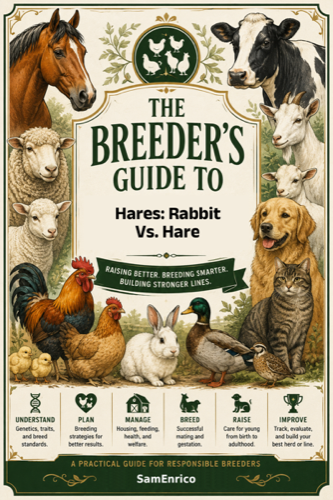
Non-FictionInformativeEducational
Hares: Rabbit Vs. Hare eBook
This wildlife publication, published by SamEnrico,
This wildlife publication, published by SamEnrico, covers Hares: Rabbit Vs. Hare
Formats
Free sample
Chapter 1: The Leporid Riddle...–- The first mistake most people make is assuming that a hare is simply a rabbit with longer legs. This error appears in children’s books, nature documentaries, and even in the casual conversations of otherwise well-educated adults. Walk into any pet store during the week before Easter, and you will see cages labeled “Bunnies” containing animals that range from floppy-eared domesticated rabbits to—on occasion—actual hares that someone has mistakenly captured and sold. The confusion runs so deep that many English speakers use the words “rabbit” and “bunny” interchangeably for any small, long-eared mammal they encounter, while the word “hare” conjures images of something wilder, faster, and vaguely mythical. But few people could tell you, with confidence and accuracy, exactly what distinguishes one from the other when both are standing still in a field.This book exists because that confusion matters.
It matters for wildlife biologists trying to track declining populations. It matters for farmers attempting to protect their crops from grazing animals. It matters for conservationists deciding where to allocate limited resources. And it matters for anyone who has ever looked across a meadow, spotted a leporid, and wondered: is that a rabbit or a hare? The answer to that seemingly simple question opens a door into one of the most fascinating evolutionary divergences in the mammalian world—a story of speed versus stealth, solitude versus society, and two completely different solutions to the problem of surviving as a prey animal.The family Leporidae contains over sixty species of rabbits and hares distributed across every continent except Antarctica and Australia (where rabbits were introduced by humans, a disaster we will explore in Chapter 8).
Within this family, the genus Lepus comprises the true hares—approximately thirty-two species including the European brown hare, the Arctic hare, the snowshoe hare, and all animals commonly called jackrabbits. Everything else in the family—cottontails, brush rabbits, pygmy rabbits, the European rabbit from which all domesticated breeds descend, and approximately twenty other species—belongs to various rabbit genera, primarily Sylvilagus (cottontails) and Oryctolagus (the European rabbit). The evolutionary split between these two lineages occurred roughly ten to twelve million years ago, during the late Miocene epoch, when changing global climates began opening vast grasslands across Eurasia and North America.That date—ten million years of separate evolution—explains why the differences between rabbits and hares run far deeper than leg length or ear size. These two groups have been adapting to radically different ecological niches for so long that they have developed distinct skeletal structures, digestive systems, social behaviors, and reproductive strategies. A hare cannot become a rabbit any more than a wolf can become a coyote.
They are separate evolutionary paths that happen to share a common ancestor and a superficial resemblance, much as dolphins and sharks share a streamlined body shape but have almost nothing else in common.The Universal Confusion: Why We Mix Them Up The average person’s inability to distinguish rabbits from hares is not a failure of observation. It is a predictable outcome of how popular media, folklore, and the pet industry have deliberately blurred the lines between these two animals. Consider the Easter Bunny. This figure is traditionally depicted as a white, fluffy, round-bodied creature delivering eggs to children—anatomical features that suggest a domesticated rabbit. Yet the Easter Bunny’s behavior in folklore (solitary, springtime-associated, engaging in wild “madness” behavior) aligns more closely with the European hare, particularly the famous “March hare” of Alice in Wonderland.
The truth is that the Easter Bunny is a hybrid, a folkloric chimera that borrows the body of a rabbit and the behavior of a hare. This blending has occurred because most human cultures have never maintained a clear distinction between the two animals, using them interchangeably as symbols of fertility, speed, and springtime renewal.The confusion extends far beyond holiday symbolism. Children’s cartoons routinely depict rabbits with the long legs of hares and hares with the burrows of rabbits. Pet stores sell animals labeled “bunnies” that are, in fact, hares—a practice that is harmful to both the animals (hares do not thrive in captivity and are illegal to own in many jurisdictions) and the buyers, who end up with a wild animal that cannot be domesticated. Nature documentaries, even well-respected ones, occasionally misidentify their subjects, showing footage of a snowshoe hare while the narrator speaks about “the clever rabbit.” Wildlife rehabilitation centers report that members of the public bring in leverets (baby hares) every spring, convinced they have found abandoned baby rabbits, when in fact the leverets’ mothers left them intentionally—a behavior we will examine in depth in Chapter 5.This book will cut through that confusion.
By the time you finish reading these twelve chapters, you will be able to identify any leporid you encounter with confidence. You will understand not just what the differences are, but why they evolved. And you will be equipped to participate in citizen science efforts that rely on accurate species identification to track population trends and guide conservation efforts.The Unified 5-Second Field Rule Before we dive into the evolutionary history, anatomy, and behavior that distinguish rabbits from hares, this chapter introduces a practical tool that you can use immediately. The Unified 5-Second Field Rule consists of four sequential questions. Ask them in order, and you will arrive at a correct identification in nearly every case.
This same rule will appear again in Chapter 12 as a concluding reinforcement, but learning it now will serve as a framework for the detailed chapters that follow.Question 1: Does the animal live in a hole or warren?If yes, you are looking at a rabbit. True hares never burrow. They do not dig permanent tunnels. They do not live in underground communities. A hare’s “nest” is a shallow depression in grass or soil called a form, which provides minimal shelter and is abandoned after a few weeks.
Rabbits, in contrast, are master excavators. The European rabbit’s warren can extend six feet underground, contain dozens of entrances, and house up to fifty individuals. If you see an animal disappear into a hole in the ground, you have seen a rabbit. This single observation alone is sufficient for identification, as no hare species exhibits burrowing behavior.Question 2: Are the babies born furless and blind?If yes, you are looking at a rabbit. This is the most biologically significant difference between the two groups, and we will devote all of Chapter 5 to it.
Baby rabbits (called kits) are altricial—born naked, with eyes sealed shut, completely dependent on their mother for warmth and food. Baby hares (called leverets) are precocial—born fully furred, with eyes open, and able to hop within minutes of birth. If you encounter a nest of furless, helpless babies, you have found rabbit kits. If you encounter a single furred baby sitting alone in a shallow depression in the grass, you have found a hare leveret—and its mother is nearby, despite appearances.Question 3: How does the animal run when threatened?Watch the escape pattern. Rabbits run in a zigzag pattern—sharp left, sharp right, doubling back, changing direction unpredictably.
This behavior evolved to confuse aerial predators like hawks and owls that strike from above. The rabbit’s shorter hind legs…
This is the end of the free sample. Get the eBook to keep going. Buy now
About this book
Details
- Author
- Barnhill Griselda
- Publisher
- SamEnrico
- Language
- English
- Genre
- Non-Fiction, Informative, Educational
- Released
- 2026-06-02
- Pages (approx.)
- 142
- Available as
- eBook, Audiobook

Read better in the ZLOADR app
Your eBooks on your phone or tablet. Sign in with your SamEnrico account and start reading.
More by Barnhill Griselda
 Gen Z TikTok UseBarnhill Griselda$11.99
 Copper IUD Non Hormonal AlternativeBarnhill Griselda$11.99
 Molybdenum Detox Support GuideBarnhill Griselda$11.99
 Passive Aggressive CommunicationBarnhill Griselda$11.99
 Disney Princess Voice SecretsBarnhill Griselda$11.99
 Peyronie Treatment GuideBarnhill Griselda$11.99
 Creative Habits for Product ManagersBarnhill Griselda$11.99
 Sacroiliac Pelvic LinkBarnhill Griselda$11.99
 The Hanover Forger: The 18th Century Art Scandal That Shook EuropeBarnhill Griselda$11.99
 Codex of the Forgotten: The AI That Wrote the BibleBarnhill Griselda$11.99
 UAE Free Zone B2B Sales PlaybookBarnhill Griselda$12.99
 Jury Duty Leave Compliance ManualBarnhill Griselda$12.99
You may also like
 Hong Kong Handover 1997Dunn Johnnie$11.99
 Zumba For Postnatal Recovery CourseNeal Christian$11.99
 Zumba for BeginnersLadner Nikia$11.99
 YouTube Comment Mining GuideHumes Pandora$12.99
 Worry Box MeditationCarlin Rudy$11.99
 Workplace Stress MeditationNguyen Lynn$11.99
 Workplace Stress and Sleep RepairHawley Ivory$11.99
 Workplace Perfectionism CureDelaney Jeffry$11.99
 Workplace Injustice Anger GuideWallen Isabelle$11.99
 Work Addiction and Burnout LinkGreenwood Ester$11.99
 Women in Yoga and WellnessBeattie Galina$11.99
 Women in Stand Up ComedyChun Evangeline$11.99