
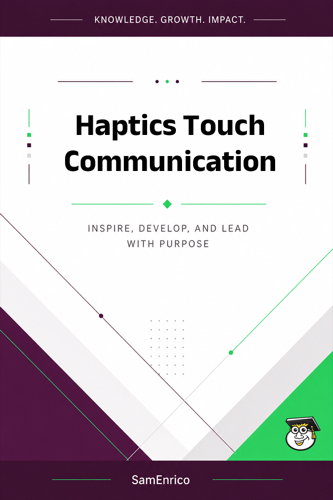
Non-FictionSelf-HelpHapticsTouch
Haptics Touch Communication eBook
Use appropriate touch in professional and social c
by Nixon Dara
Use appropriate touch in professional and social contexts without crossing boundaries.
Formats
Free sample
Chapter 1: The Touch Paradox--–- You are born with the fastest sense you will ever possess, yet you spend decades learning to distrust it. Before your eyes can focus, before you can recognize your mother’s face, your skin already knows her. The pressure of her hand, the warmth of her chest, the rhythm of her heartbeat against your back—this is your first language. It is called haptics, from the Greek haptesthai, meaning “to touch.” And it is the only sense you cannot live without. Close your eyes, and you navigate.
Stop your ears, and you still feel. But sever the skin’s connection to the world, and within days, your body begins to unravel. Premature infants placed in isolation tanks without human touch stop growing. Their organs fail. Some die.
This is not metaphor. This is physiology.Yet here you are, decades later, standing in an office hallway, watching a colleague cry at her desk. Your biology screams at you to reach out. Your training tells you to keep your hands to yourself. A voice in your head—perhaps from a human resources webinar, perhaps from the evening news—whispers that a single pat on the shoulder could end your career.
So you do nothing. You stand frozen. And in that frozen moment, something fractures. Not your career. Not yet.
But the thin thread of human connection that might have held.This is the Touch Paradox: you are wired to need physical contact, but the modern professional world has made touch feel like a landmine. The science is unambiguous—touch reduces cortisol, releases oxytocin, lowers blood pressure, and builds trust faster than words ever could. A study from the University of California, Berkeley, found that a five-second handshake can predict the outcome of a job interview more accurately than the candidate’s qualifications. Another study, this one from the University of Miami’s Touch Research Institute, demonstrated that a single supportive touch from a teacher increases a student’s likelihood of speaking up in class by nearly 40 percent. Touch is not merely polite.
It is powerful. It is persuasive. It is, in many ways, the glue of social cohesion.But the same hand that heals can harm. The same pat that encourages can condescend. The same hug that comforts can trap.
And in the wake of two seismic cultural shifts—the #Me Too movement and the COVID-19 pandemic—the rules of touch have been rewritten without a ceremony, without a memo, and without anyone giving you a new manual. #Me Too taught the world that unwanted touch, even when non-sexual, even when “well-intentioned,” can constitute harassment. It taught that intent does not equal impact. It taught that what feels like a friendly gesture to one person can feel like a violation to another. And the pandemic taught germ aversion.
It taught six-foot distances. It taught that a handshake is a vector, not a greeting.You now live in a world where the old rules are dead and the new rules have not yet been written. You have been left to improvise. And improvisation, when it comes to touch, is a very dangerous game.This book is your new manual.Before we build the frameworks, before we map the body’s boundaries, before we give you the scripts and the decision matrices and the recovery plans, we must first understand the biological imperative that makes all of this so difficult. Why do you crave touch even when you fear it?
Why does your hand reach out before your brain can stop it? And why has evolution, in its infinite wisdom, made you so vulnerable to a single gesture?The answer begins in your skin.The Largest Organ You Never Think About Your skin is not a wrapper. It is not a bag containing your organs. It is, in fact, an organ itself—the largest one you own. Spread flat, the average adult’s skin would cover approximately twenty square feet.
It weighs about eight pounds. And it contains more than 2.8 million sensory receptors, each one a tiny spy reporting back to your brain about pressure, temperature, vibration, and pain.But here is what most people do not know: your skin is also a brain. Not literally, of course. But embedded within its layers is a network of nerves so dense and so fast that your body can process a touch and generate a response before your conscious mind even registers that you have been touched. This is the reason you snatch your hand back from a hot stove before you feel the burn.
This is why a tap on the shoulder in a dark room makes you spin around before you identify the toucher. Your skin does not wait for permission from your cortex. It acts.This speed comes with a cost. Because touch is processed so quickly, it bypasses many of the cognitive filters that regulate other senses. You can decide not to listen to a loud noise.
You can close your eyes against a bright light. But you cannot decide not to feel. Touch happens to you. And because it happens so fast, your emotional response to touch—whether you feel safe or threatened, comforted or violated—is often established before you have had a chance to think about it.This is why intent does not equal impact. By the time your brain has caught up to the fact that you touched someone, their body has already decided how to feel about it.The neuroscientist David Linden, in his book Touch: The Science of Hand, Heart, and Mind, describes this as the “emotional primacy” of touch.
The nerves that carry touch signals from your skin to your brain are directly connected to the limbic system—the ancient, animal part of your brain that processes emotion, memory, and threat. Touch does not stop by the rational cortex first. It goes straight to the place where fear and love and trust live. This is why a gentle touch from a loved one can dissolve anxiety in seconds. And it is why an unwanted touch from a stranger can trigger a full fight-or-flight response before you have even named the feeling.You are not being dramatic when you recoil from an unwelcome hand on your shoulder.
Your body is being efficient.The Chemistry of Connection Let us talk about oxytocin. You have heard of it, probably. It is called the “love hormone” or the “cuddle chemical.” It is released during hugging, kissing, and sex. It is the reason mothers bond with newborns and why couples who touch more stay together longer. But oxytocin is not a simple on-off switch.
It is a complex molecule with a dark side.Oxytocin does not make you love everyone. It makes you love the people you already trust. And it makes you more suspicious of strangers. Research from the University of Amsterdam found that people who were given a nasal spray of oxytocin showed increased trust toward people in their social group but decreased trust toward outsiders. Oxytocin is not a universal goodwill ambassador.
It is a tribal loyalty booster. This has profound implications for professional touch.When you touch a colleague, you are not…
This is the end of the free sample. Get the eBook to keep going. Buy now
About this book
Details
- Author
- Nixon Dara
- Publisher
- SamEnrico
- Language
- English
- Genre
- Non-Fiction, Self-Help, Haptics, Touch
- Released
- 2026-06-09
- Pages (approx.)
- 138
- Available as
- eBook, Audiobook

Read better in the ZLOADR app
Your eBooks on your phone or tablet. Sign in with your SamEnrico account and start reading.
More by Nixon Dara
 Harvest Festival PromotionNixon Dara$11.99
 Canva Brand Identity for AuthorsNixon Dara$11.99
 Digital Smoking Cessation Apps GuideNixon Dara$11.99
 The Silk Road of Style: Mali's Royal Weavers and the Birth of African Luxury (1300-1600)Nixon Dara$11.99
 How to Start a Carpet Fitter Business (Beginners Guide)Nixon Dara$11.99
 AI for Website TranslationNixon Dara$12.99
 Learn to Play the SodinaNixon Dara$11.99
 Executive ProducerNixon Dara$11.99
You may also like
 Hong Kong Handover 1997Dunn Johnnie$11.99
 Zumba For Postnatal Recovery CourseNeal Christian$11.99
 Zumba for BeginnersLadner Nikia$11.99
 YouTube Comment Mining GuideHumes Pandora$12.99
 Worry Box MeditationCarlin Rudy$11.99
 Workplace Stress MeditationNguyen Lynn$11.99
 Workplace Stress and Sleep RepairHawley Ivory$11.99
 Workplace Perfectionism CureDelaney Jeffry$11.99
 Workplace Injustice Anger GuideWallen Isabelle$11.99
 Work Addiction and Burnout LinkGreenwood Ester$11.99
 Women in Yoga and WellnessBeattie Galina$11.99
 Women in Stand Up ComedyChun Evangeline$11.99