
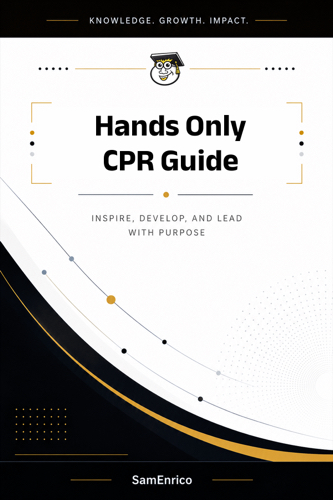
Hands Only CPR Guide eBook
Teaches compression only CPR for bystanders withou
Teaches compression only CPR for bystanders without training.
Formats
Free sample
Chapter 1: The Permission Problem--You are about to make a mistake. Not a small mistake, like misplacing your keys or forgetting a birthday. A mistake that will replay in your mind for years, in the dark, when you cannot sleep. You will see the person’s face. You will hear the sounds they made.
And you will ask yourself one question over and over: Why didn’t I do something?Here is the answer that no one tells you. You will not act not because you are cruel, not because you are weak, not because you do not care. You will not act because no one ever gave you explicit, unconditional, legally binding permission to try. And without that permission, your brain will default to its safest setting: do nothing. Watch.
Wait. Hope someone else arrives.This chapter is that permission. Written down. In ink.By the time you finish reading these pages, you will have something that most people never acquire: the legal, moral, and psychological clearance to put your hands on a dying person’s chest and push. You will understand why the fear of hurting someone is backwards, why the fear of being sued is a myth, and why the only unforgivable sin in a cardiac arrest is standing still.
You will also learn a truth that emergency rooms know but rarely say out loud: you cannot make this situation worse. The person on the floor is already dead. Your job is not to save them perfectly. Your job is to give them a chance. And that chance begins the moment you decide that your fear is less important than their life.Let us start with a story.The Man on the Airport Floor In 2017, a sixty-two-year-old man named Robert collapsed at the gate of a busy airport.
He was traveling alone. He had no known heart problems. He was standing at the counter, asking about an upgrade, and then he was on the floor. His eyes stayed open. His body twitched once.
Then he stopped breathing.What happened next is the reason this book exists.Within seconds, people noticed. Someone shouted for a doctor. Someone else called 911. A third person pulled out their phone and started filming—not to be cruel, but because they did not know what else to do. The gate area was full of people.
At least twenty witnesses. And for the first ninety seconds after Robert collapsed, no one touched him.Ninety seconds. That is long enough for a brain to begin dying. Long enough for oxygen levels to drop from normal to critical. Long enough for a survivable cardiac arrest to become a neurological catastrophe.Finally, a woman in her fifties pushed through the crowd.
She was not a doctor. She was not a nurse. She was a high school biology teacher who had taken a single CPR class seven years earlier. She knelt down, put her hands on Robert’s chest, and started pushing. She pushed to the beat of a song she remembered from the class—something about staying alive.
She pushed until her arms burned. She pushed until airport security arrived with an automated defibrillator. She pushed until the paramedics took over.Robert survived. He walked out of the hospital ten days later with no brain damage, no permanent injuries, and a cracked sternum that healed in two months. He met the biology teacher at a press conference.
He thanked her. She said, “I almost didn’t do it. I was so scared of hurting you.”That woman’s hesitation—those ninety seconds when no one moved—is the single greatest barrier to survival in cardiac arrest. Not lack of knowledge. Not lack of strength.
Lack of permission.Why Permission Matters More Than Training The medical establishment has spent decades perfecting CPR guidelines. The American Heart Association updates its recommendations every five years. Researchers publish studies on compression depth, recoil velocity, and the optimal ratio of compressions to breaths. All of that science is valuable. All of it saves lives.
But none of it matters if the person standing over the victim is too afraid to kneel down.Here is a hard truth from emergency medicine: most people who witness a cardiac arrest know what to do. They have seen CPR on television. They have read an article. They took a class six years ago and forgot the details, but they remember the basic idea—push on the chest. The barrier is not ignorance.
The barrier is fear dressed up as uncertainty.What if I push too hard?What if I push in the wrong spot?What if I hurt them?What if I get sued?What if I do it wrong and someone films it and puts it on the internet?These are not rational calculations. They are the brain’s way of avoiding a high-stakes, socially risky situation. And they are deadly.Let us examine each fear, one by one, and tear it apart.The Fear of Hurting Someone Who Is Already Dead This is the most common fear and the most logically absurd. You are afraid of hurting a person who, at that moment, has no heartbeat, no blood pressure, and no consciousness. They cannot feel pain.
They cannot feel your hands. They cannot experience the sensation of a cracked rib or a bruised sternum. They are, for all practical purposes, already gone.The only thing that can hurt them now is inaction.Consider the biology. When the heart stops pumping, blood stops flowing to the brain. Brain cells begin to die after four to six minutes without oxygen.
Every minute that passes without compressions reduces the chance of survival by seven to ten percent. After ten minutes, survival is rare. After fifteen minutes, it is nearly zero. The clock is not your friend. It is not even neutral.
It is actively killing the person in front of you.Now consider what “hurting” someone actually means in this context. The worst injury you can realistically cause during CPR is a cracked rib or a broken sternum. In approximately thirty to forty percent of adult CPR cases, ribs crack or separate from the cartilage that attaches them to the breastbone. This is more common in the elderly, more common in people with osteoporosis, and more common in people who have had previous chest surgery. It sounds terrible.
It feels terrible under your hands—a popping or crunching sensation that will make you want to stop.Do not stop.A cracked rib heals. It takes six to eight weeks. It is painful. It may require pain medication. But a cracked rib is a survivable injury.
Brain death is not. The choice you are making when you push on a chest is not between perfect rescue and imperfect rescue. It is between a cracked rib and a corpse. That is the real calculus. And any rational person, given that choice, chooses the cracked rib.There is a phrase used in emergency medicine training.
It sounds harsh, but it is designed to cut through the hesitation. Here it is: The dead don’t care. The victim in cardiac arrest cannot feel pain. They cannot feel your hands on their chest. They…
This is the end of the free sample. Get the eBook to keep going. Buy now
About this book
Details
- Author
- Crabtree Agustin
- Publisher
- SamEnrico
- Language
- English
- Genre
- Non-Fiction, Health & Wellness, First Aid
- Released
- 2026-06-06
- Pages (approx.)
- 123
- Available as
- eBook, Audiobook

Read better in the ZLOADR app
Your eBooks on your phone or tablet. Sign in with your SamEnrico account and start reading.
More by Crabtree Agustin
 Social Worker Burnout PreventionCrabtree Agustin$11.99
 Senior Forgiveness GuideCrabtree Agustin$11.99
 Mind Mapping for Complex ProblemsCrabtree Agustin$11.99
 Matrosskaya Tishina PrisonCrabtree Agustin$11.99
 TM for Depression SupportCrabtree Agustin$11.99
 Military Service Anger GuideCrabtree Agustin$11.99
 Goal Setting for ParentsCrabtree Agustin$11.99
 The Weaver and the Sky: A Navajo Love That Shaped the WorldCrabtree Agustin$11.99
 La Reina del Jaripeo: The Untold Story of María de la Cruz, Mexico's First Female BullfighterCrabtree Agustin$11.99
 The Photographer's Guide to ThoughtographyCrabtree Agustin$11.99
 How to Produce Ear SyringesCrabtree Agustin$11.99
 Bankruptcy DIP FinancingCrabtree Agustin$12.99
You may also like
 Adult HeimlichHogan Mike$11.99
 Overdose Education TrainingBurgess Kim$11.99
 Essential Oil First Aid KitNegron Anderson$11.99
 CPR AED Certification GuideCabral Merlene$11.99
 The CPR and AED HandbookCarvalho Tanesha$11.99
 First Degree BurnHeaton Wyatt$11.99
 First Degree Burn GuideNguyen Omar$11.99
 First Aid Kit for EmergenciesButler Charlene$11.99
 Direct Pressure GuideJenson Elouise$11.99
 Hands Only CPRCarlin Rudy$11.99
 Cocaine Nosebleed First AidKirby Shonna$11.99
 Ayurvedic First Aid GuideGoetz Lenora$11.99