
Non-FictionSelf-HelpGesturesPublic Speaking
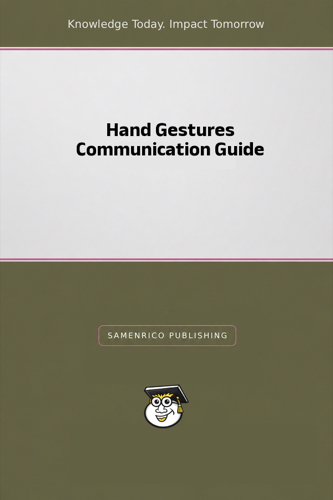
Hand Gestures Communication Guide eBook
Use purposeful hand movements to emphasize points
Use purposeful hand movements to emphasize points and appear more credible.
Formats
Free sample
Chapter 1: The Seven-Second Verdict...--The moment you walk into a room, stand up to speak, or appear on screen, your hands begin testifying about you. They speak before your lips part. They continue speaking while you talk. And long after you’ve made your point, they keep talking to anyone who’s watching. The uncomfortable truth is this: within seven seconds of seeing you, most people have already decided how credible, confident, and competent you are.
They haven’t heard your arguments, analyzed your data, or evaluated your expertise. They’ve simply watched your hands.This is not pop psychology. It is peer-reviewed behavioral science. Researchers at Princeton University found that judgments of trustworthiness, competence, and likeability form after less than one second of exposure to a new face. When that face is attached to a moving body, hand gestures become the fastest shortcut the brain uses to decide: “Should I believe this person?” Before a single word of your presentation, before your second sentence in a job interview, before you’ve explained the terms of a deal, your hands have already cast a vote for or against you.The Seven-Second Credibility Window Let’s name this phenomenon so you can remember it, recognize it, and control it.
The first seven seconds of any interaction constitute your Credibility Window. Within this narrow frame, observers unconsciously scan three things: your facial expression (warm or cold), your posture (open or closed), and most importantly, your hands (visible or hidden, purposeful or chaotic, calm or frantic).Why hands? Because the human brain has evolved to pay extraordinary attention to hands. Neuroimaging studies show that the visual cortex dedicates disproportionate processing power to watching other people’s hands. This makes evolutionary sense: for our ancestors, watching hands meant watching for weapons, tools, food sharing, and friendly versus hostile gestures.
Today, that ancient wiring remains. When your hands are visible and moving purposefully, observers unconsciously register safety and competence. When your hands are hidden, frozen in rigid stillness, or fidgeting chaotically, observers unconsciously register threat, anxiety, or deception.Consider two scenarios. In the first, a manager enters a meeting, keeps both hands clasped under the table, speaks in a steady voice, and delivers a quarterly update. In the second, a different manager enters, rests open palms on the table, uses small beat gestures on key numbers, and delivers the exact same script.
Research from the nonverbal communication lab at UCLA shows that listeners will rate the second manager as more credible, more confident, and more trustworthy—even when shown video without sound. The words are identical. The hands tell different stories.The Three Mechanisms of Hand-Based Trust Why do purposeful hand movements trigger trust? The answer lies in three psychological mechanisms that operate beneath conscious awareness. Understanding these mechanisms transforms gesturing from a vague “nice to have” into a strategic tool you can deploy with precision.Mechanism One: Fluency Signals The human brain craves fluency—information that is easy to process, predict, and understand.
When you watch someone speak with smooth, purposeful gestures, your brain registers “fluent processing.” Fluent processing feels good. And because it feels good, your brain unconsciously attributes that positive feeling to the speaker’s competence. In other words, your gestures don’t just illustrate your words; they make your words feel easier to understand. And when something feels easy to understand, we assume the person explaining it is smart.The opposite is also true. Jerky, hesitant, or absent gestures create processing disfluency.
Listeners have to work harder to follow you. They may not know why they feel confused or skeptical, but they feel it. And they will unconsciously blame you. A 2014 study published in the journal Psychological Science found that speakers who used congruent gestures (gestures that matched their spoken content) were rated as more charismatic and persuasive than speakers who used no gestures or mismatched gestures—even when the audio was played for a separate group with no video. The gestures changed how the words sounded to listeners.Mechanism Two: Congruence and the Suspicion Trigger When your hands say one thing and your voice says another, listeners may not consciously notice the mismatch.
But their brains do. Neuroscientists have identified a region called the anterior cingulate cortex that activates when people detect incongruence between verbal and nonverbal channels. This activation produces a vague feeling of unease, skepticism, or suspicion. The listener may not be able to articulate why they distrust you. They simply feel that something is “off.”Imagine a salesperson saying, “This is a huge opportunity,” while making a tiny pinching gesture with thumb and forefinger.
The words say “huge.” The hands say “small.” The mismatch triggers suspicion. Or consider a politician saying, “I believe in transparency,” with both hands hidden behind a lectern. The words claim openness. The hands signal concealment. The audience feels the gap even if they can’t name it.Congruence is not about memorizing “correct” gestures for specific words.
It is about alignment. When you say “two options,” show two fingers. When you say “over time,” make a horizontal sweeping motion. When you say “I am certain,” use a small downward beat rather than a hesitant upward flick. The specific gesture matters less than the fact that your hands and voice are telling the same story.Mechanism Three: The Honesty Palm Of all hand configurations, none carries more cross-cultural weight than the open palm.
From ancient Rome (where showing empty palms signaled “I carry no weapon”) to modern courtrooms (where witnesses place an open palm on the Bible), the open palm has become hardwired into human psychology as a signal of honesty, vulnerability, and truthfulness.When you gesture with open palms facing your listener at approximately chest height, you trigger a subconscious response: safety. The listener’s brain releases a small amount of oxytocin, the neurochemical associated with trust and bonding. This is not metaphor. It is measurable physiology. Conversely, when you hide your palms (hands in pockets, clasped behind back, or pointing fingers), you trigger vigilance.
The listener’s brain remains slightly on guard.This does not mean you must gesture with open palms constantly. That would look strange and performative. It means that in the first seven seconds—and during moments of high stakes (disclosing bad news, asking for trust, making a commitment)—open palms are your most powerful credibility tool. A single open-palm gesture during your Credibility Window can set a tone that lasts the entire conversation.The Two Types of Stillness (And Why One Destroys You)Before we go further, we must resolve a confusion that derails many well-intentioned gesture learners. You may have heard advice like “keep your hands still” or “stop fidgeting.” This advice is incomplete and often harmful because it conflates two entirely different states: rigid stillness and calm stillness.Rigid stillness is what happens when you tense your muscles, lock your joints, hold your breath, and freeze your hands in place.
This is the “frozen hands” phenomenon. It reads as anxiety, fear, or deception. Listeners unconsciously interpret rigid stillness as a sign that you are controlling yourself—and they wonder what you are controlling yourself from. Rigid stillness destroys credibility. It is not a solution to fidgeting…
This is the end of the free sample. Get the eBook to keep going. Buy now
About this book
Details
- Author
- Churchill Zora
- Publisher
- SamEnrico
- Language
- English
- Genre
- Non-Fiction, Self-Help, Gestures, Public Speaking
- Released
- 2026-06-09
- Pages (approx.)
- 149
- Available as
- eBook, Audiobook

Read better in the ZLOADR app
Your eBooks on your phone or tablet. Sign in with your SamEnrico account and start reading.
More by Churchill Zora
 Awkward Silence Filler GuideChurchill Zora$11.99
 The Scarcity and Urgency GrowthChurchill Zora$11.99
 Suspending Judgment ListeningChurchill Zora$11.99
 Singapore's Stadium Dream: The Rise of the National Stadium (1986-2007)Churchill Zora$11.99
 AI Customer Case Study GenerationChurchill Zora$12.99
 How to Start a Cargo Handling for Land Transport Business (Beginners Guide)Churchill Zora$11.99
 Dolly GripChurchill Zora$11.99
You may also like
 Hong Kong Handover 1997Dunn Johnnie$11.99
 Zumba For Postnatal Recovery CourseNeal Christian$11.99
 Zumba for BeginnersLadner Nikia$11.99
 YouTube Comment Mining GuideHumes Pandora$12.99
 Worry Box MeditationCarlin Rudy$11.99
 Workplace Stress MeditationNguyen Lynn$11.99
 Workplace Stress and Sleep RepairHawley Ivory$11.99
 Workplace Perfectionism CureDelaney Jeffry$11.99
 Workplace Injustice Anger GuideWallen Isabelle$11.99
 Work Addiction and Burnout LinkGreenwood Ester$11.99
 Women in Yoga and WellnessBeattie Galina$11.99
 Women in Stand Up ComedyChun Evangeline$11.99