
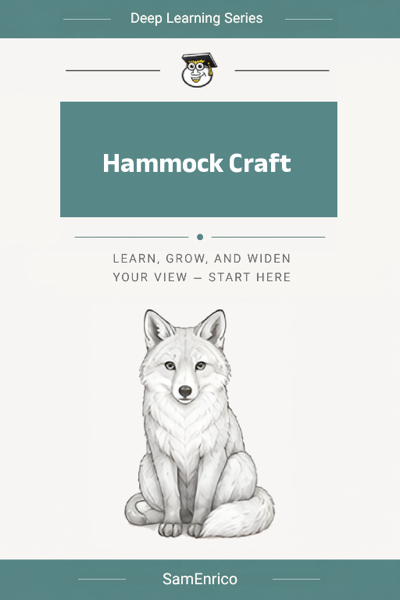
Hammock Craft eBook
A Coursebook on Hammock Craft
by Roark Parker
A Coursebook on Hammock Craft
Formats
Free sample
Chapter 1: The Geometry of Suspension...--–- The first time I hung between two trees, I did everything wrong.The rope was too thin—some scavenged nylon cord from a broken clothesline, maybe three millimeters in diameter. The trees were too close together, a pair of struggling birches in my parents' backyard, their trunks no thicker than my wrist. I tied a knot I had learned in Boy Scouts, a square knot, which any sailor will tell you is the worst possible choice for a load-bearing application because it slips under tension. And I hung the whole thing almost horizontal, pulled taut like a tightrope, because I assumed that flat meant comfortable.I was eighteen years old, and I knew nothing.I climbed in anyway. For a moment, I floated.
Then the knot slipped. The rope bit into the birch bark. The whole contraption rotated like a rotisserie, dumping me onto my tailbone in a patch of crabgrass. The birches, mercifully, did not snap—but they leaned ever after, two crooked sentinels bearing witness to my ignorance.That was my first hammock. It lasted approximately four seconds.What I did not know then—what I have spent the intervening years learning, unlearning, and finally mastering—is that a hammock is not merely a piece of fabric strung between two points.
It is a physical poem about tension and release. It is a geometric proof written in rope and wood. It is a negotiation between the body's desire for weightlessness and the earth's relentless claim on everything that falls.This book exists because I have made every mistake a person can make with a hammock, and I have catalogued them so you do not have to repeat them.The Misunderstood Bed Before we tie a single knot, before we select a single strand of cotton or nylon, we must understand what a hammock actually is. Most people, when they hear the word "hammock," imagine something specific: a rope mesh stretched between two posts in a suburban backyard, or perhaps a brightly colored Brazilian cloth hammock on a Caribbean beach. But these images are to hammock craft what a fast-food hamburger is to gastronomy—a pale imitation of what is possible.A hammock, at its core, is a suspended sleeping surface that achieves its comfort through controlled sag rather than resistance.This last point is critical, and it runs counter to almost every other piece of furniture you have ever used.
A mattress resists your body. It pushes back. A chair supports you through rigidity. Even a sofa, soft as it may seem, relies on foam and springs that actively oppose gravity. A hammock does none of these things.
A hammock yields. It conforms. It redistributes your weight not by pushing back but by redistributing tension across a web of fibers.Think of it this way: when you lie on a mattress, you are lying on top of something. When you lie in a hammock, you are lying inside something.This distinction has profound implications for comfort, for sleep, for posture, and for the very act of relaxation. And it is the first principle upon which all hammock craft is built.The Skeleton Key: Understanding the Three Disciplines Throughout this book, we will return again and again to what I call the Three Disciplines of Hammock Craft.
These are not arbitrary categories. They emerge from the physical realities of what a hammock must do: hold a human body safely, comfortably, and durably, using materials that are accessible to a home craftsperson.Discipline One: Textile Craft. This is the art of fiber. It encompasses everything from selecting the right rope or fabric to weaving, knotting, crocheting, and finishing. In the chapters ahead, you will learn to distinguish cotton from hemp, polyester from nylon, and to understand why a rope's thickness—its gauge—can mean the difference between a hammock that feels like a cloud and one that feels like a cheese grater.
You will learn to tie knots that hold and splices that never slip. You will master the three great weaving traditions of the hammock world: the open diamond netting of the Maya, the enveloping cloth of Brazil, and the taut, knotted flat of nautical design.Discipline Two: Woodworking. A hammock is not only fiber. It is also structure. The spreader bars that hold open a traditional rope hammock, the stands that allow indoor hanging, the carved toggles and clews that distribute tension—these are woodworking projects in their own right.
You do not need a full workshop to make a hammock. A hand saw, a drill, and some sandpaper will suffice for most projects. But you do need to understand how wood behaves under load: which species bend, which species split, and which species will slowly rot away if left untreated in the rain.Discipline Three: Knot Theory. This is the most intimidating of the three, but also the most beautiful. Knot theory, in its pure mathematical form, is the study of closed loops in three-dimensional space.
In hammock craft, it is the study of how a rope can grip another rope, how a hitch can be tied to be secure but not permanent, and how a single knot—the Bowline of the Hammock, which you will learn in Chapter 5—can be the difference between a safe night's sleep and a sudden, painful meeting with the ground.These three disciplines do not exist in isolation. A hammock is precisely where they intersect. The fiber must be chosen with the wood in mind. The knots must accommodate the fiber's stretch. The wood must be finished to avoid snagging the rope.
To master hammock craft is to become fluent in all three languages simultaneously.Why This Book Exists: The Gap I Could Not Fill When I began my hammock journey—after that humiliating spill in my parents' backyard—I did what any earnest beginner does: I went looking for a book.I found plenty.I found coffee table books filled with gorgeous photographs of people lounging in hammocks on exotic beaches, their faces tilted toward impossibly blue skies. These books taught me nothing about knots. I found academic texts on the history of pre-Columbian sleeping platforms, dense with footnotes and devoid of practical instruction. I found DIY pamphlets from the 1970s, mimeographed and barely legible, that assumed I already owned a ropewalk and a dedicated weaving shed.What I did not find was a single volume that took me from absolute beginner—someone who could not tie a bowline, who did not know the difference between a clew and a cleat, who had never heard of the 30° rule—to a confident maker capable of producing a hammock that was safe, beautiful, and durable.I found no book that acknowledged that most of us live in apartments and backyards, not on sailboats or in rainforest villages. No book that explained why a rope hammock fails differently than a fabric hammock, or how to repair a broken strand without dismantling the entire weave.
No book that treated hammock-making as a serious craft, worthy of the same attention and respect as woodworking or pottery or knitting.This book is my attempt to fill that gap.It is a…
This is the end of the free sample. Get the eBook to keep going. Buy now
About this book
Details
- Author
- Roark Parker
- Publisher
- SamEnrico
- Language
- English
- Genre
- Non-Fiction, Informative, Educational
- Released
- 2026-05-09
- Pages (approx.)
- 145
- Available as
- eBook, Audiobook

Read better in the ZLOADR app
Your eBooks on your phone or tablet. Sign in with your SamEnrico account and start reading.
More by Roark Parker
 Low Glycemic Diet Resistance GuideRoark Parker$11.99
 Student Loan Stress Solutions GuideRoark Parker$11.99
 Franciscan Poverty Spiritual WorkbookRoark Parker$11.99
 Emotional Boundary Protection GuideRoark Parker$11.99
 Asynchronous Workflow DesignRoark Parker$11.99
 The Unseen Architect: How a Forgotten Woman Reshaped the Civil Rights MovementRoark Parker$11.99
 Whispers of the Forgotten: The Lost Library of Alexandria’s Last LibrarianRoark Parker$11.99
 SAFe for Siemens StartupsRoark Parker$12.99
 Redbubble Holiday AI ArtRoark Parker$12.99
 Understanding Eosinophilic GastroenteritisRoark Parker$17.99
 How to Start a Dance Hall Business (Beginners Guide)Roark Parker$11.99