
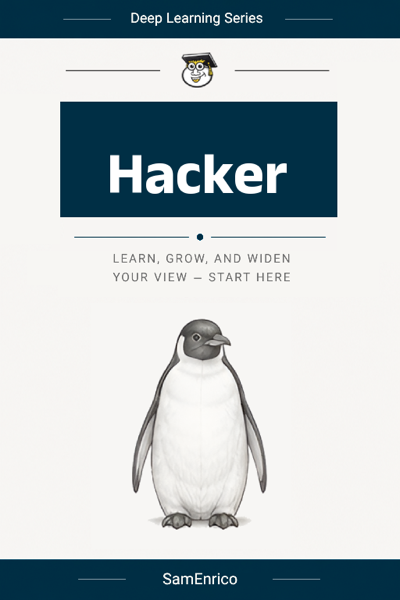
Non-FictionInformativeEducational
Hacker eBook
A Coursebook on Hacker
by Mattos Kyung
A Coursebook on Hacker
Formats
Free sample
Chapter 1: The Permission Slip...--–- The first thing you need to know about hacking is that you already have permission. Not from me, not from some online forum, and certainly not from a "learn to hack in 24 hours" You Tube video. You need permission from the person or organization that owns the computer you are about to touch. Without that, you are not a hacker. You are a criminal.
And criminals go to prison.I learned this lesson six months before I ever wrote my first line of exploit code. I was twenty-two, freshly hired as a junior security analyst at a regional bank, and convinced I was destined for greatness. I had read every blog post about penetration testing. I had installed Kali Linux on my laptop three times (the first two times I broke the bootloader and had to reinstall Windows). I had even managed to crack my neighbor's Wi-Fi password—"Fluffy123"—which I thought made me some kind of cyber god.Then my boss, a woman named Carol who had been in information security since before I knew what a modem was, handed me a sheet of paper.
It was four pages long, single-spaced, and covered in legal jargon. "This," she said, "is your most important tool."I looked at it. "It's a contract.""It's a Rules of Engagement document," she corrected. "Without this, you are breaking the law. With this, you are a paid professional.
Never, ever scan a single IP address until this is signed."That moment changed how I thought about hacking. The movies don't show the legal review. The clickbait articles don't mention the non-disclosure agreements. But the real world runs on paper. And if you want to be a real hacker—not a script kiddie, not a criminal, but a professional who gets paid to break things so they can be fixed—you need to start with the permission slip.This book is going to teach you how to hack.
But more importantly, it is going to teach you how to hack legally, ethically, and professionally. By the time you finish this chapter, you will understand the legal framework that separates a career from a criminal record. You will build your first safe hacking laboratory. And you will commit to memory five rules that will keep you out of prison.Let's begin.The Three Hats: White, Grey, and Black Before you write a single command, you need to understand the moral and legal landscape of hacking. The industry divides hackers into three categories based on hat color—a metaphor borrowed from old Western movies where the good guys wore white hats and the bad guys wore black hats.White Hat Hackers are the good guys.
They have explicit, written permission from the target organization. They follow a Rules of Engagement document that specifies what systems they can test, when they can test them, and what techniques they are allowed to use. White hats get paid salaries or consulting fees. They sleep well at night. And when they find a vulnerability, they write a report and help fix it.Black Hat Hackers are the criminals.
They break into systems without permission. They steal data, install ransomware, or sell access on dark web forums. Black hats face prison time, forfeiture of assets, and a permanent criminal record. The FBI's Cyber Division has over 1,000 special agents dedicated to hunting them. The average prison sentence for computer fraud in the United States is over four years.Grey Hat Hackers operate in the murky middle.
They might find a vulnerability and report it to the company without permission—but after they have already looked around. Or they might deface a website to prove a point, then offer to fix it for a fee. Grey hats often believe they are doing good, but the law disagrees. The Computer Fraud and Abuse Act (CFAA) does not have a "good intentions" exception. If you access a system without authorization, you are breaking the law, regardless of whether you steal anything or not.Here is the truth that many aspiring hackers do not want to hear: there is no safe grey area.
The only way to hack professionally, repeatedly, and without fear of prosecution is to be a white hat. This book teaches white hat methodology exclusively. Every technique, tool, and command in these pages is demonstrated in a lab environment that you will build in the next section. You will never be instructed to hack a real system without permission.Two Models of Hacking: The Cyber Kill Chain and The Five Phases Now that we have established the ethical boundaries, let us talk about how hacking actually works. Professional penetration testers do not simply "hack into things." They follow structured, repeatable processes.
This book uses two complementary models to teach you the attack lifecycle.The Cyber Kill Chain (Industry Standard)The Cyber Kill Chain was developed by Lockheed Martin and is the industry standard for describing adversary behavior. It breaks a cyber attack into seven stages:Reconnaissance – Gathering information about the target. This includes looking up email addresses, scanning public websites, and using tools like Google Dorking or Shodan.Weaponization – Creating the malicious payload. This might be a phishing email attachment, a modified exploit, or a custom Trojan.Delivery – Transmitting the weapon to the target. Common delivery methods include email, USB drives, or malicious websites.Exploitation – Triggering the vulnerability.
This could be a buffer overflow, a SQL injection, or simply tricking a user into clicking "Allow."Installation – Establishing a foothold. Installing a backdoor, creating a new user account, or adding a scheduled task.Command & Control (C2) – Opening a communication channel back to the attacker. This allows remote control of the compromised machine.Actions on Objectives – Accomplishing the goal. This might be data exfiltration, ransomware deployment, or lateral movement to other systems.The Five Phases (Simplified for Learning)The Cyber Kill Chain is comprehensive, but it can be overwhelming for beginners. This book uses a simplified five-phase model as a pedagogical framework.
These phases map directly to the Kill Chain but are easier to remember and teach.Five Phases Maps to Kill Chain Stages1. Reconnaissance Reconnaissance2. Scanning Reconnaissance, Weaponization, Delivery (simplified)3. Exploitation Exploitation4. Persistence Installation, Command & Control5.
Covering Tracks Actions on Objectives (cleanup)Throughout this book, you will see these five phases referenced repeatedly. Each chapter belongs to one of these phases. By the end of the book, you will have executed every phase in your own laboratory.The Legal Framework: What You Can and Cannot Do You cannot hack ethically without understanding the law. Ignorance is not a defense. The following legal frameworks govern almost every professional penetration test.The Computer Fraud and Abuse Act (CFAA) – United States The CFAA is the primary federal law against hacking in the United States.
It was passed in 1986 and has been amended several times. The key provision, 18 U.S.C. § 1030(a)(2), makes it a crime to intentionally access a computer "without authorization" or "exceeding authorized access."What does this mean in practice? If you scan a website without permission, you have likely violated the CFAA. If you find a vulnerability and test it "just to see if it works," you have violated…
This is the end of the free sample. Get the eBook to keep going. Buy now
About this book
Details
- Author
- Mattos Kyung
- Publisher
- SamEnrico
- Language
- English
- Genre
- Non-Fiction, Informative, Educational
- Released
- 2026-06-02
- Pages (approx.)
- 154
- Available as
- eBook, Audiobook

Read better in the ZLOADR app
Your eBooks on your phone or tablet. Sign in with your SamEnrico account and start reading.
More by Mattos Kyung
 Cocaine Recovery Journal WorkbookMattos Kyung$11.99
 The Parent Perfectionism ReleaseMattos Kyung$11.99
 Weight Loss Self HypnosisMattos Kyung$11.99
 The Vilna Shas PrinterMattos Kyung$11.99
 Clutterers Anonymous Step GuideMattos Kyung$11.99
 The Shot That Shook the World: The 1996 NBA Draft HeistMattos Kyung$11.99
 The Quantum Coral: Decoding the Great Barrier Reef's Prehistoric SecretsMattos Kyung$11.99
 Augmented Reality Retail OutlookMattos Kyung$12.99
 Online Bootcamp Vs In PersonMattos Kyung$12.99
 Understanding Brachymesophalangy Mesomelic Short Limbs Osseous AnomaliesMattos Kyung$17.99
 10 Ways to Use Comfrey (Recipe Book)Mattos Kyung$11.99
You may also like
 Hong Kong Handover 1997Dunn Johnnie$11.99
 Zumba For Postnatal Recovery CourseNeal Christian$11.99
 Zumba for BeginnersLadner Nikia$11.99
 YouTube Comment Mining GuideHumes Pandora$12.99
 Worry Box MeditationCarlin Rudy$11.99
 Workplace Stress MeditationNguyen Lynn$11.99
 Workplace Stress and Sleep RepairHawley Ivory$11.99
 Workplace Perfectionism CureDelaney Jeffry$11.99
 Workplace Injustice Anger GuideWallen Isabelle$11.99
 Work Addiction and Burnout LinkGreenwood Ester$11.99
 Women in Yoga and WellnessBeattie Galina$11.99
 Women in Stand Up ComedyChun Evangeline$11.99