
Non-FictionHealth & WellnessMaintenance
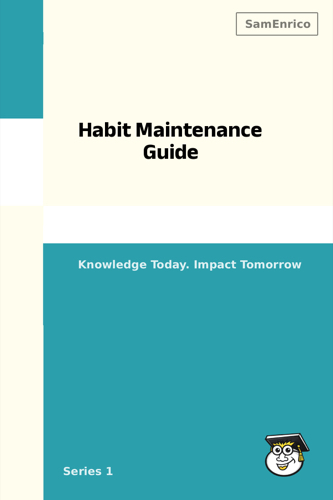
Habit Maintenance Guide eBook
Sustain behavior changes long term after weight lo
by Clem Emerita
Sustain behavior changes long term after weight loss.
Formats
Free sample
Chapter 1: The Arrival Trap--–- The scale reads your goal weight. You step off, smile, and text three friends. You have done it. Months of discipline, hunger, and sacrifice have finally paid off. You feel invincible.
And that feeling, according to every major study on long-term weight maintenance, is the single most dangerous moment of your entire journey.Welcome to the Arrival Trap.The Arrival Trap is what happens when you confuse reaching a destination with ending a struggle. It is the quiet, seductive belief that once the scale hits a certain number, the hard part is over. You have climbed the mountain. Now you can rest. Except biology does not work that way.
Psychology does not work that way. And the 70 percent of dieters who regain most or all of the weight within one year did not fail because they were lazy or weak. They failed because they fell into the Arrival Trap, and no one taught them how to get out.This book exists because the weight loss industry has lied to you. Not maliciously, but systematically. Every diet plan, every 90-day challenge, every before-and-after photo sells the same story: that the finish line is freedom.
That reaching your goal weight is the end of the story. But if you have ever lost significant weight and then watched it creep back, you already know the truth. The finish line is not the end. It is the beginning of an entirely different game.Let me say that again, because it is the single most important sentence in this book: The finish line is not the end. It is the beginning of an entirely different game.Weight loss and weight maintenance are not the same skill.
Losing weight requires calorie deficit, consistency, and motivation. Maintaining weight requires metabolic management, habit architecture, psychological resilience, and a completely different relationship with food. You can lose weight using brute force willpower for 90 days. You cannot maintain weight loss using brute force willpower forever. Willpower is a finite resource, and science has known this for decades.The Myth of the Finish Line In 2007, a Princeton philosophy professor named Ruth Chang gave a now-famous lecture on something she called the "arrival fallacy." She defined it as the mistaken belief that reaching a goal will bring lasting satisfaction and that the struggle ends at the destination.
The term was later popularized by author and motivational speaker Robert Greene, but the concept has been validated by decades of behavioral psychology research.Here is what the research actually shows. A landmark study published in the American Journal of Public Health followed over 4,000 successful dieters for five years. The researchers found that the most significant predictor of weight regain was not age, not starting weight, not type of diet used, and not even exercise frequency. The most significant predictor was something they called "goal disengagement"—the psychological process of relaxing effort after achieving a target.In plain English: people who celebrated their goal weight as the end of the struggle regained weight. People who treated their goal weight as a checkpoint, not a finish line, kept it off.Think about what that means.
The very act of celebrating your success—the thing every diet program encourages you to do—may be the thing that undoes you. This is not because celebration is bad. It is because the finish line mindset is incompatible with the lifelong reality of metabolic management.Why Your Body Is Not Your Ally Before we go any further, we need to have an honest conversation about what you are actually fighting against. Most people believe that weight regain happens because they lose willpower or get lazy. That is like saying a boat sank because water got into it.
It is true at the most superficial level, but it completely misses the underlying mechanisms.Your body does not want to be thin.I need you to read that sentence three times. Your body does not want to be thin. Your body wants to survive. And from the perspective of 200,000 years of human evolution, being thin is a sign of danger. Low body fat signals famine, scarcity, and potential death.
Every hormonal system in your body is designed to defend against weight loss, not to celebrate it.This is what scientists call the set point theory, and it is one of the most well-replicated findings in obesity research. Your body has a preferred weight range—typically a 10 to 15 pound window—that it will fight to maintain. When you lose weight, your body does not say, "Great job, let's stay here." It says, "Something is wrong, and we need to fix it immediately."The mechanisms your body uses to fight back are brutal and relentless. Let me walk you through the three major hormonal weapons your body deploys after weight loss. We will explore each of these in depth in the coming chapters, but for now, understand that they are not character flaws.
They are survival instincts.First, leptin plummets. Leptin is the hormone that tells your brain, "You are full, stop eating." After weight loss, leptin levels drop by as much as 50 percent. This means you literally feel less full after eating the same amount of food. You are not imagining it. Your biology has changed.Second, ghrelin skyrockets.
Ghrelin is the hunger hormone. It is what makes your stomach growl and your brain obsess about food. After weight loss, ghrelin levels increase and become more aggressive. You feel hungry more often, and the hunger is harder to ignore.Third, cortisol becomes dysregulated. Cortisol is the stress hormone, and it has a direct line to your appetite.
When cortisol rises, your brain craves calorie-dense, highly palatable foods—the very foods you worked so hard to avoid during weight loss. Your body is literally chemically manufacturing cravings.Here is the number that should terrify you: a person who has lost 50 pounds burns 300 to 500 fewer calories per day than a person who has always weighed that same amount. This is called adaptive thermogenesis, and it is the reason two people of the same weight can eat the same meal and have completely different outcomes. The person who lost weight is fighting with one arm tied behind their back.None of this is your fault. You did not ask for your leptin to drop.
You did not choose for your ghrelin to spike. You did not decide that cortisol would make you crave sugar. This is biology. And the first step to winning the maintenance game is to stop blaming yourself for playing against a rigged system.The 90-Day Myth Almost every diet program on the market is structured around 90 days. There is a reason for this.
Ninety days is approximately the amount of time most people can sustain high levels of willpower before depletion becomes inevitable. Diet companies know this. They count on it. They structure their programs so that you see dramatic results in the first 90 days, then quietly hope you do not notice what happens on day 91.The science of willpower depletion is well established. In the late 1990s, psychologist Roy Baumeister and his colleagues conducted a now-classic series of experiments on what they called "ego depletion."…
This is the end of the free sample. Get the eBook to keep going. Buy now
About this book
Details
- Author
- Clem Emerita
- Publisher
- SamEnrico
- Language
- English
- Genre
- Non-Fiction, Health & Wellness, Maintenance
- Released
- 2026-06-11
- Pages (approx.)
- 112
- Available as
- eBook, Audiobook

Read better in the ZLOADR app
Your eBooks on your phone or tablet. Sign in with your SamEnrico account and start reading.
More by Clem Emerita
 Spouse Loss Travel GuideClem Emerita$11.99
 Loving Kindness for a Dying PetClem Emerita$11.99
 Anki For Fantasy FootballClem Emerita$11.99
 The 1857 Uniforms ExplainedClem Emerita$11.99
 The Stress Fitness RecoveryClem Emerita$11.99
 Qigong For Pain ReliefClem Emerita$11.99
 London Student Pop Up SeasonClem Emerita$11.99
 Yakuza Construction IndustryClem Emerita$11.99
 The Billion-Dollar Bet: How Donald Trump Built, Bankrupted, and Rebuilt His EmpireClem Emerita$11.99
 The Day the Internet Broke: A Timeline of ChaosClem Emerita$11.99
 Love and Cannon Fire: The Queen and the Tsar in the Great Northern WarClem Emerita$11.99
 Game Design and Development SystemsClem Emerita$11.99
You may also like
 Hong Kong Handover 1997Dunn Johnnie$11.99
 Zumba For Postnatal Recovery CourseNeal Christian$11.99
 Zumba for BeginnersLadner Nikia$11.99
 YouTube Comment Mining GuideHumes Pandora$12.99
 Worry Box MeditationCarlin Rudy$11.99
 Workplace Stress MeditationNguyen Lynn$11.99
 Workplace Stress and Sleep RepairHawley Ivory$11.99
 Workplace Perfectionism CureDelaney Jeffry$11.99
 Workplace Injustice Anger GuideWallen Isabelle$11.99
 Work Addiction and Burnout LinkGreenwood Ester$11.99
 Women in Yoga and WellnessBeattie Galina$11.99
 Women in Stand Up ComedyChun Evangeline$11.99