
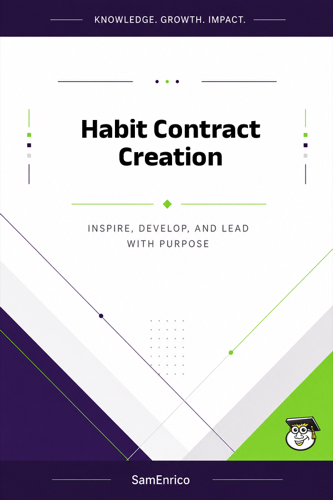
Non-FictionSelf-HelpHabit Contract
Habit Contract Creation eBook
Write formal agreement with consequences for missi
Write formal agreement with consequences for missing habit.
Formats
Free sample
Chapter 1: The Odometer Principle--–- Every driver knows the feeling. You are cruising down an empty highway, the speedometer reads 65 miles per hour, and the road ahead is straight and clear. Then you notice something in the distance—a small white car parked on the shoulder, barely visible behind a cluster of trees. Your foot instinctively lifts from the accelerator. Your eyes dart to the speedometer.
You slow to 62, then 60. You are not a criminal. You are not a reckless person. But the mere presence of a police radar changes your behavior more effectively than any internal commitment to "drive safely" ever could.This is the Odometer Principle, and it is the single most important concept in habit formation that almost no one understands.The Odometer Principle states simply this: human beings comply with rules when they believe they are being watched and when they believe non-compliance will carry an immediate, tangible cost. When the radar disappears—when the probability of getting caught drops to zero—behavior drifts almost instantly toward the path of least resistance.
Drivers speed. Dieters eat the cake. Writers watch Netflix. The gym membership goes unused. Not because we are bad people.
Not because we lack willpower. But because the brain is wired to optimize for short-term pleasure unless there is a credible threat of short-term pain.For the past fifty years, the self-help industry has sold us a comforting lie. The lie is this: if you want to change your habit, you need more motivation. You need a better "why." You need to visualize your success, create a vision board, repeat affirmations, find your passion, and dig deep for that elusive reservoir of willpower that supposedly lives somewhere inside you, waiting to be unlocked.The lie sells billions of dollars in books, courses, seminars, and apps every year.And it does not work.The Intention-Action Gap Let us define the central problem. Psychologists have a name for the chasm between what we intend to do and what we actually do.
They call it the intention-action gap. You intend to wake up at 6:00 AM and run three miles before work. At 6:00 AM, when the alarm blares and the bed is warm and the rain is tapping against the window, you intend to sleep for "just ten more minutes." The gap between those two intentions—the one you wrote in your journal last night and the one that seized your brain this morning—is where habits die.The intention-action gap is not a moral failing. It is a neurological feature. The human brain is not a single unified commander making rational decisions.
It is a collection of competing subsystems, roughly divisible into two categories. The first is the limbic system, sometimes called the "old brain." It processes emotion, seeks immediate reward, avoids immediate discomfort, and operates on timescales of seconds to minutes. The second is the prefrontal cortex, the "new brain." It plans for the future, delays gratification, understands long-term consequences, and operates on timescales of months to years.Here is the problem. The limbic system is faster, stronger, and more metabolically efficient than the prefrontal cortex. When you are tired, stressed, hungry, or distracted—which is to say, most of the time—the limbic system wins every single negotiation.
Your prefrontal cortex knows that you should go to the gym. Your limbic system points out that the couch is very comfortable right now. The limbic system is not interested in your six-month fitness goals. It is interested in the next thirty seconds.This is why resolutions fail. A resolution is a conversation between your prefrontal cortex and itself.
You sit down on December 31st, well-rested, well-fed, optimistic, and you make a solemn promise to your future self. That promise feels real in the moment because your limbic system is quiet, sated, and not currently being tempted by anything. But January 2nd arrives, and with it comes stress, fatigue, a missed lunch, a fight with your spouse, and suddenly your limbic system is shouting while your prefrontal cortex is whispering. The resolution collapses not because you are weak but because you built a structure that assumed your brain would always be in its calmest, most rational state.Willpower Is a Finite Resource Let us be precise about willpower because the self-help industry has muddied this concept beyond recognition. Willpower is not a character trait.
It is not something you either have or do not have. Willpower is a depletable cognitive resource, analogous to a battery or a fuel tank. This is not a metaphor. It is a scientific finding replicated across dozens of studies.The most famous of these studies involved two groups of people. One group was asked to resist eating freshly baked chocolate chip cookies placed directly in front of them.
The other group was asked to resist eating radishes—a trivial task because no one craves radishes. Afterward, both groups were given a set of impossible puzzles to solve. The cookie group gave up in an average of eight minutes. The radish group persisted for nineteen minutes. The act of resisting the cookies had depleted their willpower, leaving them with nothing left for the puzzles.This phenomenon is called ego depletion.
Every act of self-control draws from the same limited pool. When you force yourself to wake up early, that draws from the pool. When you force yourself to answer difficult emails, that draws from the pool. When you resist the donut in the break room, that draws from the pool. By 3:00 PM, for most people, the pool is empty.
This is why you are more likely to skip your evening workout than your morning workout. This is why dieters binge at night. This is why you say yes to things you regret after a long day of decisions.The implication is devastating for traditional habit advice. If willpower is a finite resource that depletes throughout the day, then any habit strategy that relies on willpower is doomed to fail. And nearly every conventional habit strategy relies on willpower.
"Just try harder." "Stay motivated." "Remember your why." These are appeals to a resource that you do not have in the moments when you need it most.The Asymmetry of Consequences Here is where the Odometer Principle becomes a practical tool rather than an abstract observation. The reason police radar changes driver behavior is not because drivers morally transform into law-abiding citizens when they see it. It is because the radar changes the immediate calculus of consequences.Let us map out the consequences of speeding in a world without police radar. The benefit is immediate: you arrive three minutes faster, you feel a small thrill of transgression, and you avoid the mild boredom of driving the speed limit. The cost is delayed and probabilistic: you might get a ticket someday, you might get into an accident eventually, you might wear out your brakes marginally faster.
The limbic system values the immediate benefit highly and discounts the delayed cost almost to zero. The rational choice, from the brain's perspective, is to speed.Now introduce police radar. The benefit remains the same: you still arrive three minutes faster. But the cost is no longer delayed and probabilistic. It…
This is the end of the free sample. Get the eBook to keep going. Buy now
About this book
Details
- Author
- Stackhouse Maryln
- Publisher
- SamEnrico
- Language
- English
- Genre
- Non-Fiction, Self-Help, Habit Contract
- Released
- 2026-06-07
- Pages (approx.)
- 137
- Available as
- eBook, Audiobook

Read better in the ZLOADR app
Your eBooks on your phone or tablet. Sign in with your SamEnrico account and start reading.
More by Stackhouse Maryln
 LBO Refinancing ScenariosStackhouse Maryln$11.99
 Body Scan for RegretStackhouse Maryln$11.99
 Swimming Flip Turn TechniqueStackhouse Maryln$11.99
 Multiple Victim Scene ReconstructionStackhouse Maryln$11.99
 Waterlogged TeethStackhouse Maryln$11.99
 Emotional Validation for AngerStackhouse Maryln$11.99
 Self Hypnosis for Sleep ParalysisStackhouse Maryln$11.99
 The Queen of Sheba: Africa's Golden Diplomat and Architect of LegendStackhouse Maryln$11.99
 The Dancers of Babylon: Gambling, Ritual, and the Birth of Performance ArtStackhouse Maryln$11.99
 How to Start a Magneto Business (Beginners Guide)Stackhouse Maryln$11.99
 How to Produce PET Heating Pad AccessoriesStackhouse Maryln$11.99
 How to Produce Dairy ProductsStackhouse Maryln$11.99
You may also like
 Hong Kong Handover 1997Dunn Johnnie$11.99
 Zumba For Postnatal Recovery CourseNeal Christian$11.99
 Zumba for BeginnersLadner Nikia$11.99
 YouTube Comment Mining GuideHumes Pandora$12.99
 Worry Box MeditationCarlin Rudy$11.99
 Workplace Stress MeditationNguyen Lynn$11.99
 Workplace Stress and Sleep RepairHawley Ivory$11.99
 Workplace Perfectionism CureDelaney Jeffry$11.99
 Workplace Injustice Anger GuideWallen Isabelle$11.99
 Work Addiction and Burnout LinkGreenwood Ester$11.99
 Women in Yoga and WellnessBeattie Galina$11.99
 Women in Stand Up ComedyChun Evangeline$11.99