
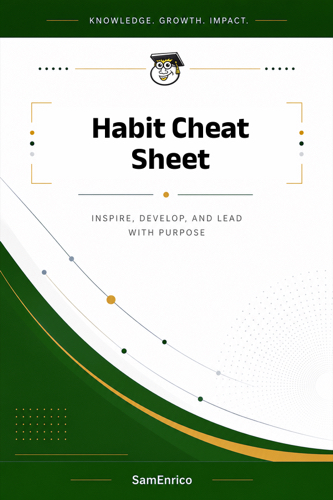
Free sample
Chapter 1: The Compounding Deception--–- Imagine two people. The first person wakes up tomorrow morning and decides to transform her life. She is going to exercise for one hour, eat only whole foods, meditate for twenty minutes, write three pages in her journal, and learn a new language. She is motivated. She is inspired.
She has finally found the willpower she was missing. The second person wakes up and decides to do one pushup. That is it. One pushup. Then he will go about his day.Now ask yourself: Who is more likely to still be doing their new habit six months from now?If you answered the person doing one pushup, you are correct.
But your intuition probably fought you on the way to that answer. Everything about our culture celebrates the dramatic transformation. We love the story of the person who quit everything overnight, who woke up one day and simply decided to be different. We love it because it promises that we are only one heroic decision away from the lives we want. The problem is that these stories are not just oversimplified.
They are actively misleading. They hide the secret that actually drives lasting change: the power of microscopic, almost embarrassingly small actions repeated over time.This chapter is called "The Compounding Deception" because the deception is not in the math of compounding—the math is unassailable—but in how we feel about compounding. We nod along when someone says "small changes add up," but deep down, we do not believe it. We believe that big results require big efforts. We believe that if we are not pushing ourselves to the limit, we are not really trying.
We believe that the one-pushup person is wasting his time.That belief is the single greatest obstacle between you and every habit you have ever wanted to build.The Mathematics of Almost Nothing Let us start with the numbers, because the numbers do not care about your feelings. If you improve by just 1% every day—not 10%, not 20%, but 1%, an amount so small you would barely notice it in a single sitting—how much better are you after one year?Most people guess somewhere between three and ten times better. They are off by a staggering margin. The correct answer is thirty-seven times better. One point zero one raised to the power of three hundred and sixty-five is approximately thirty-seven point seven eight.
A 1% daily improvement compounds into a thirty-seven-fold annual improvement.Now consider the opposite. If you get 1% worse every day—skip one small task, make one slightly poor choice, lose five minutes of focus—where do you end up? Zero point nine nine raised to the three hundred and sixty-fifth power is approximately zero point zero three. You do not feel yourself getting worse. It happens invisibly, beneath the threshold of daily perception.
And then one day you wake up and wonder how everything fell apart.This is not motivational rhetoric. This is arithmetic. The same math that governs compound interest in your bank account governs compound interest in your behavior. A tiny daily advantage, repeated consistently, produces a result that looks like magic to anyone who only sees the endpoint. A tiny daily disadvantage, repeated consistently, produces a disaster that looks like bad luck to anyone who only sees the aftermath.The deception is that we cannot feel the 1%.
A single workout does not change your body. A single page does not write a book. A single dollar does not make you wealthy. Because the individual unit feels insignificant, we dismiss it. We chase the twenty-percent day, the heroic effort, the dramatic overhaul.
But the twenty-percent day is not sustainable. The 1% day is. And over a year, the 1% day produces thirty-seven times the improvement of the person who does nothing at all.The Myth of the Overnight Success There is a famous study of Olympic athletes that reveals something uncomfortable about how we perceive excellence. Researchers asked elite swimmers, runners, and gymnasts to describe their training regimens. What they found was not a secret technique or a genetic miracle.
They found that the athletes simply practiced more consistently than everyone else. Not more intensely. More consistently. They showed up on the days when they were tired, when they were bored, when it was raining, when they did not feel like it. The gap between gold medalists and the athletes who finished tenth was not a gap in talent.
It was a gap in the number of days they chose to practice when practicing was the last thing they wanted to do.Now consider how we tell the stories of these athletes. We talk about their "natural ability." We talk about the "moment it all clicked." We talk about the "breakthrough performance" that changed everything. We almost never talk about the ten thousand hours of boring, repetitive, unglamorous practice that happened before anyone was watching. Those hours do not make a good story. A good story requires a turning point, a revelation, a before-and-after that fits into a two-minute segment on television.The same pattern appears in every domain.
The writer who publishes a bestseller did not wake up one day with a finished manuscript. She wrote badly for years. She wrote sentences that went nowhere. She wrote pages that she later deleted. The entrepreneur who sells a company did not have a single brilliant insight.
He made small improvements to his product, his marketing, his operations, day after day, year after year. The person who lost fifty pounds did not find a secret diet. He made slightly better food choices, slightly more often, for a very long time.We call these people "overnight successes" because we did not see the nights. We saw the morning after. And we mistakenly believed that the morning after was the beginning, not the end, of a very long process.Why Your Willpower Is a Finite Tank There is a second reason that dramatic transformations usually fail, and it has to do with the biology of self-control.
In the 1990s, the psychologist Roy Baumeister conducted a now-famous series of experiments. He brought hungry college students into a room that smelled of freshly baked chocolate chip cookies. On a table in front of them sat a plate of warm cookies and a bowl of radishes. Some students were told to eat the cookies. Others were told to eat the radishes.
Then, after this first task, all the students were given an impossible puzzle to solve.The students who had eaten the radishes—who had exerted willpower to resist the cookies—gave up on the puzzle in about eight minutes. The students who had eaten the cookies kept trying for nearly twenty minutes. The act of resisting the cookies had depleted the radish eaters' willpower. They had less left for the puzzle.Baumeister called this Ego Depletion. The theory, which has been replicated in dozens of studies, is simple: willpower is a finite resource.
Every decision you make, every temptation you resist, every time you force yourself to do something you do not want to do, you draw from the same limited pool. By the end of the day, your willpower reserves are often…
This is the end of the free sample. Get the eBook to keep going. Buy now
About this book
Details
- Author
- Hutchens Edyth
- Publisher
- SamEnrico
- Language
- English
- Genre
- Non-Fiction, Self-Help / Reference
- Released
- 2026-06-06
- Pages (approx.)
- 150
- Available as
- eBook, Audiobook

Read better in the ZLOADR app
Your eBooks on your phone or tablet. Sign in with your SamEnrico account and start reading.
More by Hutchens Edyth
 Financial Stress First Aid HandbookHutchens Edyth$11.99
 Multivariate Validation TestingHutchens Edyth$11.99
 MILD Lucid Dreaming ProtocolHutchens Edyth$11.99
 Thunberg Climate Strikes BookHutchens Edyth$11.99
 Orrin HatchHutchens Edyth$11.99
 Addressing Religious DifferencesHutchens Edyth$11.99
 Prevent Defense Caution GuideHutchens Edyth$11.99
 Hustle Culture RejectionHutchens Edyth$11.99
 The Silk Road Spice Masters: Jan Huyghen van Linschoten and the Secrets of the EastHutchens Edyth$11.99
 The Siege of Hara: The Last Stand of the HashashinHutchens Edyth$11.99
 The Dancer's Guide to PentozalisHutchens Edyth$11.99
 Quality Estimation and Rework HandbookHutchens Edyth$12.99
You may also like
 Remote Work Cheat SheetHope Strickland$11.99
 Memory Palace ChecklistCastaneda Latoria$11.99
 Pain Meditation Cheat SheetMilner Libby$11.99
 Anticipatory Grief Cheat SheetHoyt Krysten$11.99
 Pattern Recognition ChecklistMusgrove Fidelia$11.99
 Difficult Conversation ChecklistKimbrell Wilhelmina$11.99
 Nightmare Cheat SheetSimms Isaiah$11.99
 Remote Work ChecklistShayne Gandy$11.99
 Interruption ChecklistGoldstein Daren$11.99
 Difficult Conversation Cheat SheetKohn Joshua$11.99
 Anticipatory Grief ChecklistFord Jason$11.99
 Scripting ChecklistLowry Maisie$11.99