
Non-FictionHealth & WellnessHabit Formation
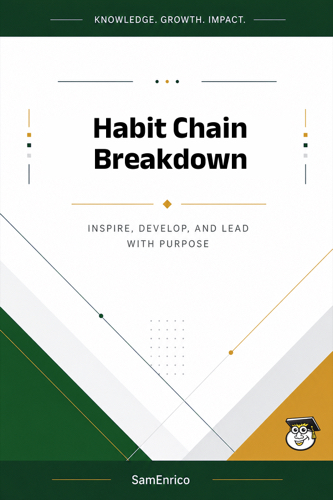
Habit Chain Breakdown eBook
Identify cue, routine, reward loops and replace un
Identify cue, routine, reward loops and replace unhealthy habits.
Formats
Free sample
Chapter 1: The Willpower Trap--–- Every morning, Sarah told herself the same lie. “Today,” she would whisper, standing in her kitchen with a coffee mug in one hand and her phone in the other, “today I will not order takeout. Today I will cook the vegetables in my refrigerator before they rot. Today I will be disciplined.” And every evening, around 7:15 PM, she would find herself scrolling through a delivery app, exhausted from work, her resolve shattered like the empty cartons she would throw away the next morning. She had tried everything—meal prepping on Sundays (lasted two weeks), deleting the delivery apps (re-downloaded them within days), even taping a handwritten note to her refrigerator that read “YOU ARE NOT HUNGRY.
YOU ARE BORED.” The note had been there for four months. She had stopped seeing it after the first week.Sarah is not lazy. Sarah is not weak. Sarah is not broken. Sarah is running a neurological program that she did not write, does not understand, and has been trying to delete by screaming at it.
That strategy has never worked for anyone, and it will not work for you.This book is built on a single, radical proposition: you do not have a willpower problem. You have a replacement problem. Every habit you wish to break—every cigarette, every late-night snack, every hour lost to social media, every procrastination spiral—is not a moral failure. It is a neurological loop that your brain has optimized for efficiency. And efficiency cannot be shouted down.
It can only be overwritten.Before we go any further, let me prove this to you with a story that has nothing to do with habits, and everything to do with how your brain actually works.The Rat, The Lever, and The Lie We Tell Ourselves In the early 1990s, neuroscientist Ann Graybiel at MIT conducted an experiment that would fundamentally change our understanding of automatic behavior. She placed rats in a T-shaped maze with chocolate at one end. At first, the rats sniffed every corner, hesitated at every turn, and took nearly two minutes to find the reward. Their brains—specifically, the prefrontal cortex, the seat of decision-making—were blazing with activity. Every choice was conscious, deliberate, effortful.Then something remarkable happened.
After a week of running the same maze, the rats sprinted from start to chocolate in under ten seconds. More importantly, Graybiel’s neural recordings showed that the rats’ prefrontal cortexes had gone almost completely quiet. The decision-making part of their brains had stopped working. The behavior had been transferred to the basal ganglia—a primitive, ancient structure that runs on autopilot, like a train on a track. The rats were not “choosing” to run the maze.
They were running it because the track existed.Here is what Graybiel concluded, and what every habit researcher since has confirmed: once a behavior becomes a habit, your brain literally stops making choices about it. The cue (entering the maze, or in your case, 3:00 PM at your desk) triggers the routine (sprinting to the chocolate, or reaching for your phone) without any meaningful input from your conscious mind. You are not deciding to check Instagram. You are performing a neurological reflex.This is the first and most important fact you must internalize: your bad habits are not decisions. They are tracks.And you cannot destroy a track by staring at it and feeling ashamed.The Myth of Moral Failure Almost every culture on earth has a word for the experience of failing to resist a bad habit, and almost every one of those words carries a moral judgment.
Gluttony. Sloth. Weakness. Lack of discipline. We talk about habits as if they are character defects, as if the person who cannot stop smoking is somehow less virtuous than the person who never started.This is not just unkind.
It is scientifically wrong.Consider two people: Maria and James. Maria has never smoked a cigarette in her life. She has no habit loop to fight. James has smoked a pack a day for fifteen years. His cue (stress, coffee, finishing a meal) triggers a craving (nicotine plus hand-to-mouth motion) that drives a routine (lighting a cigarette) that delivers a reward (dopamine release within seven seconds).
When James tries to quit, he is not fighting a choice. He is fighting a neurological superhighway that has been paved over fifteen years of repetition. Maria is not morally superior. She simply lacks the highway.The research on ego depletion—the limited nature of willpower—bears this out. In a famous study by Roy Baumeister, participants who were forced to resist eating freshly baked chocolate chip cookies (while sitting next to a bowl of radishes) gave up on a subsequent puzzle task twice as fast as participants who were allowed to eat the cookies.
The act of resisting had depleted their willpower reserves. They did not become morally worse people. They ran out of fuel.Here is what this means for you: every time you have told yourself, “I just need more self-control,” you have been chasing a phantom. Willpower is not a muscle you can strengthen indefinitely. It is a battery that drains with use.
And relying on it to break a habit is like trying to empty the ocean with a teaspoon—possible in theory, impossible in practice, and exhausting beyond measure.The people you admire—the ones who seem effortlessly disciplined—are not secretly stronger than you. They have simply stopped fighting their habits and started designing around them. They have learned what this book will teach you: the only way to break a habit is to replace it, not resist it.The Golden Rule of Habit Change Charles Duhigg, in his groundbreaking book The Power of Habit, distilled decades of neuroscience into a single, elegant principle that he called the Golden Rule of Habit Change:You cannot extinguish a bad habit. You can only change it.This sounds simple, but its implications are radical. Most people approach habit change as an act of subtraction: “I want to stop eating sugar.
I want to stop biting my nails. I want to stop procrastinating.” They identify the behavior they wish to eliminate and then try to not do it. And because the habit loop still exists—the cue still triggers the craving, which still demands a reward—their brains respond to the absence of the routine with a sensation called psychological friction.Psychological friction is the mental equivalent of trying to push a door that says “pull.” It is the feeling of resistance, discomfort, and mounting tension that arises when you suppress an automatic behavior without providing an alternative. It is what Sarah felt at 7:15 PM every night, standing in her kitchen, trying to will herself not to order takeout. The friction built and built until the only way to relieve it was to give in.Now consider a different approach.
What if, instead of trying to not order takeout, Sarah replaced the routine with something else that delivered the same reward? What if her 7:15 PM cue (exhaustion plus empty kitchen) was not the enemy but the raw material for change? What if she kept the cue (exhaustion)…
This is the end of the free sample. Get the eBook to keep going. Buy now
About this book
Details
- Author
- Ahrens Anneliese
- Publisher
- SamEnrico
- Language
- English
- Genre
- Non-Fiction, Health & Wellness, Habit Formation
- Released
- 2026-06-08
- Pages (approx.)
- 146
- Available as
- eBook, Audiobook

Read better in the ZLOADR app
Your eBooks on your phone or tablet. Sign in with your SamEnrico account and start reading.
More by Ahrens Anneliese
 Walking Meditation for Remote WorkersAhrens Anneliese$11.99
 Work Addiction And Sick DaysAhrens Anneliese$11.99
 The Systems Thinking Creativity GuideAhrens Anneliese$11.99
 Spouse Hospice Grief GuideAhrens Anneliese$11.99
 Self Hypnosis For Procrastination Advanced GuideAhrens Anneliese$11.99
 Weather Pain MindfulnessAhrens Anneliese$11.99
 The Seeker Dream FigureAhrens Anneliese$11.99
 Art From Dreams ActivityAhrens Anneliese$11.99
 The March of the Iron King: Frederick the Great and the Birth of Prussian DisciplineAhrens Anneliese$11.99
 The Phantom of the Pyramids: Egypt's Unsolved Art HeistAhrens Anneliese$11.99
 The Day the Music Died... Again: The 1985 Live Aid Reunion That Almost Wasn'tAhrens Anneliese$11.99
 Understanding Adams–Oliver SyndromeAhrens Anneliese$17.99
You may also like
 Hong Kong Handover 1997Dunn Johnnie$11.99
 Zumba For Postnatal Recovery CourseNeal Christian$11.99
 Zumba for BeginnersLadner Nikia$11.99
 YouTube Comment Mining GuideHumes Pandora$12.99
 Worry Box MeditationCarlin Rudy$11.99
 Workplace Stress MeditationNguyen Lynn$11.99
 Workplace Stress and Sleep RepairHawley Ivory$11.99
 Workplace Perfectionism CureDelaney Jeffry$11.99
 Workplace Injustice Anger GuideWallen Isabelle$11.99
 Work Addiction and Burnout LinkGreenwood Ester$11.99
 Women in Yoga and WellnessBeattie Galina$11.99
 Women in Stand Up ComedyChun Evangeline$11.99