
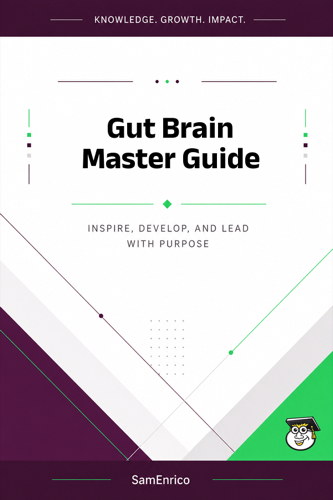
Non-FictionHealth & WellnessComplete
Gut Brain Master Guide eBook
Complete reference for connection and health.
Complete reference for connection and health.
Formats
Free sample
Chapter 1: The Second Brain...--Imagine waking up tomorrow with a profound sense of calm. Your mind is clear. Your stomach feels flat and settled. The usual morning anxiety—that low hum of dread that has followed you into the kitchen for years—is simply gone. You eat breakfast without bloating.
You walk into work without brain fog. You handle stress without your gut tying itself into knots.This is not a fantasy. This is the default state of a properly functioning human body. And the fact that it feels like a fantasy to you right now is evidence of just how broken the gut-brain connection has become for millions of people.Here is the truth that will change everything you think you know about your health: You have two brains. One sits inside your skull, weighs about three pounds, and contains roughly 86 billion neurons.
The other—your "second brain"—lines your gastrointestinal tract from esophagus to anus. It contains over 500 million neurons, more than the spinal cord or the peripheral nervous system. Scientists call it the Enteric Nervous System (ENS). You can call it the reason your stomach "dropped" when you got bad news. The reason you felt "butterflies" before a first date.
The reason anxiety gives you diarrhea and depression gives you constipation.This second brain is not a metaphor. It is a real, complex, fully functional nervous system that operates largely independently of the organ in your head. It produces neurotransmitters—the very same chemical messengers your brain uses to regulate mood, including 90-95% of your body's serotonin and about 50% of your dopamine. It communicates constantly with your first brain via a physical cable called the vagus nerve. And here is the most important fact you will read in this entire book: 80-90% of the traffic on that cable flows from the second brain to the first brain, not the other way around.Let that land.
Most people believe their brain runs the show. They think anxiety starts in the mind and then affects the stomach. They think brain fog is a cognitive failure, a weakness of will, a problem "in their head." The science says the exact opposite. Your gut is sending constant signals to your brain that shape your mood, your energy, your focus, and even your personality. When your gut is inflamed, your brain receives inflammation signals.
When your gut lacks diversity of bacteria, your brain starves for neurotransmitters. When your gut barrier is damaged, your brain is exposed to toxins that should never cross into its territory.The gut is not your body's passive digestive tube. It is a command center. And you have been ignoring its orders for years.Why This Book Exists You have likely encountered the gut-brain connection before. Maybe you read an article about probiotics for anxiety.
Maybe a friend mentioned that cutting gluten helped their depression. Maybe your doctor told you that your IBS was "stress-related" and sent you home with a prescription for antispasmodics and a referral to a psychiatrist.These fragmented approaches fail because they treat the gut and brain as separate problems requiring separate solutions. They are not separate. They are one interconnected system. You cannot fix anxiety without fixing the gut.
You cannot fix IBS without fixing the stress response. You cannot resolve brain fog without addressing inflammation at its source.The Gut Brain Master Guide exists to give you the complete picture. Not a diet book. Not a meditation guide. Not a probiotic advertisement.
A comprehensive, science-based, actionable reference that synthesizes gastroenterology, neuroscience, immunology, nutrition, and chronobiology into a single protocol. By the time you finish these twelve chapters, you will understand exactly how your two brains communicate, exactly what breaks that communication, and exactly how to restore it.But before we get to the solutions, you need to understand the hardware. And the hardware begins with a revolutionary fact: your gut has a mind of its own.The Enteric Nervous System: Your Second Brain, Revealed In 1846, a German physiologist named Carl Ludwig discovered that a frog's heart continued beating even after he severed all connections to the brain and spinal cord. The heart, it turned out, had its own internal nervous system—a local control center that could operate independently. A similar discovery about the gut took much longer.
For decades, scientists believed that the gut was a simple tube controlled entirely by the brain via the vagus nerve. If you cut the vagus nerve, the thinking went, digestion would stop.In the 1960s, a young British researcher named Geoffrey Burnstock proved otherwise. Working at University College London, Burnstock cut the vagus nerves of experimental animals and watched in astonishment as their intestines continued to contract, secrete enzymes, and move food along in coordinated waves. The gut was not paralyzed. It was still working.
Something else was in charge.What Burnstock discovered was the Enteric Nervous System: a vast, interconnected mesh of over 500 million neurons embedded in the walls of the gastrointestinal tract. To understand its scale, consider this: the ENS contains as many neurons as the spinal cord of a cat. It is more complex than the entire peripheral nervous system of a rat. If you removed the ENS from a human body and laid it flat, it would cover an area roughly the size of a standard bedsheet.The ENS is organized into two main networks. The myenteric plexus sits between the outer longitudinal and middle circular muscle layers of the intestinal wall.
Its primary job is motor control—coordinating the rhythmic contractions called peristalsis that push food from your esophagus to your rectum. The submucosal plexus lies closer to the inner lining of the gut. Its job is sensory and secretory—detecting the presence of nutrients, toxins, and bacteria, and signaling the gut lining to release digestive enzymes, acid, mucus, and water.These two plexuses communicate with each other constantly. They process information, make decisions, and execute actions without waiting for instructions from your brain. When you eat a meal, your ENS detects the arrival of food, measures its chemical composition, and releases precisely the right mix of enzymes to break it down.
It does this automatically. You do not think about it. You cannot control it. Your second brain handles it.But here is where the gut-brain connection becomes truly fascinating. While your ENS can operate independently, it is not isolated.
It is connected to your first brain by the vagus nerve—a superhighway of information that runs both directions. And here is the statistic that flips the conventional wisdom on its head: of the approximately 100,000 nerve fibers in the vagus nerve, roughly 80-90% carry signals from the gut to the brain. Only 10-20% carry signals from the brain to the gut.Your gut talks to your brain constantly, sending updates about nutrients, inflammation, microbial activity, and physical distension. Your brain listens. And then your brain adjusts your mood, your energy, your appetite, and your cognitive function based on what your gut is reporting.The Vagus Nerve: The Superhighway You Never Knew You Had The vagus nerve deserves its own introduction because it is the single most important structure in the gut-brain axis.
Its name comes from the Latin word for "wandering"—an apt description for a nerve that originates in the brainstem, exits…
This is the end of the free sample. Get the eBook to keep going. Buy now
About this book
Details
- Author
- Silvia Porsche
- Publisher
- SamEnrico
- Language
- English
- Genre
- Non-Fiction, Health & Wellness, Complete
- Released
- 2026-06-06
- Pages (approx.)
- 149
- Available as
- eBook, Audiobook

Read better in the ZLOADR app
Your eBooks on your phone or tablet. Sign in with your SamEnrico account and start reading.
More by Silvia Porsche
 Child Social Security BenefitsSilvia Porsche$11.99
 Stock Trader Stress GuideSilvia Porsche$11.99
 Self Hypnosis for Fear of ContaminationSilvia Porsche$11.99
 Team Hypnosis GuideSilvia Porsche$11.99
 The DBT Emotional Regulation GuideSilvia Porsche$11.99
 French West Africa DecolonizationSilvia Porsche$11.99
 Alcohol Recovery for Young AdultsSilvia Porsche$11.99
 Whispers in the Bamboo: The Cursed Dance of the Yuki-OnnaSilvia Porsche$11.99
 The Lost Pharaoh's Last Stand: The Fall of AkhenatenSilvia Porsche$11.99
 Portuguese Water Dog: Working Water DogSilvia Porsche$11.99
 A Collector's Handbook to the Austin Sprite IvSilvia Porsche$11.99
 Price Negotiation Script GuideSilvia Porsche$12.99
You may also like
 Hong Kong Handover 1997Dunn Johnnie$11.99
 Zumba For Postnatal Recovery CourseNeal Christian$11.99
 Zumba for BeginnersLadner Nikia$11.99
 YouTube Comment Mining GuideHumes Pandora$12.99
 Worry Box MeditationCarlin Rudy$11.99
 Workplace Stress MeditationNguyen Lynn$11.99
 Workplace Stress and Sleep RepairHawley Ivory$11.99
 Workplace Perfectionism CureDelaney Jeffry$11.99
 Workplace Injustice Anger GuideWallen Isabelle$11.99
 Work Addiction and Burnout LinkGreenwood Ester$11.99
 Women in Yoga and WellnessBeattie Galina$11.99
 Women in Stand Up ComedyChun Evangeline$11.99