
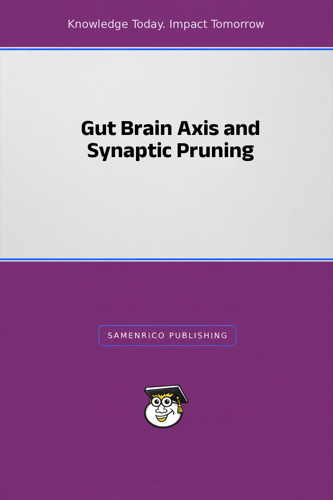
Non-FictionHealth & WellnessSynapses
Gut Brain Axis and Synaptic Pruning eBook
Microbiome affects elimination of unused connectio
by Hook Corrine
Microbiome affects elimination of unused connections.
Formats
Free sample
Chapter 1: The Boy Who Changed--The first time I met Leo, he was building a castle out of blocks. Not a simple stack, mind you—a sprawling fortress with towers, a drawbridge, and a moat defended by plastic dinosaurs. He was three years old, blond hair falling over his eyes, tongue poking out in concentration. His mother, Sarah, watched him with the quiet pride of someone who had spent countless sleepless nights worrying about everything from vaccines to preschool admissions, never imagining that the real threat was already inside her son's body, invisible and silent.Six months later, Leo couldn't build a tower of two blocks. He didn't pretend.
He didn't call for his mother. He didn't make eye contact. Instead, he sat on the floor for hours, spinning the wheel of a toy car, watching it rotate with the same intensity he had once reserved for his dinosaur-manned castle. The diagnosis came quickly: autism spectrum disorder with regression. The doctors told Sarah it was genetic—that Leo was born this way, that it was no one's fault, that early intervention could help but there was no cure.But Sarah couldn't shake the feeling that something had happened.
Something specific. Something she could almost touch if she thought hard enough.She was right.The Question No One Was Asking This book is not about Leo alone. Leo is a doorway. His story opens into a much larger, much stranger, and far more urgent question: What if your gut bacteria are physically remodeling your brain architecture without your consent? Not just influencing your mood through serotonin—everyone has heard that by now.
Not just causing brain fog through inflammation—that's become common knowledge. No, something far more literal, far more structural, far more permanent.What if trillions of microscopic organisms living in your intestines are telling your brain's immune cells which connections to keep and which to destroy? What if the difference between a brain that processes social cues effortlessly and one that finds eye contact agonizing is not a matter of genetics or parenting or environment in the way we've traditionally understood those words—but a matter of which bacteria colonized your gut during the first week of your life?This is the central argument of this book, and I want you to feel its weight before we go any further: You are not born with a finished brain. You are born with a lump of clay, and your gut holds the carving knife.The Collapse of Genetic Determinism For decades, we were told a simple story about brain disorders. Autism, schizophrenia, depression, anxiety—all of these, we were assured, had strong genetic components.
Identical twins, the argument went, share nearly 100% of their DNA. If one identical twin has autism, the other has a 60-90% chance of also having autism. That sounds like a genetic slam dunk.Except it's not. Because if genetics were destiny, that number would be 100%. The fact that it's not—the fact that up to 40% of identical twins can have completely different neurological outcomes despite sharing the same DNA—tells us something profound.
Something is modifying genetic expression. Something is intervening between the blueprint and the finished building.That something, it turns out, is the microbiome.Consider the landmark study from the University of Oregon that I'll explore in detail in Chapter 3. Researchers raised zebrafish larvae in completely sterile conditions—no bacteria whatsoever. These germ-free fish developed brains that were structurally abnormal: dense, messy, overconnected. Their microglia—the brain's resident immune cells—were asleep at the wheel, failing to perform the critical task of synaptic pruning.
Behaviorally, these fish were asocial. They couldn't recognize their peers. They swam in chaotic patterns. They were, in every meaningful sense, neurologically disabled.Then came the rescue experiment. When researchers added bacteria back within the first seven days of life, everything normalized.
Pruning resumed. Social behavior emerged. The fish developed normally. But when they added bacteria after day seven—just one week later—nothing happened. The damage was permanent.
The pruning window had closed.Seven days. That's all it took. Seven days to determine whether a fish would grow up social or asocial, connected or disconnected, capable or disabled.Now ask yourself: What if the same principle applies to humans? What if the first week of your life—or the first month, or the first year—contains a critical window during which your gut bacteria must instruct your microglia to prune your brain's connections, and if that window is missed, the structural damage is permanent?This is not science fiction. This is the cutting edge of neuroscience, immunology, and microbiology converging on a single, radical idea: synaptic pruning is the missing link between gut health and brain health.What This Book Is—And What It Is Not Before we go further, let me be clear about what you're holding.This is not another book about how fermented foods will cure your anxiety.
(They might help, but that's not the point.) This is not a simple guide to "healing your gut" through probiotics and bone broth. (Those interventions have their place, but they're like putting a bandage on a broken bone.) This is not a repackaging of the serotonin-mood connection that has dominated popular gut-brain literature for the past decade.This book is about structure. It is about the physical architecture of your brain—the 100 trillion synapses that connect your neurons, the constant process of destruction and rebuilding that allows you to learn, remember, socialize, and think. It is about the revelation that this architectural process is not controlled solely by your genes or your experiences, but by the trillions of bacteria living in your gut.Most importantly, this book is about windows. Critical developmental windows that open and close before you can speak, before you can remember, before anyone even knows to look.
The pruning that determines your social capacity, your cognitive flexibility, your risk for disorders like autism and schizophrenia—much of it happens in the first days of life and again during adolescence. Miss those windows, and no amount of therapy or medication will fully reopen them.That sounds bleak. I know. But there is hope, and that hope is why I wrote this book.Because if we understand the mechanism—if we understand how the gut tells the brain which synapses to prune—then we can intervene. We can protect the windows before they close.
We can develop biomarkers that identify infants at risk. We can design probiotics that specifically target microglial function. We can repurpose existing drugs to suppress excessive pruning or stimulate deficient pruning.This is not speculative. The research I'll present in these pages—from leading labs at Stanford, Oxford, the University of Oregon, and elsewhere—is already pointing the way. The first clinical trials targeting synaptic pruning in schizophrenia have shown promising results.
The first microbiome-based interventions for autism are being tested. The first blood tests for complement proteins (which I'll explain in Chapter 4) are already available, offering a window into the pruning status of your brain.We are at the beginning of a revolution in how we understand the brain. This book is your map.The Gardeners You Never Knew You Had Let me…
This is the end of the free sample. Get the eBook to keep going. Buy now
About this book
Details
- Author
- Hook Corrine
- Publisher
- SamEnrico
- Language
- English
- Genre
- Non-Fiction, Health & Wellness, Synapses
- Released
- 2026-06-08
- Pages (approx.)
- 129
- Available as
- eBook, Audiobook

Read better in the ZLOADR app
Your eBooks on your phone or tablet. Sign in with your SamEnrico account and start reading.
More by Hook Corrine
 The Micro Conversation HandbookHook Corrine$11.99
 MBSR for LonelinessHook Corrine$11.99
 Stress and Relationship CheckupsHook Corrine$11.99
 The Adze: Ghana's Shape-Shifting Vampire of the NightHook Corrine$11.99
 How to Produce Bathtub AccessoriesHook Corrine$11.99
 HistotechnologyHook Corrine$11.99
 US Bank for Non US CompaniesHook Corrine$12.99
 How to Become a Glass CalibratorHook Corrine$11.99
You may also like
 Hong Kong Handover 1997Dunn Johnnie$11.99
 Zumba For Postnatal Recovery CourseNeal Christian$11.99
 Zumba for BeginnersLadner Nikia$11.99
 YouTube Comment Mining GuideHumes Pandora$12.99
 Worry Box MeditationCarlin Rudy$11.99
 Workplace Stress MeditationNguyen Lynn$11.99
 Workplace Stress and Sleep RepairHawley Ivory$11.99
 Workplace Perfectionism CureDelaney Jeffry$11.99
 Workplace Injustice Anger GuideWallen Isabelle$11.99
 Work Addiction and Burnout LinkGreenwood Ester$11.99
 Women in Yoga and WellnessBeattie Galina$11.99
 Women in Stand Up ComedyChun Evangeline$11.99