
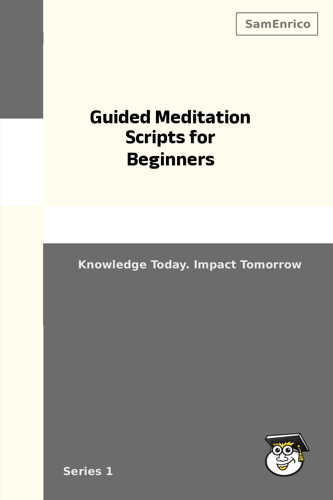
Non-FictionSelf-HelpGuided Practice
Guided Meditation Scripts for Beginners eBook
Follow along with spoken instructions for various
by Peck Takisha
Follow along with spoken instructions for various practice lengths and themes.
Formats
Free sample
Chapter 1: The Permission Pause...--–- You have probably been told, at least once, that meditation is about “clearing your mind.” Maybe a well-meaning friend said it. Maybe a glossy app promised it. Maybe you read it in an article and felt a familiar sinking sensation when you tried it yourself, only to discover that your mind was anything but clear. Within seconds, you were thinking about dinner, that email you forgot to send, the strange noise your car is making, and then — because the mind loves a good spiral — you started thinking about how bad you are at meditating. That thought led to another: Maybe I’m not the kind of person who can do this.If that sounds familiar, I have good news and better news.
The good news is that you are not bad at meditation. The bad news — or rather, the second piece of good news delivered in a different disguise — is that everything you were told about “clearing your mind” is wrong. It is not just unhelpful; it is neurologically impossible. Your brain is designed to generate thoughts the way your heart is designed to pump blood. Expecting silence is like expecting your heart to stop beating.
It will not happen, and if it did, you would be in serious trouble.This chapter is not about teaching you to meditate. Not yet. That would be like handing someone a scalpel on their first day of medical school and saying, “Go ahead, perform surgery.” First, you need to understand the instrument — your own mind — and the one thing that makes guided meditation uniquely effective for modern, overstimulated, perpetually distracted brains. That one thing is the focus of this entire book: the guiding voice.Here is the argument that will frame every script and every practice in the pages ahead. For most of human history, people meditated in silence because they lived in a world without constant interruption.
Their Default Mode Network — the part of the brain responsible for wandering thoughts, self-criticism, and rumination — was not under perpetual assault. Today, your phone buzzes, your email pings, your to-do list scrolls, and your brain has learned to expect a new emergency every ninety seconds. In that environment, silence is not a sanctuary. Silence is a void, and the void is terrifying. The mind fills it with the worst things it can find.A guided meditation gives that frantic, overprotective brain something to do.
It offers a single, evolving focal point — a voice, a breath count, an image, a sensation — that occupies the mind just enough to let the body finally relax. You do not need to silence anything. You just need to follow.The Myth of Silent Mastery Before we go any further, let us name the lie. The lie is that “real” meditation happens in perfect silence, with a perfectly straight spine, a perfectly empty mind, and ideally, a perfectly aesthetic sunrise in the background. This image sells millions of yoga mats and meditation cushions, but it has also kept countless people from ever starting.
They try the silent approach, fail within three minutes, and conclude that they are broken.You are not broken. You are normal.In fact, the brain’s tendency to wander is not a flaw — it is a feature. Neuroscientists call it the Default Mode Network (DMN) . This is a collection of brain regions that become active when you are not focused on an external task. The DMN is responsible for self-referential thought, autobiographical memory, planning, and — yes — worrying.
It is the part of you that rehearses past conversations, imagines future disasters, and compares your insides to other people’s outsides. The DMN is not your enemy. It is your survival mechanism. It kept your ancestors alert to predators. It reminds you to pay your bills.
It processes your grief.The problem is that the DMN never stops. And in the absence of anything to do — in the void of silence — it works overtime.Research using functional MRI scans has shown that the DMN is more active during silent rest than during almost any other state. When you tell yourself to “clear your mind,” you are essentially asking the brain’s most active network to shut down. That is like telling your heart to stop. It will rebel.
And then you will feel like a failure.A guided meditation works differently. It gives the DMN a gentle task. Instead of wandering aimlessly, the brain follows the voice. Instead of generating its own catastrophic scenarios, it listens to a script. Instead of spinning in circles, it moves through a structured arc: induction, body scan, main content, return.
The DMN is not silenced — it is occupied. And that makes all the difference.The Three Pillars of Following a Voice If guided meditation is simply the act of following a voice, then your job is not to “meditate” in the traditional sense. Your job is to listen. That is it. You do not need to evaluate, analyze, or improve.
You just need to point your attention toward the sound of the words and let the rest of your brain do what it naturally does: relax into a single channel.To make that as easy as possible, this book is built on three foundational pillars. Master these, and every script in the remaining chapters will work for you, whether you have five minutes or twenty-five, whether you are sitting on a cushion or stuck in traffic.Pillar One: Posture (The Body’s Message to the Brain)Your posture is not arbitrary. It is a direct signal to your nervous system. Sit slumped forward with your head hanging low, and your brain will interpret that as exhaustion or defeat. Perch on the edge of a chair with your muscles braced for action, and your brain will prepare for a threat.
Neither is ideal for meditation, but neither is wrong — they are just signals. The goal is to choose a posture that sends the signal you actually want to send: I am safe. I am awake. I am ready to rest with attention.This book uses two primary postures, each suited to different practices.The Dignified Slump (Seated Alertness)This is your default posture for daytime meditations: breath awareness, body scans, compassion practices, and letting-go work. Sit on a firm cushion or a straight-backed chair.
If you are using a chair, place your feet flat on the floor, hip-width apart. If you are using a cushion, cross your legs comfortably or kneel on a small bench. Now, imagine a string pulling the crown of your head gently toward the ceiling. Your spine lengthens, but it does not go rigid. Your shoulders soften and drop away from your ears.
Your chin tucks slightly — not so much that you are looking at the floor, but just enough to align the back of your neck with your upper spine.This is the “dignified slump.” The spine is upright enough to keep you alert, but the muscles are not locked in place. You are not a soldier at attention. You are a person resting with dignity.The Soldier Pose (Supine for Sleep)This posture is reserved exclusively for sleep meditations (Chapter 7) and, occasionally, for…
This is the end of the free sample. Get the eBook to keep going. Buy now
About this book
Details
- Author
- Peck Takisha
- Publisher
- SamEnrico
- Language
- English
- Genre
- Non-Fiction, Self-Help, Guided Practice
- Released
- 2026-06-06
- Pages (approx.)
- 135
- Available as
- eBook, Audiobook

Read better in the ZLOADR app
Your eBooks on your phone or tablet. Sign in with your SamEnrico account and start reading.
More by Peck Takisha
 Relationship Priority GuidePeck Takisha$11.99
 Sexual Integrity PrimerPeck Takisha$11.99
 Self Compassion Metta HandbookPeck Takisha$11.99
 Self Hypnosis for Assertiveness HabitsPeck Takisha$11.99
 Iron Tracks to Victory: The Railroad That Won World War IIPeck Takisha$11.99
 Echoes in the Abyss: The Grand Canyon of Africa’s Forgotten MappersPeck Takisha$11.99
 Grass HarvestingPeck Takisha$11.99
 Community Churn ReductionPeck Takisha$12.99
 Nonprofit Insurance CompliancePeck Takisha$12.99
 Understanding Deafness Nonsyndromic, Connexin 26 LinkedPeck Takisha$17.99
 How to Become a Jacquard-plate MakerPeck Takisha$11.99
You may also like
 Hong Kong Handover 1997Dunn Johnnie$11.99
 Zumba For Postnatal Recovery CourseNeal Christian$11.99
 Zumba for BeginnersLadner Nikia$11.99
 YouTube Comment Mining GuideHumes Pandora$12.99
 Worry Box MeditationCarlin Rudy$11.99
 Workplace Stress MeditationNguyen Lynn$11.99
 Workplace Stress and Sleep RepairHawley Ivory$11.99
 Workplace Perfectionism CureDelaney Jeffry$11.99
 Workplace Injustice Anger GuideWallen Isabelle$11.99
 Work Addiction and Burnout LinkGreenwood Ester$11.99
 Women in Yoga and WellnessBeattie Galina$11.99
 Women in Stand Up ComedyChun Evangeline$11.99