
Non-FictionFirst 30 DaysTax Registration
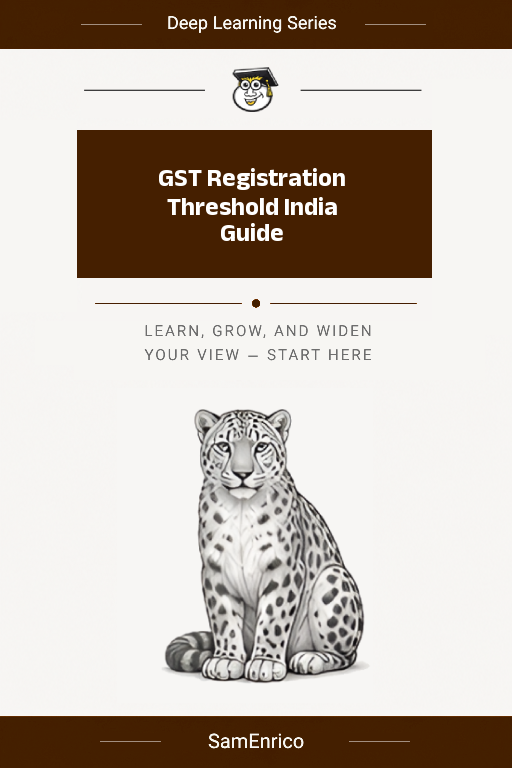
GST Registration Threshold India Guide
Check if your business needs GST registration in I
by Russo Alane
Check if your business needs GST registration in India. Register when annual turnover exceeds 20 lakh or 10 lakh in special category states.
Formats
About this book
Free sample
Chapter 1: The Mixed Supply Trap...--–- Most business owners believe the GST registration threshold is simple. They think: "My turnover is ₹35 lakhs, the threshold is ₹40 lakhs for goods, so I am safe." This belief has ruined thousands of small businesses. In 2023 alone, over 12,000 notices were issued to MSMEs who crossed the threshold without realizing it – not because they hid their income, but because they misunderstood which threshold applied to them. The difference between ₹20 lakhs and ₹40 lakhs is not just a number. It is the difference between sleeping peacefully at night and facing a demand notice for ₹7 lakhs with 100% penalty.Take the case of Meera Sharma, who ran a small catering business in Pune.
She also sold packaged spices online as a side business. Her total turnover was ₹38 lakhs – well below the ₹40 lakhs goods threshold, she thought. She never registered. Two years later, a GST officer knocked on her door. The department had done a data match between her spice sales on Amazon and her catering income.
Their assessment? She had crossed the ₹20 lakhs service threshold in the first year itself because her principal supply was catering (a service), and the spice sales were merely incidental. The demand: ₹6.8 lakhs tax, ₹6.8 lakhs penalty, plus 18% interest. Total: over ₹15 lakhs. Her business shut down within six months.This chapter is the first line of defense against such disasters.
It will teach you exactly how to determine which threshold applies to your business – not by guessing, but by applying the legal framework of "mixed supply" and "principal supply" that the GST department uses in its assessments.The Three Numbers That Changed Indian Business When GST was introduced on July 1, 2017, the government created a threshold system to protect small businesses. The logic was simple: if your business is very small, you don't need to register, file returns, or collect tax. You are exempt. But the government also recognized that different types of businesses have different cost structures and different abilities to comply.Thus, three thresholds emerged:First, the general threshold of ₹20 lakhs applies to businesses that predominantly supply services. This includes consultants, freelancers, restaurants…
This is the end of the free sample. Get the eBook to keep going. Buy now
Contents
- Chapter 1
- Chapter 2
- Chapter 3
- Chapter 4
- Chapter 5
- Chapter 6
- Chapter 7
- Chapter 8
- Chapter 9
- Chapter 10
- Chapter 11
- Chapter 12
Details
- Author
- Russo Alane
- Publisher
- SamEnrico
- Language
- English
- Genre
- Non-Fiction, First 30 Days, Tax Registration
- Released
- 2026-06-03
- Pages (approx.)
- 149
- Available as
- eBook, Audiobook

Read better in the ZLOADR app
Your eBooks on your phone or tablet. Sign in with your SamEnrico account and start reading.
More by Russo Alane
 Upwork Freelance Business PlanRusso Alane$11.99
 Ketamine for Depression GuideRusso Alane$11.99
 Career Transition for Tech WorkersRusso Alane$11.99
 Child Star Complete AnthologyRusso Alane$11.99
 Iraq War F18 PilotRusso Alane$11.99
 Seasonal Energy PlanningRusso Alane$11.99
 Luftwaffe Radar CountermeasuresRusso Alane$11.99
 Citation Rules for Editions and VolumesRusso Alane$11.99
 Resentment Toward SiblingsRusso Alane$11.99
 The Silk and the Spy: A Forbidden Love in the Age of ImperialismRusso Alane$11.99
 The Last Voyage of the Mary Celeste: A Ghost Ship's Memory MapRusso Alane$11.99
 The Last Oracle of the Andes: The Hidden Prophecies of the ChasquiRusso Alane$11.99
You may also like
 Hong Kong Handover 1997Dunn Johnnie$11.99
 Zumba For Postnatal Recovery CourseNeal Christian$11.99
 Zumba for BeginnersLadner Nikia$11.99
 YouTube Comment Mining GuideHumes Pandora$12.99
 Worry Box MeditationCarlin Rudy$11.99
 Workplace Stress MeditationNguyen Lynn$11.99
 Workplace Stress and Sleep RepairHawley Ivory$11.99
 Workplace Perfectionism CureDelaney Jeffry$11.99
 Workplace Injustice Anger GuideWallen Isabelle$11.99
 Work Addiction and Burnout LinkGreenwood Ester$11.99
 Women in Yoga and WellnessBeattie Galina$11.99
 Women in Stand Up ComedyChun Evangeline$11.99