
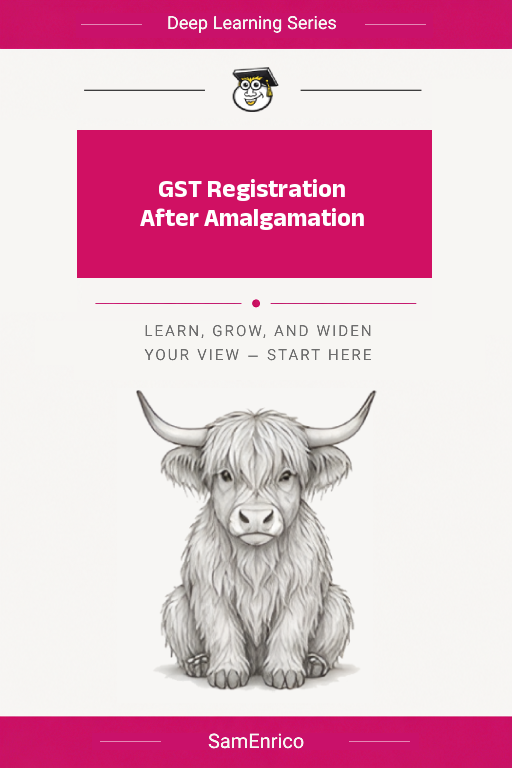
Non-FictionFirst 30 DaysAmalgamation
GST Registration After Amalgamation
Apply for new GST registration after business merg
Apply for new GST registration after business merger, demerger, or change in constitution.
Formats
About this book
Free sample
Chapter 1: The 30-Day Trap--Every year, hundreds of Indian companies walk into a compliance trap that costs them crores in lost Input Tax Credit, late fees, and litigation. They follow the merger documents carefully. They get the High Court order. They file the forms with the Registrar of Companies. And then, thirty days later, they discover that their GST registration is technically invalid, their ITC has vanished, and the tax officer is asking uncomfortable questions.The trap is simple.
It is hidden in plain sight within Section 22(4) of the CGST Act. And almost nobody understands it fully until it is too late.This book exists because that trap is avoidable. In fact, with the right knowledge, a business merger or demerger can be a seamless GST event – no lost credit, no penalty notices, no midnight panic about whether the transferor's past liabilities will bankrupt the surviving entity.But to avoid the trap, you must first understand it. And to understand it, you must start at the very beginning: what exactly happens under GST when two businesses become one?The Simple Question That Starts Everything Imagine you own a manufacturing company in Pune. Your group also owns a distribution company in Mumbai.
After years of operating separately, the board decides to merge the two. The manufacturing entity will dissolve into the distribution entity. One company, two locations, one GST future.On the day the High Court approves the merger, what happens to your GST registration?Most people assume the answer is straightforward: the manufacturing company's GSTIN gets cancelled, and the distribution company continues as before. That assumption is wrong. Dangerously wrong.Under the GST framework, the moment a merger becomes effective, the transferee – the company that survives – is required to apply for a fresh registration.
Not an amendment. Not a simple update. A new registration application, with all the documentation, verification, and waiting periods that entails.Section 22(4) of the CGST Act states this explicitly: "Where a person who is liable to take a registration under this Act transfers his business to another person as a result of sale, merger, demerger, amalgamation, lease…
This is the end of the free sample. Get the eBook to keep going. Buy now
Contents
- Chapter 1
- Chapter 2
- Chapter 3
- Chapter 4
- Chapter 5
- Chapter 6
- Chapter 7
- Chapter 8
- Chapter 9
- Chapter 10
- Chapter 11
- Chapter 12
Details
- Author
- Marshall Jaime
- Publisher
- SamEnrico
- Language
- English
- Genre
- Non-Fiction, First 30 Days, Amalgamation
- Released
- 2026-06-01
- Pages (approx.)
- 146
- Available as
- eBook, Audiobook

Read better in the ZLOADR app
Your eBooks on your phone or tablet. Sign in with your SamEnrico account and start reading.
More by Marshall Jaime
 Body Image for Facial Hair WomenMarshall Jaime$11.99
 Emotional Envy RegulationMarshall Jaime$11.99
 Craving Survival KitMarshall Jaime$11.99
 Charity Fundraising PersuasionMarshall Jaime$11.99
 Silverstone British GP GuideMarshall Jaime$11.99
 Murder on Social MediaMarshall Jaime$11.99
 Divorce Post Traumatic GrowthMarshall Jaime$11.99
 Mendeleev Periodic Table PredictionsMarshall Jaime$11.99
 Love Letters from the Silver Screen: The Wartime Romance That Won the OscarMarshall Jaime$11.99
 The Enchanted Scores: Erich Wolfgang Korngold and the Birth of Hollywood's Golden AgeMarshall Jaime$11.99
 How to Produce Food Mixers and BlendersMarshall Jaime$11.99
 Understanding AgraphiaMarshall Jaime$17.99
You may also like
 Hong Kong Handover 1997Dunn Johnnie$11.99
 Zumba For Postnatal Recovery CourseNeal Christian$11.99
 Zumba for BeginnersLadner Nikia$11.99
 YouTube Comment Mining GuideHumes Pandora$12.99
 Worry Box MeditationCarlin Rudy$11.99
 Workplace Stress MeditationNguyen Lynn$11.99
 Workplace Stress and Sleep RepairHawley Ivory$11.99
 Workplace Perfectionism CureDelaney Jeffry$11.99
 Workplace Injustice Anger GuideWallen Isabelle$11.99
 Work Addiction and Burnout LinkGreenwood Ester$11.99
 Women in Yoga and WellnessBeattie Galina$11.99
 Women in Stand Up ComedyChun Evangeline$11.99