
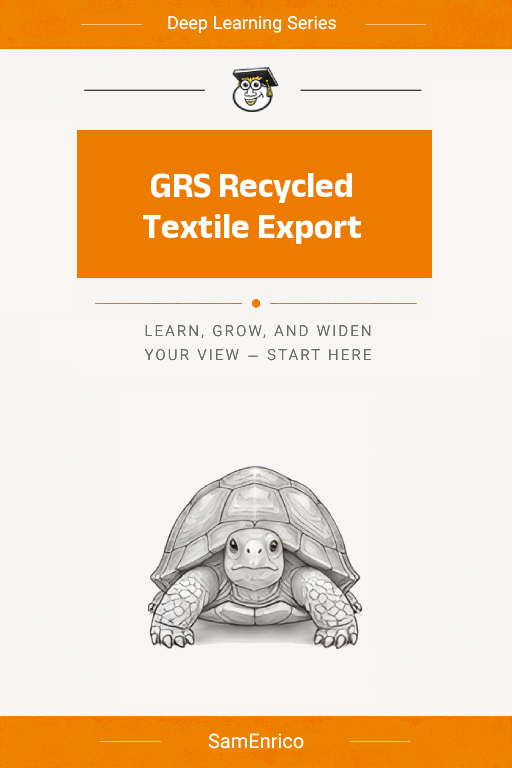
GRS Recycled Textile Export
Certify recycled content in textile exports with G
Certify recycled content in textile exports with Global Recycled Standard for European fashion brands.
Formats
About this book
Free sample
Chapter 1: The Four Pillars--–- The first time Minh opened the email from her German buyer, she thought it was a mistake. The subject line read: “Contract Termination – GRS Non-Compliance.” She had spent six months and nearly $40,000 preparing for the Global Recycled Standard audit. Her factory in Ho Chi Minh City had passed. The certificate hung on her wall. Yet here was a cancellation notice for a €1.2 million order of recycled polyester fleece, already cut and sitting in her warehouse.
The reason? Her material had only 48 percent recycled content. Not 50. She could not use the GRS logo. And without the logo, the brand could not market the product as sustainable.
The fabric was, for all practical purposes, dead stock.That morning taught Minh something that this book will teach you in the next three hundred pages: GRS is not a checklist. It is a strategy. And if you do not understand the four pillars and the hidden rules that govern them, you will lose money, waste time, and watch your containers get rejected at the port of Rotterdam. This chapter is the foundation. Read it twice.The Four Pillars: More Than a Badge The Global Recycled Standard is often described as a certification for recycled content.
That is like describing a car as a device for turning a steering wheel. Technically true. Practically useless. GRS is actually four distinct standards stacked inside a single audit. Textile Exchange, the organization that owns GRS, calls them “requirements.” This book calls them pillars because if any one crumbles, the entire structure collapses.Pillar One: Recycled Content.
This is the most visible pillar. It requires that a product contains at least 20 percent recycled material to be certified at all, and at least 50 percent to carry the GRS logo. But here is where most exporters stumble: the percentage is calculated by weight, excluding water, solvents, and other processing inputs. If you are blending recycled polyester with virgin polyester, the calculation seems simple. But if you are adding elastane, dyes, or finishes, the math becomes treacherous.
One Chinese spinner we worked with lost its certification because it calculated recycled content on finished fabric weight including moisture…
This is the end of the free sample. Get the eBook to keep going. Buy now
Contents
- Chapter 1
- Chapter 2
- Chapter 3
- Chapter 4
- Chapter 5
- Chapter 6
- Chapter 7
- Chapter 8
- Chapter 9
- Chapter 10
- Chapter 11
- Chapter 12
Details
- Author
- Shearer Lashunda
- Publisher
- SamEnrico
- Language
- English
- Genre
- Non-Fiction, Business Brief, GRS
- Released
- 2026-06-01
- Pages (approx.)
- 147
- Available as
- eBook, Audiobook

Read better in the ZLOADR app
Your eBooks on your phone or tablet. Sign in with your SamEnrico account and start reading.
More by Shearer Lashunda
 Gibberish Translator GameShearer Lashunda$11.99
 Overcoming Social IsolationShearer Lashunda$11.99
 Medication Management for SeniorsShearer Lashunda$11.99
 Teen Sleep Meditation GuideShearer Lashunda$11.99
 Essay Exam Outline First MethodShearer Lashunda$11.99
 Irregular Periods PerimenopauseShearer Lashunda$11.99
 Cree Summer Different VoicesShearer Lashunda$11.99
 Morning Routine for ArtistsShearer Lashunda$11.99
 Whispers of Defiance: Love and Rebellion in the Sepoy MutinyShearer Lashunda$11.99
 Bubble Burst: The Phantom Mortgages of 2007Shearer Lashunda$11.99
 PGWP Part Time Semester PenaltyShearer Lashunda$12.99
 How to Produce Vehicle EquipmentShearer Lashunda$11.99
You may also like
 Hong Kong Handover 1997Dunn Johnnie$11.99
 Zumba For Postnatal Recovery CourseNeal Christian$11.99
 Zumba for BeginnersLadner Nikia$11.99
 YouTube Comment Mining GuideHumes Pandora$12.99
 Worry Box MeditationCarlin Rudy$11.99
 Workplace Stress MeditationNguyen Lynn$11.99
 Workplace Stress and Sleep RepairHawley Ivory$11.99
 Workplace Perfectionism CureDelaney Jeffry$11.99
 Workplace Injustice Anger GuideWallen Isabelle$11.99
 Work Addiction and Burnout LinkGreenwood Ester$11.99
 Women in Yoga and WellnessBeattie Galina$11.99
 Women in Stand Up ComedyChun Evangeline$11.99