
Non-FictionBusiness BriefEmail Marketing
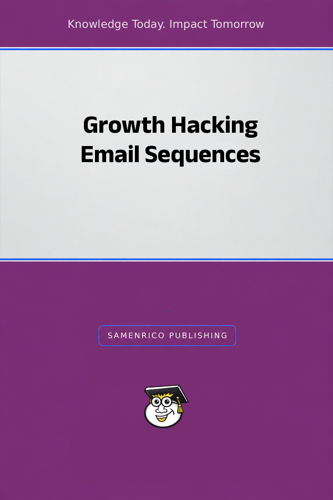
Growth Hacking Email Sequences eBook
Automate lifecycle campaigns that nurture leads fr
by Huntley Amie
Automate lifecycle campaigns that nurture leads from signup to purchase.
Formats
Free sample
Chapter 1: The Hidden Funnel--–- Every email marketer has felt it. That quiet, sinking realization three days into a “perfectly crafted” drip campaign. You open your analytics dashboard, and the numbers stare back like a bad review. Opens are down. Clicks are lower.
Unsubscribes are climbing. And somewhere in your CRM, a lead who downloaded your best whitepaper six weeks ago just marked your eleventh follow-up as spam.You did everything right. You wrote clever subject lines. You personalized the greetings. You followed the “best practices” from every blog post and webinar.
And still, nothing works.The problem isn’t your writing. It isn’t your offer. And it isn’t that your audience hates you.The problem is that you’re still thinking in campaigns.For the past twenty years, email marketing has been built on a fundamentally broken model: the batch-and-blast. You gather a list. You write a message.
You pick a date. You hit send. Then you wait, hoping that enough people open, click, and buy to justify the hours you spent.But here is the truth that the software vendors won’t tell you and the gurus conveniently forget: batch-and-blast email is a lottery. You might win sometimes. Most of the time, you lose.
And the losses are not random. They are structural.This book exists because a better way has emerged. Not a tweak. Not a hack. A complete re-architecture of how email interacts with the customer lifecycle.
It is called the Adaptive Inbox—a system where every message is triggered by behavior, not a calendar. Where sequences branch, pause, accelerate, and die based on what the customer actually does. Where you stop sending “just checking in” emails to people who already bought and start sending exactly what each lead needs, exactly when they need it.But before we build that system, we have to understand why the old one failed. And to understand that, we need to talk about the hidden funnel—the gap between what your analytics say and what your customers are actually doing.The 95 Percent Illusion Here is a number that should terrify you: ninety-five percent of your cold leads are not ready to buy today.Not five percent. Not fifty percent.
Ninety-five.That statistic comes from aggregated data across more than four thousand B2B and B2C companies studied over a five-year period by the research firm Marketing Sherpa. The number has remained remarkably stable across industries, price points, and audience sizes. Whether you sell fifty-dollar subscription boxes or fifty-thousand-dollar enterprise software, roughly nineteen out of every twenty people who enter your funnel for the first time will not convert on their first visit, or their second, or their tenth.They are not rejecting you. They are not ignoring you. They are simply not ready.Yet most email marketing behaves as if the opposite were true.
We build sequences assuming that leads are waiting, eager, and just one clever subject line away from pulling out their credit cards. We send email two three days after email one. Email three three days after that. We call it a “nurture sequence,” but it is really just a calendar with a goal.Consider a typical Saa S company. A prospect signs up for a free trial.
The marketing automation system immediately enrolls them in a fourteen-day drip: Day 1 welcome, Day 2 feature highlight, Day 3 customer story, Day 4 pricing, Day 5 limited-time offer, Day 6 case study, Day 7 “last chance,” Day 8… you know the rest.But what happens if that prospect logs in on Day 2, explores every feature, and hits their “aha moment” ahead of schedule? The drip keeps sending. Day 3’s “here’s how to get started” email arrives after they have already mastered the product. Day 5’s pricing email comes after they already signed up for a paid plan. The system is not adaptive.
It is mechanical. It does not see what the customer did. It only sees where the calendar says they should be.That is the hidden funnel. Your customers are moving through their own journey—fast, slow, sideways, backwards—while your emails march forward on a schedule they never agreed to.The ROI Lie You’ve Been Told Email marketing has an ROI problem. But not the one you think.The widely repeated statistic is that email generates thirty-six dollars for every dollar spent.
That number comes from a 2019 Data & Marketing Association report and has been recycled endlessly by every ESP, agency, and Linked In influencer. It is not wrong, exactly. It is just misleading.That thirty-six-to-one return is an average. And averages hide enormous variation. The top quartile of email programs generate returns closer to fifty-to-one.
The bottom quartile generate returns below ten-to-one. The difference is not luck. The difference is lifecycle automation versus batch-and-blast.Here is the data that matters: companies using behavioral triggers (sequences that start based on what a lead does, not when they signed up) see conversion rates two to four times higher than companies using only time-based drips. According to a 2022 study by Omnisend that analyzed 1.2 billion emails across five thousand brands, triggered emails had an average open rate of 49.3 percent compared to 18.2 percent for standard bulk campaigns. Click-through rates were nearly triple.But open rates are vanity metrics.
Let’s talk about revenue.The same study found that abandoned cart emails alone recover an average of 11.7 percent of lost sales. Welcome sequences generate 320 percent more revenue per email than standard newsletters. And post-purchase sequences (which most brands ignore entirely) produce an average lift in customer lifetime value of forty-three percent.So why isn’t everyone doing this?Because behavioral automation requires thinking differently. It requires mapping your customer’s actual journey instead of the journey you wish they would take. It requires admitting that your email schedule does not control your customer’s readiness.
And it requires building systems that adapt, which takes more time upfront than setting up a simple drip.The brands that do this work capture the thirty-six-to-one return. The brands that don’t drag down the average. Which side of that average do you want to be on?The Cost of Rigidity (A Short Horror Story)Let me tell you about a company I consulted with several years ago. Let us call them Lead Flow (not their real name, but close enough). Lead Flow sold project management software to mid-sized agencies.
They had a list of forty-three thousand leads. They were doing everything “right.” Weekly newsletters. Monthly webinars. A thirteen-email drip campaign for new signups. And their conversion rate from lead to customer was stuck at 1.8 percent.I asked to see their automation logic.
They showed me a beautiful, complex workflow with more than forty conditional branches. It looked impressive. But when I dug into the conditions, I found the problem.Every branch was time-based.After seven days, send this. After fourteen days, send that. After twenty-one days, if no open, send this other thing.
The system had no idea what the leads were actually doing. It only knew how many days had passed since they entered the sequence.I pulled their raw CRM data for the previous ninety days. What I found was a horror show of misaligned messages.One lead…
This is the end of the free sample. Get the eBook to keep going. Buy now
About this book
Details
- Author
- Huntley Amie
- Publisher
- SamEnrico
- Language
- English
- Genre
- Non-Fiction, Business Brief, Email Marketing
- Released
- 2026-06-08
- Pages (approx.)
- 148
- Available as
- eBook, Audiobook

Read better in the ZLOADR app
Your eBooks on your phone or tablet. Sign in with your SamEnrico account and start reading.
More by Huntley Amie
 Brand Ranking Momentum FrameworkHuntley Amie$11.99
 The Two Term MayorHuntley Amie$11.99
 Harvard Extension vs LSE Student ClubsHuntley Amie$11.99
 The Silk Road's Forgotten Diplomat: How a 13th-Century Envoy Shaped the Modern WorldHuntley Amie$11.99
 The Silent Reaper: How a Nurse Turned Hospice into a Killing FieldHuntley Amie$11.99
 How to Start a Cases for Musical Instruments (not Wooden) Business (Beginners Guide)Huntley Amie$11.99
 Startup Exit Readiness WorkbookHuntley Amie$12.99
 Payment Issuer Outlook 2030Huntley Amie$12.99
 Technical Implementation SpecialistHuntley Amie$11.99
 Understanding Hydrops Ectrodactyly SyndactylyHuntley Amie$17.99
You may also like
 Hong Kong Handover 1997Dunn Johnnie$11.99
 Zumba For Postnatal Recovery CourseNeal Christian$11.99
 Zumba for BeginnersLadner Nikia$11.99
 YouTube Comment Mining GuideHumes Pandora$12.99
 Worry Box MeditationCarlin Rudy$11.99
 Workplace Stress MeditationNguyen Lynn$11.99
 Workplace Stress and Sleep RepairHawley Ivory$11.99
 Workplace Perfectionism CureDelaney Jeffry$11.99
 Workplace Injustice Anger GuideWallen Isabelle$11.99
 Work Addiction and Burnout LinkGreenwood Ester$11.99
 Women in Yoga and WellnessBeattie Galina$11.99
 Women in Stand Up ComedyChun Evangeline$11.99