
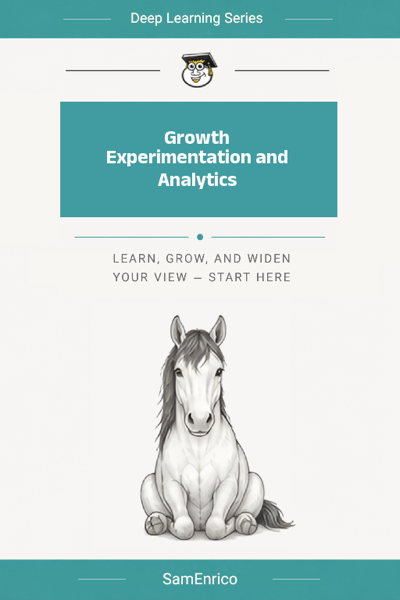
Non-FictionInformativeEducational
Growth Experimentation and Analytics eBook
A Coursebook on Growth Experimentation and Analyti
A Coursebook on Growth Experimentation and Analytics
Formats
Free sample
Chapter 1: The Certainty Illusion...-- The email arrived at 11:47 PM on a Tuesday. Sarah, the founder of a fast-growing Saa S company called Lumina, had just closed her laptop when her phone buzzed. It was her head of marketing. The campaign they had spent 200,000on—sixweeksofwork,fourdesigners,twocopywriters,andaveryexpensivevideoproductionagency—hadlaunchedthatmorning.Theheadlineread:"Lumina’s Biggest Launch Ever."Theteamhadcelebratedwithchampagneat10AM.By11PM,theclickthroughratehadcrateredto0.3percent.Thecostperacquisitionwashoveringaround200,000 on — six weeks of work, four designers, two copywriters, and a very expensive video production agency — had launched that morning. The headline read: "Lumina’s Biggest Launch Ever." The team had celebrated with champagne at 10 AM.
By 11 PM, the clickthrough rate had cratered to 0.3 percent. The cost per acquisition was hovering around 200,000on—sixweeksofwork,fourdesigners,twocopywriters,andaveryexpensivevideoproductionagency—hadlaunchedthatmorning.Theheadlineread:"Lumina’s Biggest Launch Ever."Theteamhadcelebratedwithchampagneat10AM.By11PM,theclickthroughratehadcrateredto0.3percent.Thecostperacquisitionwashoveringaround287. Their average customer paid $49 per month. At that rate, it would take nearly six months of subscription revenue to recover the cost of acquiring a single user — assuming the user didn't cancel first, which, historically, half of them did within 90 days. Sarah stared at the screen.
She had done everything right. She had hired the best agency. She had followed the playbook. She had "sprayed and prayed"—spraying money across channels and praying that something would stick. And now, she was watching her runway shrink in real time.This is not a story about failure.
It is a story about a broken belief system.The belief system goes like this: growth is a creative act. The best campaigns win. The cleverest copy converts. The most beautiful designs attract the most users. If you fail, you simply didn't try hard enough, or you didn't hire the right agency, or you didn't have enough budget.
This belief system is pervasive. It is taught in marketing seminars. It is reinforced by case studies of unicorn startups that seem to have stumbled into explosive growth through sheer genius. And it is catastrophically wrong.What Sarah did not yet know — what this book will teach you, chapter by chapter — is that growth is not a creative act. It is a scientific one.
And the difference between those two words is the difference between burning $200,000 on a Tuesday night and building a predictable, scalable, repeatable engine that turns uncertainty into certainty.Welcome to the end of guessing.The Law of Shitty Clickthroughs There is an uncomfortable truth that every experienced growth professional learns, usually after a humiliating failure. It is called, unofficially, the Law of Shitty Clickthroughs. First observed by Andrew Chen, a venture capitalist and former growth lead, the law states: All marketing strategies decay over time. What works today will stop working tomorrow. Not because you did anything wrong.
Not because your agency dropped the ball. But because audiences adapt. The banner ad that got a 5 percent clickthrough rate in 1999 now gets 0.05 percent. The email subject line that worked last month is now ignored. The Facebook ad that generated a 3x return on ad spend six weeks ago now breaks even — or worse, loses money.The law is not a bug.
It is a feature of human psychology. Humans are pattern-recognition machines. When we see the same stimulus repeatedly, we stop noticing it. Advertisers call this "banner blindness." Neuroscientists call it "habituation." Whatever you call it, the effect is the same: your clever campaign has an expiration date. And most of the time, you won't know when that date arrives until you have already spent the money.Here is what Sarah learned the next morning, after she stopped panicking and started looking at the data.
Her team had run the exact same campaign structure — same channels, same creative formats, same targeting — for four consecutive quarters. The first quarter, it worked beautifully. Cost per acquisition was 42.Returnonadspendwas3.4x.Everyonewashappy.Thesecondquarter,performancedroppedto42. Return on ad spend was 3.4x. Everyone was happy.
The second quarter, performance dropped to 42.Returnonadspendwas3.4x.Everyonewashappy.Thesecondquarter,performancedroppedto78 CPA and 1.9x ROAS. The team blamed seasonality. The third quarter, 143CPAand1.1x ROAS.Theteamblamedthenewcompetitorthathadenteredthemarket.Thefourthquarter,143 CPA and 1.1x ROAS. The team blamed the new competitor that had entered the market. The fourth quarter, 143CPAand1.1x ROAS.Theteamblamedthenewcompetitorthathadenteredthemarket.Thefourthquarter,287 CPA and 0.6x ROAS.
There was no one left to blame. The campaign had simply rotted.The Law of Shitty Clickthroughs had claimed another victim.But here is the deeper problem, the one that keeps growth leaders awake at night. The law is predictable. You know it will happen. You just don't know when.
And most organizations respond to this unpredictability by doing exactly what Sarah did: they double down. They assume that the strategy that worked before just needs more budget, more creative, more optimization. They treat the symptom (falling performance) instead of the cause (a fundamentally broken approach to growth).The Scientific Method as Antidote There is an alternative. It is not new. It is not sexy.
It does not appear in marketing blogs that promise "10x growth overnight." But it works. It has worked for centuries. It is the Scientific Method, and it is the single most powerful tool ever devised for separating truth from fiction, signal from noise, and what actually works from what we merely hope will work.The Scientific Method, in its simplest form, consists of four steps: Hypothesis, Test, Analyze, Iterate or Reject. That is it. Four steps.
But within those four steps lies the entire difference between gambling and growing.Let us translate this into the language of growth. A hypothesis is not a guess. It is a falsifiable statement about cause and effect. You are not saying, "I think this campaign will work." You are saying, "I believe that changing X for segment Y will cause Z behavior, and I will know I am right when I see a specific metric improve by a specific amount." A test is not a launch. It is a controlled comparison between a new variant (the treatment) and an existing baseline (the control).
You cannot claim to have run an experiment if you cannot answer the question: "Compared to what?" An analysis is not a dashboard. It is a rigorous statistical determination of whether the observed difference between treatment and control could have happened by random chance. And iterate or reject is not a judgment on your worth as a marketer. It is a simple binary: either the hypothesis survived the test (iterate, meaning run another test to refine further), or it did not (reject, meaning discard that hypothesis and move to the next one).This sounds simple. It is simple.
But it is not easy. The reason most organizations fail at growth is not that they lack intelligence or creativity or budget. It is that they confuse activity with experimentation. They launch features, campaigns, and products — and then they declare victory or defeat based on incomplete data, emotional attachment, or the loudest voice in the room. They do not run experiments.
They run gambles dressed up as strategy.Action Versus Experiment: The Crucial Distinction Let us draw this distinction sharply, because it will save you millions of dollars.An action is anything you do that you do not measure against a controlled baseline. Launching a new homepage is an action. Sending an email to your entire list…
This is the end of the free sample. Get the eBook to keep going. Buy now
About this book
Details
- Author
- Ocampo Francine
- Publisher
- SamEnrico
- Language
- English
- Genre
- Non-Fiction, Informative, Educational
- Released
- 2026-05-11
- Pages (approx.)
- 149
- Available as
- eBook, Audiobook

Read better in the ZLOADR app
Your eBooks on your phone or tablet. Sign in with your SamEnrico account and start reading.
More by Ocampo Francine
 Seller Note Terms RegistryOcampo Francine$11.99
 Parental Addiction and ArtOcampo Francine$11.99
 Social Media and Self Esteem WorkbookOcampo Francine$11.99
 FODMAP Stacking Awareness GuideOcampo Francine$11.99
 Bariatric Surgery Food Log CourseOcampo Francine$11.99
 The Last Telegram: How a Single Message Changed WWIIOcampo Francine$11.99
 The Firewalkers of the Pacific: Taming the Volcanic Wrath of the AncientsOcampo Francine$11.99
 How to Become a InletterOcampo Francine$11.99
 Understanding Cataract CardiomyopathyOcampo Francine$17.99
 Proposal Budget Justification GuideOcampo Francine$12.99
 Business Credit Repair TimelineOcampo Francine$12.99
You may also like
 Hong Kong Handover 1997Dunn Johnnie$11.99
 Zumba For Postnatal Recovery CourseNeal Christian$11.99
 Zumba for BeginnersLadner Nikia$11.99
 YouTube Comment Mining GuideHumes Pandora$12.99
 Worry Box MeditationCarlin Rudy$11.99
 Workplace Stress MeditationNguyen Lynn$11.99
 Workplace Stress and Sleep RepairHawley Ivory$11.99
 Workplace Perfectionism CureDelaney Jeffry$11.99
 Workplace Injustice Anger GuideWallen Isabelle$11.99
 Work Addiction and Burnout LinkGreenwood Ester$11.99
 Women in Yoga and WellnessBeattie Galina$11.99
 Women in Stand Up ComedyChun Evangeline$11.99