
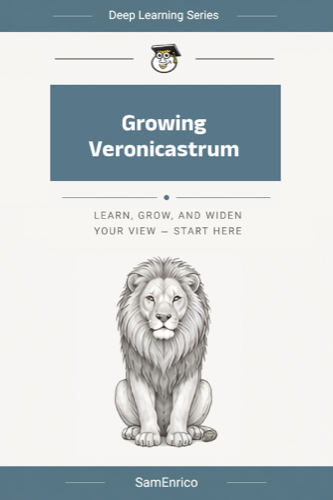
Non-FictionInformativeEducational
Growing Veronicastrum
This publication, published by SamEnrico, covers G
This publication, published by SamEnrico, covers Growing Veronicastrum
Formats
About this book
Free sample
Chapter 1: The Forgotten Giant...–- Every great garden has its exclamation points. The plants that stop your eye, pull it upward, and anchor everything around them. For most gardeners, these are delphiniums (too fussy), foxgloves (biennial, short-lived), or lupines (slug magnets). But there is another way. A native perennial that stands six feet tall without a single stake, blooms for ten weeks straight, feeds over twenty species of bees at once, and asks almost nothing in return.
And yet, incredibly, most gardeners have never heard of it.This is the story of Veronicastrum—a genus so overlooked that it doesn’t even have a decent common name. “Culver’s Root” sounds like a medieval medical procedure (which, as you will learn in Chapter 11, it essentially was). “Blackroot” is drab. “Bowman’s Root” is obscure. The plant deserves better.
And so do you, the gardener who has been tying up floppy phlox, staking leggy asters, and watching your perennial borders collapse in July rain like a house of cards.I wrote this chapter to answer a single question: why should you care about a plant you’ve never heard of? The answer, it turns out, is rooted in a century of horticultural neglect, a misunderstanding of what “vertical accent” really means, and a quiet revolution happening in the world’s most influential gardens—from Piet Oudolf’s meadows at Hauser & Wirth in Somerset to the prairie restorations of the Chicago Botanic Garden.The Architectural Case: Why Vertical Matters Let me start with a confession. For the first ten years of my gardening life, I did not understand vertical space. I planted in layers—low mounds in front, medium shrubs in the middle, a few token tall things in the back. But those tall things were always a problem.
Delphiniums needed individual stakes and constant vigilance against wind. Foxgloves bloomed gloriously for three weeks and then looked like brown skeletons. Hollyhocks got rust. I spent more time propping up my “vertical accents” than enjoying them.Then I saw Veronicastrum for the first time. It was at the Lurie Garden in Chicago’s Millennium Park…
This is the end of the free sample. Get the eBook to keep going. Buy now
Contents
- Chapter 1
- Chapter 2
- Chapter 3
- Chapter 4
- Chapter 5
- Chapter 6
- Chapter 7
- Chapter 8
- Chapter 9
- Chapter 10
- Chapter 11
- Chapter 12
Details
- Author
- Moody Natalie
- Publisher
- SamEnrico
- Language
- English
- Genre
- Non-Fiction, Informative, Educational
- Released
- 2026-05-11
- Pages (approx.)
- 140
- Available as
- eBook, Audiobook

Read better in the ZLOADR app
Your eBooks on your phone or tablet. Sign in with your SamEnrico account and start reading.
More by Moody Natalie
 Weekly Anger Check InMoody Natalie$11.99
 The Demo Presentation GuideMoody Natalie$11.99
 IBS For Vegans GuideMoody Natalie$11.99
 Fitness Tech InvestmentMoody Natalie$11.99
 Meadow of Wildflowers ScriptMoody Natalie$11.99
 Scripted Self Trance ManualMoody Natalie$11.99
 The CEO Pressure CookerMoody Natalie$11.99
 Time Blocking For PerfectionistsMoody Natalie$11.99
 OCD in SeniorsMoody Natalie$11.99
 The Golden Brewmasters of Nubia: Crafting Civilization’s First Fermented LegacyMoody Natalie$11.99
 Beneath the Black Ice: The Frozen Whispers of the Franklin ExpeditionMoody Natalie$11.99
 Private Label Dropshipping ModelsMoody Natalie$11.99
You may also like
 Hong Kong Handover 1997Dunn Johnnie$11.99
 Zumba For Postnatal Recovery CourseNeal Christian$11.99
 Zumba for BeginnersLadner Nikia$11.99
 YouTube Comment Mining GuideHumes Pandora$12.99
 Worry Box MeditationCarlin Rudy$11.99
 Workplace Stress MeditationNguyen Lynn$11.99
 Workplace Stress and Sleep RepairHawley Ivory$11.99
 Workplace Perfectionism CureDelaney Jeffry$11.99
 Workplace Injustice Anger GuideWallen Isabelle$11.99
 Work Addiction and Burnout LinkGreenwood Ester$11.99
 Women in Yoga and WellnessBeattie Galina$11.99
 Women in Stand Up ComedyChun Evangeline$11.99