
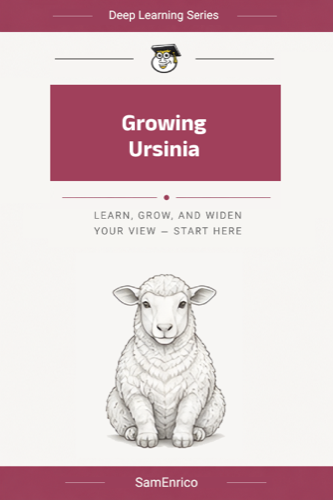
Non-FictionInformativeEducational
Growing Ursinia eBook
This publication, published by SamEnrico, covers G
by Crump Altha
This publication, published by SamEnrico, covers Growing Ursinia
Formats
Free sample
Chapter 1: A Map of Petals...--The first time you see a mature Ursinia in full bloom, you might mistake it for a painted weed. Its stems are wiry, its leaves are cut so fine they resemble dill weed, and its flowers—those blazing disks of gold and orange with a bullseye of deep maroon—seem almost too theatrical for a plant that asks for nothing. This is the paradox of Ursinia. It belongs to a family of botanical overachievers, the daisies, but it refuses to play the part of a diva. Unlike roses that demand constant feeding or hydrangeas that wilt at the first sign of neglect, Ursinia operates like a stoic philosopher of the plant world: it thrives not because of what you give it, but because of what you withhold.If you have picked up this book, you are likely someone who has grown tired of high-maintenance ornamentals.
Perhaps you have lost petunias to root rot, watched your lavender turn leggy from too much compost, or simply want a plant that blooms its head off without requiring a degree in soil chemistry. You have come to the right genus. Growing Ursinia is less about mastering a set of complicated techniques and more about unlearning the habits that gardeners have been taught for generations. Water deeply every day? No.
Feed every two weeks with a balanced fertilizer? Absolutely not. Plant in rich, moisture-retentive soil? That is a death sentence.This chapter serves as your botanical map—a guide to understanding exactly what Ursinia is, where it came from, and why it behaves the way it does. By the time you finish reading these pages, you will know the difference between an annual Ursinia that blooms for one glorious season and a tender perennial that can return for years with minimal winter protection.
You will recognize the three most commonly cultivated species by sight. More importantly, you will understand the single most important rule of Ursinia cultivation: this plant is built for poverty. Treat it like a queen, and it will die. Treat it like a survivor, and it will reward you with more flowers than you can cut.Let us begin with the plant’s origin story, because geography explains everything.The Cape’s Golden Child Ursinia does not come from the gentle, rain-soaked gardens of England or the fertile loam of the American Midwest. It evolved in one of the toughest neighborhoods on Earth: the Cape Floristic Region of South Africa.
This is a landscape of ancient, weathered sandstone, soils so low in nutrients they would make a cactus blush, and a climate defined by extremes. Winters bring reliable rain, but summers are bone-dry, often baking for months without a single shower. The plants that survive here—and there are over nine thousand species found nowhere else on the planet—have developed strategies that would seem insane to any plant adapted to temperate gardens.Ursinia chose the strategy of profligate generosity. Instead of hoarding resources or growing slowly to conserve energy, it produces masses of flowers, sets seed quickly, and then either dies (if it is an annual) or goes dormant (if it is a perennial). This is a gambling strategy: throw everything into reproduction before the dry season kills you.
For the gardener, this translates into a plant that blooms with almost aggressive enthusiasm, producing waves of flowers from late spring well into autumn, provided you do not interrupt its built-in survival programming.The genus was named in 1757 by the German botanist Johannes Heinrich Ursinus, though the plant had been known to indigenous Khoisan peoples for centuries before European classification. In the wild, Ursinia species occupy a range of habitats from sandy coastal flats to rocky mountain slopes, but they share one common requirement: absolutely no standing water around their roots during their dormant or semi-dormant periods. In the Cape, winter rains arrive when days are short and cool, and the plants grow actively during this season. By the time summer heat arrives, most species have already flowered, set seed, and are waiting out the dry months as seeds or underground storage organs. This inverted schedule—growing in winter, sleeping in summer—throws many first-time growers off.
But as you will see throughout this book, Ursinia is remarkably adaptable to northern hemisphere growing seasons, provided you respect its need for dry rest.The Three You Will Actually Grow While there are over sixty species of Ursinia, the horticultural world has narrowed its focus to three that perform reliably in gardens and containers. Each has a distinct personality, and choosing the right one for your climate and patience level is the first real decision you will make as an Ursinia grower.The first and most common is Ursinia anthemoides, often called the “annual chamomile daisy” or “Cape marigold.” This is the plant you will find in most seed catalogs, and for good reason. It completes its entire life cycle in one growing season, growing from seed to flower in as little as seventy days under optimal conditions. It reaches twelve to eighteen inches tall, with finely dissected, lacy green foliage that smells faintly of anise or chamomile when crushed. The flowers are one to two inches across, typically bright orange or golden yellow with a dark purple ring around the central disc.
U. anthemoides is an annual in the truest sense: it germinates, blooms, sets seed, and dies within a single year. For gardeners in cold climates with long, harsh winters, this is the most practical choice because there is no need to overwinter anything. You simply save seeds in autumn and start fresh the following spring. The disadvantage is that you must replant every year, but the advantage is complete freedom from winter storage worries.The second species, Ursinia speciosa, is the showboat of the genus.
Its specific epithet means “beautiful” or “showy,” and it earns that name with flowers that can reach three inches across—substantially larger than U. anthemoides. The petals are typically a richer, deeper orange, often shading to bronze at the base, and the dark central ring is more pronounced, creating a stark, almost hypnotic contrast. U. speciosa is a tender perennial, meaning it will live for several years if protected from freezing temperatures.
In USDA Zones 9 and above, it can remain in the ground year-round with minimal care. In colder zones, you will need to lift its roots in autumn or take cuttings to carry it through winter. The foliage is slightly coarser and less fern-like than its annual cousin, with a silvery-green cast that adds textural interest even when the plant is not in bloom. This species is for gardeners who are willing to put in a bit more effort for a bigger floral payoff. If you have space for overwintering or a bright windowsill for cuttings, U.
speciosa will reward you with perennial loyalty.The third species is the outlier: Ursinia sericea. Unlike the previous two, this is a shrubby perennial that develops a woody base and can reach two to three feet in height and equal spread. Its leaves are covered in fine, silvery hairs, giving the plant a soft, almost felted appearance. The flowers are smaller than U. speciosa…
This is the end of the free sample. Get the eBook to keep going. Buy now
About this book
Details
- Author
- Crump Altha
- Publisher
- SamEnrico
- Language
- English
- Genre
- Non-Fiction, Informative, Educational
- Released
- 2026-05-11
- Pages (approx.)
- 151
- Available as
- eBook, Audiobook

Read better in the ZLOADR app
Your eBooks on your phone or tablet. Sign in with your SamEnrico account and start reading.
More by Crump Altha
 Triggers and Eating BehaviorsCrump Altha$11.99
 Drone Delivery InvestmentCrump Altha$11.99
 Sam Sheppard Case Cold Case ReviewCrump Altha$11.99
 Postpartum Oversupply ManagementCrump Altha$11.99
 The IBS Sleep ConnectionCrump Altha$11.99
 Pet Loss For Shelter WorkersCrump Altha$11.99
 CGRP Antagonist GuideCrump Altha$11.99
 Mario Cuomo SonCrump Altha$11.99
 Passive Aggressive PartnerCrump Altha$11.99
 Raven’s Shadow: A Spy Among the SpiritsCrump Altha$11.99
 The Thinkers' Revolution: Enlightenment Minds That Lit the WorldCrump Altha$11.99
 Frozen Echoes: The Lost Expedition of the KarlukCrump Altha$11.99
You may also like
 Hong Kong Handover 1997Dunn Johnnie$11.99
 Zumba For Postnatal Recovery CourseNeal Christian$11.99
 Zumba for BeginnersLadner Nikia$11.99
 YouTube Comment Mining GuideHumes Pandora$12.99
 Worry Box MeditationCarlin Rudy$11.99
 Workplace Stress MeditationNguyen Lynn$11.99
 Workplace Stress and Sleep RepairHawley Ivory$11.99
 Workplace Perfectionism CureDelaney Jeffry$11.99
 Workplace Injustice Anger GuideWallen Isabelle$11.99
 Work Addiction and Burnout LinkGreenwood Ester$11.99
 Women in Yoga and WellnessBeattie Galina$11.99
 Women in Stand Up ComedyChun Evangeline$11.99