
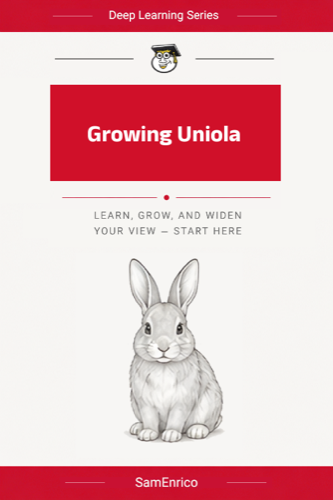
Non-FictionInformativeEducational
Growing Uniola eBook
This publication, published by SamEnrico, covers G
by Bock Tory
This publication, published by SamEnrico, covers Growing Uniola
Formats
Free sample
Chapter 1: Beyond the Beach--The first time I saw sea oats, I almost got arrested.It was a humid August afternoon on St. George Island, Florida, and I had driven six hours with a shovel in my trunk. A recent transplant from the Midwest, I had fallen in love with the way these grasses swayed—golden plumes nodding against a turquoise sky, their roots holding back the very ocean. I wanted them in my yard. Badly.
So I did what any ignorant, enthusiastic gardener would do: I pulled over, grabbed my shovel, and started digging.A park ranger appeared before I had freed the first clump. His voice was calm but firm. "Ma'am, that's a threatened species. Put the shovel down slowly." He explained that Uniola paniculata—sea oats—is protected by state and federal law. Digging wild plants carries fines up to $10,000.
In some jurisdictions, it's a misdemeanor with possible jail time. I apologized profusely, returned the sand I had disturbed, and drove home empty-handed and embarrassed.That night, I sat at my kitchen table with a cold beer and a burning question: How could a grass be so valuable that digging it up was a crime—and how could I still grow it?That question launched a seven-year obsession. I contacted botanists, restoration ecologists, native plant nurseries, and a handful of rogue gardeners who had figured out the secret. I learned about sterile cultivars that sidestep legal restrictions. I killed my first three plantings (waterlogged roots, then over-fertilized stems, then a vole infestation).
And eventually, I succeeded—not just in keeping Uniola alive, but in creating a landscape feature that drew compliments from neighbors and, unexpectedly, helped stabilize a small erosion problem on my property.This book is the manual I wish I had on that August night. It covers everything from soil science to pruning schedules, from propagation to pest management, from container gardening to large-scale erosion control. But before we dig into the how-to, we need to understand what Uniola paniculata actually is—and why it has inspired such fierce legal protection, botanical fascination, and gardener determination.What Is Uniola, Anyway?Let's start with the taxonomy, because names matter. Uniola paniculata belongs to the Poaceae family—the true grasses. Its common name, sea oats, comes from the oat-like appearance of its seed heads, which dangle in graceful, flattened panicles that catch light like wind chimes.
The plant is native to the Atlantic and Gulf coasts of North America, from Virginia south to Florida and west to Texas, as well as the Caribbean and parts of Mexico. It is a dune-building specialist, evolved to thrive in the harshest terrestrial environment on the continent: pure sand, salt spray, blazing sun, hurricane-force winds, and occasional submersion in seawater.A mature Uniola plant is a biological marvel. Above ground, it sends up culms (grass stems) that can reach 6 to 8 feet in height, topped with those signature seed heads that turn from green to golden to straw-colored as the season progresses. Below ground, it develops a network of rhizomes—underground stems that store carbohydrates, produce new shoots, and slowly expand the plant's footprint. In natural dune systems, a single genetic individual (called a clone) can spread across hundreds of feet over decades, creating a subsurface lattice that binds sand together.But here is where many gardeners get tripped up: the plant you see in coastal photographs is often not Uniola paniculata at all.
It is frequently Panicum amarum, or bitter panicum, a different grass that occupies similar habitats. The two are often confused, even by experienced botanists, because their growth habits and seed heads look similar from a distance. The key differences are subtle but important:Seed heads: Uniola seed heads are flattened, with spikelets arranged in a comb-like pattern. Panicum seed heads are more open and airy, like a miniature weeping willow.Ligules (the membrane where leaf meets stem): Uniola has a fringe of hairs. Panicum has a smooth, membranous ligule.Leaf feel: Uniola leaves feel rough to the touch in one direction (thanks to microscopic serrations, discussed in Chapter 2).
Panicum leaves are smoother.For the gardener, the distinction matters because the two plants have different legal protections (in most states, Panicum is not protected) and different cultivation requirements. Throughout this book, we focus on Uniola paniculata—specifically, the cultivated selections that you can legally grow without permits.Why Sea Oats Are So Fiercely Protected To understand the legal landscape, you need to understand the ecological role of sea oats. These grasses are not just pretty; they are infrastructure.Coastal dunes are dynamic environments. Wind blows sand inland; waves wash it back out. Without something to hold the sand in place, dunes migrate, shrink, or disappear entirely—which leaves coastal properties vulnerable to storm surge and sea level rise.
Uniola is the primary engineer of these dune systems. Its rhizomes create a three-dimensional web that traps sand grains. Its above-ground stems slow wind speed, causing sand to drop out of the air. And its deep taproots (up to 20-30 feet in natural settings) anchor the entire structure.Here is the statistic that shocked me: a single acre of healthy sea oats can trap and hold more than 20 tons of sand per year. During hurricanes, dunes held together by Uniola can reduce wave energy by up to 70 percent.
Without these grasses, coastal communities would experience catastrophic erosion after every major storm.This ecological value is why sea oats are protected. In Florida, they are listed as a threatened species. In Georgia and South Carolina, it is illegal to collect seeds or dig plants without a permit. North Carolina prohibits any disturbance of sea oats on public beaches. Texas allows seed collection only for restoration projects.
The federal Lacey Act also comes into play: transporting protected plants across state lines without documentation is a crime.But—and this is crucial—these protections apply to wild plants. They do not apply to sterile cultivars or legally propagated nursery stock grown from permitted seed sources. This distinction is the entire reason this book exists.The Sterile Cultivar Solution When I drove home from that beach with an empty trunk and a lighter wallet (the ranger gave me a warning but no ticket, mercifully), I assumed my sea oat dreams were dead. Then I found a tiny native plant nursery in Cedar Key that sold something called Uniola paniculata 'Golden Waves'.'Golden Waves' is a sterile hybrid. It was developed by a collaboration of university horticulturists and coastal restoration specialists who faced a problem: people wanted to grow sea oats, but the legal restrictions were confusing and the ecological risks of spreading wild-type genetics were real.
If homeowners planted wild-type sea oats, those plants could cross-pollinate with nearby natural populations, potentially diluting local adaptations. Worse, homeowners might dig up wild plants out of ignorance, as I had nearly done.The solution was a cultivar that looks and grows like wild sea oats but produces no viable seed. 'Golden Waves' flowers—the seed heads still form—but the spikelets are empty. The plant cannot reproduce sexually. It can only be propagated through division (splitting the rhizomes), which means it has zero potential to become invasive or to interbreed with wild…
This is the end of the free sample. Get the eBook to keep going. Buy now
About this book
Details
- Author
- Bock Tory
- Publisher
- SamEnrico
- Language
- English
- Genre
- Non-Fiction, Informative, Educational
- Released
- 2026-06-02
- Pages (approx.)
- 142
- Available as
- eBook, Audiobook

Read better in the ZLOADR app
Your eBooks on your phone or tablet. Sign in with your SamEnrico account and start reading.
More by Bock Tory
 Research Proposal Significance Section GuideBock Tory$12.99
 Senior Move Management GuideBock Tory$11.99
 Trigger Rehearsal VisualizationBock Tory$11.99
 Hair Salon Chemical ExposureBock Tory$11.99
 Self Hypnosis Script WritingBock Tory$11.99
 Wearable Tech InvestmentBock Tory$11.99
 Pet Loss For Vet TechsBock Tory$11.99
 Topical Estrogen Skin Aging WorkbookBock Tory$11.99
 DeSantis FloridaBock Tory$11.99
 Anger In PolyamoryBock Tory$11.99
 The Calculators of the Nile: Alexandria's Forgotten GeniusesBock Tory$11.99
 The Lost River Pioneers: Taming the Congo’s Prehistoric WatersBock Tory$11.99
You may also like
 Hong Kong Handover 1997Dunn Johnnie$11.99
 Zumba For Postnatal Recovery CourseNeal Christian$11.99
 Zumba for BeginnersLadner Nikia$11.99
 YouTube Comment Mining GuideHumes Pandora$12.99
 Worry Box MeditationCarlin Rudy$11.99
 Workplace Stress MeditationNguyen Lynn$11.99
 Workplace Stress and Sleep RepairHawley Ivory$11.99
 Workplace Perfectionism CureDelaney Jeffry$11.99
 Workplace Injustice Anger GuideWallen Isabelle$11.99
 Work Addiction and Burnout LinkGreenwood Ester$11.99
 Women in Yoga and WellnessBeattie Galina$11.99
 Women in Stand Up ComedyChun Evangeline$11.99