
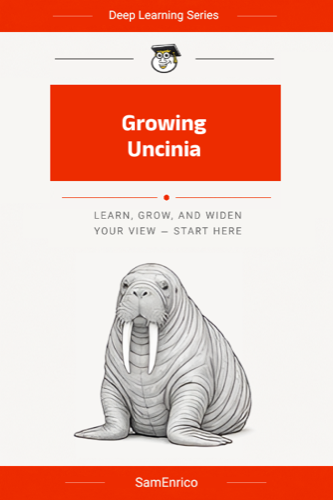
Growing Uncinia
This publication, published by SamEnrico, covers G
by Marble Hoa
This publication, published by SamEnrico, covers Growing Uncinia
Formats
About this book
Free sample
Chapter 1: The Unexpected Red...--In December, most gardens lie to you.They promise rest, but deliver only gray. Beige. Brown. The dull exhaustion of a landscape that has given up until April. Walk through any temperate garden in the depths of winter, and you will see the same thing: skeletons of perennials collapsed into mud, evergreen shrubs huddled against the cold like ashamed relatives at a funeral, and everywhere—everywhere—the color green, but not the vibrant green of spring.
The green of surrender. The green of plants doing just enough to stay alive, not a drop of pigment wasted on beauty.Then, if you know where to look, you find the exception.Tucked against a south-facing wall, or rising from a container on a protected patio, or massed along a border that catches the low winter sun, you see it: a clump of slender, arching leaves the color of burnished copper, deep burgundy, or flames frozen in time. The plant is not flowering. It may never produce a flower you notice. And yet it commands attention in a season when attention is the last thing any gardener expects to give.
This is Uncinia. And this is why you are about to care about a sedge.If you have never heard of Uncinia, you are not alone. Five years ago, almost no one outside of botanic gardens and New Zealand plant enthusiasts had. If you have heard of it but assumed it was just another ornamental grass, you are also not alone—and you are wrong. If you have tried to grow it and failed, convinced that you possess some black-thumb curse that kills anything remotely interesting, you are definitely not alone.
And this book is for you.The Seduction of the Sedge Let us begin with what Uncinia is not. It is not a grass. This matters more than you might think, because grasses and sedges have different rules. Grasses belong to the family Poaceae, the same family that gives us wheat, corn, bamboo, and lawn. Their stems are round and hollow, or nearly so.
Their leaves grow in two ranks, meaning they emerge from opposite sides of the stem like pages of an open…
This is the end of the free sample. Get the eBook to keep going. Buy now
Contents
- Chapter 1
- Chapter 2
- Chapter 3
- Chapter 4
- Chapter 5
- Chapter 6
- Chapter 7
- Chapter 8
- Chapter 9
- Chapter 10
- Chapter 11
- Chapter 12
Details
- Author
- Marble Hoa
- Publisher
- SamEnrico
- Language
- English
- Genre
- Non-Fiction, Informative, Educational
- Released
- 2026-06-02
- Pages (approx.)
- 143
- Available as
- eBook, Audiobook

Read better in the ZLOADR app
Your eBooks on your phone or tablet. Sign in with your SamEnrico account and start reading.
More by Marble Hoa
 Precision Medicine CapitalMarble Hoa$11.99
 Trigger Physical SensationsMarble Hoa$11.99
 SIBO Overlap ManagementMarble Hoa$11.99
 Postpartum Disability Leave GuideMarble Hoa$11.99
 Humor in Presentations GuideMarble Hoa$11.99
 Sarcopenia Thermal ImagingMarble Hoa$11.99
 Migraine Aura Management GuideMarble Hoa$11.99
 Co Parenting Anger ControlMarble Hoa$11.99
 Abbott Texas WheelchairMarble Hoa$11.99
 When the Sky Split: The Maori Birth of Te Rā and Te PōMarble Hoa$11.99
 Qubit's Gambit: The Race to Quantum SupremacyMarble Hoa$11.99
 Arjuna's Arrow: The Celestial Bowstring of the PandavaMarble Hoa$11.99