
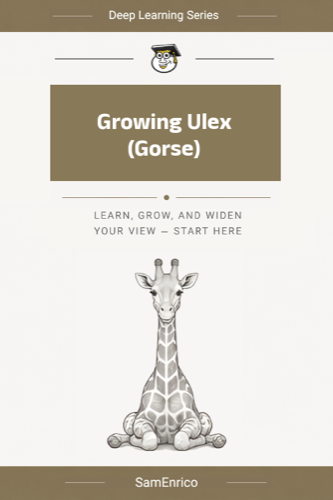
Non-FictionInformativeEducational
Growing Ulex (Gorse) eBook
This publication, published by SamEnrico, covers G
by Durr Glynda
This publication, published by SamEnrico, covers Growing Ulex (Gorse)
Formats
Free sample
Chapter 1: The Thorny Paradox...–- It begins, as these things often do, with a misunderstanding. You have likely picked up this book because you saw a photograph of a gorse hedge in full bloom—a curtain of molten gold against a grey February sky—and you thought, I want that. Or perhaps you live in New Zealand or California or Tasmania, and you have spent the last three years trying to kill the stuff, and you have failed, and now you are desperate enough to read a book written by someone who has also bled into the soil of his own garden. Or maybe you are simply curious: a gardener, a land manager, a permaculturist, or someone who has stumbled upon this plant during a coastal walk and been stopped dead by the scent of coconut and vanilla rising from a thorny thicket in the middle of winter.Whatever brought you here, understand this first: Ulex—the plant known to most of the world as gorse, furze, or whin—does not care about your intentions. It does not know whether you are a conservationist or a colonizer, a gardener or an executioner.
It has spent fifty million years evolving strategies that predate human ambition by an order of magnitude. And it is winning.This is the paradox that will shape everything you read in this book. Gorse is simultaneously one of the most beloved ornamental shrubs in European horticulture and one of the most aggressive invasive weeds on the planet. The Royal Horticultural Society gives it a "Best Buy for Pollinators" award, recommending it for gardens across the United Kingdom. Meanwhile, the governments of New Zealand, Australia, South Africa, and the western United States have declared war on it, spending hundreds of millions of dollars on control programs that have, at best, contained it.
In New Zealand alone, Ulex europaeus infests over one million hectares—an area larger than Yellowstone National Park—and costs the economy approximately one billion New Zealand dollars annually in lost agricultural productivity, wildfire suppression, and direct control measures.How can the same plant be a hero in one country and a villain in another? The answer lies not in the plant but in the context of its planting. Gorse is a creature of edge habitats—coastal cliffs, disturbed soils, fire-prone heathlands, and abandoned pastures. In its native Western Europe, it is held in check by a complex web of herbivores, pathogens, competitors, and centuries of human management. Transplanted to New Zealand, Australia, or the Pacific Northwest of North America, it arrives without its natural enemies and finds a world of empty niches, receptive soils, and climates so similar to home that it cannot tell it has left.
It does not become more aggressive. It simply encounters less resistance.This book is for both sides of that fence. If you are a gardener who wants a single, spectacular specimen of Common Gorse (Ulex europaeus) in your front garden, you will find detailed instructions on propagation, pruning, and site selection. If you are a land manager tasked with controlling a thousand-hectare infestation, you will find protocols for integrated pest management, biological control, and chemical treatment. If you are a permaculturist who sees gorse not as a weed but as a nitrogen-fixing, biomass-generating, pollinator-feeding machine, you will find strategies for turning a liability into an asset.
And if you are simply someone who has been pricked, frustrated, or bewitched by this plant, you will find company.But before we get to any of that, you need to know what you are dealing with. The name Ulex comes from the Latin uligo, meaning "to burn" or "marshy ground"—a double reference to its preference for damp, acidic soils and the explosive flammability of its oil-rich foliage. The common names tell a similar story: "gorse" from the Old English gorst, meaning "wasteland" or "rough ground"; "furze" from the Old English fyrs, related to the Norse fyr (fire); and "whin" from the Scandinavian hvin, meaning "to whine or whistle in the wind." These are not names given by botanists in laboratories. They are names given by farmers, shepherds, and hedgers who lived alongside this plant for millennia, who burned it for fuel, fed its young shoots to their horses, and cursed its thorns while repairing fences. They understood something that modern gardening books often forget: gorse is not a pet.
It is a wild thing, and it will remind you of that fact the first time you try to prune it without leather gloves.This chapter will introduce you to the three main species of Ulex that you are likely to encounter—Common Gorse, Western Gorse, and Dwarf Gorse—and explain their native ranges, growth habits, and horticultural uses. It will trace the botanical history of the genus, from its first description by Carl Linnaeus in 1753 to the modern genetic studies that have reshaped our understanding of its evolution. And it will give you a roadmap for the rest of the book, helping you decide which reading path best suits your needs: the Gardener's Path, focused on cultivation and enjoyment; or the Manager's Path, focused on control and eradication. Both are valid. Both are represented in these pages.
Neither is morally superior to the other, because morality is a human invention, and gorse, as you are about to learn, does not care.The Botanical Identity: What Ulex Actually Is Before we can grow, manage, or appreciate gorse, we must understand its place in the natural order. Ulex is a genus of flowering plants in the family Fabaceae—the legume, pea, or bean family. This is the same family that gives us peas, lentils, chickpeas, alfalfa, clover, and the magnificent nitrogen-fixing trees of tropical rainforests. The family connection explains much of gorse's ecological behavior: like other legumes, it forms a symbiotic relationship with soil bacteria of the genus Rhizobium, which convert atmospheric nitrogen into a form the plant can use. This is the secret to gorse's ability to thrive on the poorest soils.
It does not need fertile ground because it creates its own.Within the Fabaceae, Ulex belongs to the subfamily Faboideae and the tribe Genisteae, which includes other spiny, nitrogen-fixing shrubs such as broom (Cytisus), greenweed (Genista), and laburnum (Laburnum). This is a tribe of survivors: plants that evolved in the nutrient-poor, fire-prone, grazing-pressured landscapes of the Mediterranean and Atlantic Europe. Their shared characteristics—spiny stems, small leaves (or no leaves at all), bright yellow flowers adapted to bee pollination, and hard-coated seeds that persist in the soil—are all adaptations to stress.The genus Ulex contains approximately twenty species, but only three are significant for gardeners, land managers, or the scope of this book. The rest are rare, geographically restricted, or of no practical interest outside their native ranges. Here are the three you need to know.Ulex europaeus: The Common Gorse, The Aggressor Ulex europaeus is the gorse.
If you have seen one gorse plant in your life, this is almost certainly the one. It is the tallest, most aggressive, most widely distributed, and most controversial member of the genus. Common Gorse typically grows to a height of 1.5 to 3 meters (5 to 10 feet), but under…
This is the end of the free sample. Get the eBook to keep going. Buy now
About this book
Details
- Author
- Durr Glynda
- Publisher
- SamEnrico
- Language
- English
- Genre
- Non-Fiction, Informative, Educational
- Released
- 2026-06-03
- Pages (approx.)
- 145
- Available as
- eBook, Audiobook

Read better in the ZLOADR app
Your eBooks on your phone or tablet. Sign in with your SamEnrico account and start reading.
More by Durr Glynda
 Senior Housing Tax DeductionsDurr Glynda$11.99
 Parenting Trigger ManagementDurr Glynda$11.99
 Sam Sheppard Death And MysteryDurr Glynda$11.99
 Hookah and Shisha Toxin GuideDurr Glynda$11.99
 Neurotech Investment MapDurr Glynda$11.99
 The Elevator Pitch BlueprintDurr Glynda$11.99
 Tinnitus Hypnosis ScriptsDurr Glynda$11.99
 Theme Days SchedulingDurr Glynda$11.99
 Customer Service AngerDurr Glynda$11.99
 Gold, Guns, and Ghosts: The Cursed 1968 Mexico City OlympicsDurr Glynda$11.99
 Steel and Secrets: The Golden Spike ConspiracyDurr Glynda$11.99
 Quetzalcoatl's Feathers: The Serpent's Divine FlightDurr Glynda$11.99
You may also like
 Hong Kong Handover 1997Dunn Johnnie$11.99
 Zumba For Postnatal Recovery CourseNeal Christian$11.99
 Zumba for BeginnersLadner Nikia$11.99
 YouTube Comment Mining GuideHumes Pandora$12.99
 Worry Box MeditationCarlin Rudy$11.99
 Workplace Stress MeditationNguyen Lynn$11.99
 Workplace Stress and Sleep RepairHawley Ivory$11.99
 Workplace Perfectionism CureDelaney Jeffry$11.99
 Workplace Injustice Anger GuideWallen Isabelle$11.99
 Work Addiction and Burnout LinkGreenwood Ester$11.99
 Women in Yoga and WellnessBeattie Galina$11.99
 Women in Stand Up ComedyChun Evangeline$11.99