
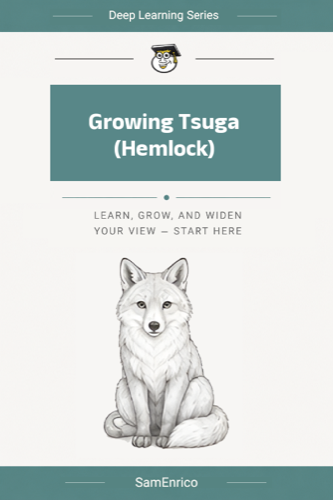
Non-FictionInformativeEducational
Growing Tsuga (Hemlock) eBook
This publication, published by SamEnrico, covers G
This publication, published by SamEnrico, covers Growing Tsuga (Hemlock)
Formats
Free sample
Chapter 1: The Gentle Giants...--Walking into an old-growth hemlock forest for the first time feels less like entering a stand of trees and more like stepping into a cathedral whose architects worked in centuries rather than years. The light changes first—what was bright and unfiltered becomes a cool, green twilight filtered through layers of delicate needles. The temperature drops, often by ten degrees or more. The sound of wind becomes a whisper. And overhead, the hemlocks stand like patient elders, their drooping leaders pointing downward as if in quiet contemplation of the forest floor they have spent centuries nurturing.This book is about how to bring that feeling into your own landscape.
Not the full cathedral—that takes generations—but the first few pews. It is about understanding a genus of trees that has survived ice ages, rising seas, and the march of human civilization, only to face its greatest threat in the past fifty years. And it is about what you can do, in your own yard, to become part of the story of Tsuga—the hemlocks.Before we dig a single hole, before we talk about soil p H or pruning shears or the tiny white menace that has killed millions of these trees, we need to understand what a hemlock actually is. Not just the botanical definition, but the living, breathing, centuries-old organism that you are about to welcome into your life. Because the difference between planting a tree and growing a hemlock is the difference between owning a pet and raising a child.
One requires occasional attention. The other asks for a relationship.What This Chapter Covers In this opening chapter, we will accomplish four essential tasks. First, we will clear up a dangerous piece of confusion that has caused more than a few anxious phone calls to poison control centers. Second, we will meet the four main species of Tsuga that are available to North American gardeners, learning their personalities, their preferences, and their lifespans. Third, we will explore why hemlocks have captured the human imagination for centuries—why Thomas Jefferson planted them at Monticello, why Japanese bonsai masters prize them, and why modern landscape architects reach for them when they want to create a sense of deep time.
And fourth, we will establish the single most important fact about hemlocks that governs everything else in this book: they are trees of the edges and the in-between places, neither full sun lovers nor deep shade specialists, neither swamp dwellers nor desert survivors. They are, in the most beautiful sense of the word, compromisers.By the end of this chapter, you will know which hemlock species is right for your property, how long you can expect it to live, and whether you are ready for the commitment that a hemlock asks of its caretaker. You will also have a story to tell—about a genus of trees that has been called the Redwoods of the East, about the difference between a hemlock and its poisonous namesake, and about why millions of gardeners have fallen under the spell of these gentle giants.The Great Confusion: Hemlock vs. Hemlock Let us begin with the question that every hemlock gardener eventually faces, usually at a dinner party or a family gathering."You're growing what?" someone will say, their eyes widening. "Isn't that the tree that killed Socrates?"The short answer is no.
The longer answer is more interesting and reveals something important about how botanical names can mislead us.The plant that killed Socrates—or more accurately, the plant that was used to execute condemned prisoners in ancient Athens—was Conium maculatum, commonly known as poison hemlock. It is a member of the carrot family, Apiaceae, and it contains a potent alkaloid called coniine that causes paralysis and death by respiratory failure. It is an herbaceous plant, not a tree. It grows in disturbed soils, along roadsides, and in abandoned fields. It has hollow, purple-spotted stems and clusters of small white flowers that look like Queen Anne's lace.
And it has absolutely nothing to do with the trees we are discussing in this book.The confusion arises because the common name "hemlock" was applied to both plants by early English settlers who noticed a superficial resemblance between the foliage of the tree and the foliage of the poison herb. The tree's needles, when crushed, were said to smell similar to the herb's leaves. That is where the similarity ends.So, are hemlock trees poisonous?Here is the nuanced answer that every responsible book on Tsuga must provide. Hemlock trees (Tsuga species) are not acutely toxic like poison hemlock (Conium) or water hemlock (Cicuta). You can touch the needles, handle the wood, stand beneath the branches, and mulch your garden with fallen foliage without any risk of poisoning.
Children can play around hemlocks safely. Pets can run through hemlock groves without danger.However—and this is an important however—hemlock needles contain small amounts of compounds called lignans, some of which can cause mild gastrointestinal distress if consumed in large quantities. A child or dog who eats a handful of needles might experience an upset stomach. A person who deliberately consumes a large quantity of needles (and why would anyone do this?) might become ill. But there are no recorded fatalities from Tsuga consumption, and the trees are not considered toxic by any major poison control database.The responsible statement, then, is this: Tsuga trees are safe to grow, handle, and live around, but their needles are not food.
Do not eat them. Do not brew them into tea. Do not use them as a culinary herb. And do not confuse them with the poison hemlock of Socrates fame, which is an entirely different plant.Now that we have cleared that up, we can move on to the much more pleasant task of meeting the trees themselves.The Four Pillars of Tsuga The genus Tsuga contains between eight and ten species worldwide, depending on which taxonomist you consult. Four of these species are native to North America.
The others are found in Asia, primarily in Japan, China, and Taiwan. For the purposes of this book—and for the purposes of almost all North American gardeners—we will focus on the four native species that are available in the nursery trade and that have proven themselves adaptable to cultivation.Each of these four species has a distinct personality, a different set of environmental preferences, and a dramatically different lifespan. Choosing the right one for your property is the first and most important decision you will make as a hemlock grower.Tsuga canadensis: The Eastern Hemlock If this book has a protagonist, it is Tsuga canadensis. The Eastern hemlock is the most widely planted, most celebrated, and most threatened of the North American hemlocks. Its natural range stretches from Nova Scotia to northern Georgia, following the Appalachian Mountains and the cool, moist ravines of the Great Lakes region.
Within this range, it is a dominant forest tree, often forming nearly pure stands on north-facing slopes and along stream corridors.Physical characteristics. The Eastern hemlock is a medium to large evergreen tree, typically reaching 60 to 80 feet in cultivation and occasionally exceeding…
This is the end of the free sample. Get the eBook to keep going. Buy now
About this book
Details
- Author
- Tubbs Roselia
- Publisher
- SamEnrico
- Language
- English
- Genre
- Non-Fiction, Informative, Educational
- Released
- 2026-05-18
- Pages (approx.)
- 152
- Available as
- eBook, Audiobook

Read better in the ZLOADR app
Your eBooks on your phone or tablet. Sign in with your SamEnrico account and start reading.
More by Tubbs Roselia
 Window of Tolerance GuideTubbs Roselia$11.99
 Art Supply Toxin PreventionTubbs Roselia$11.99
 MarTech Capital StrategiesTubbs Roselia$11.99
 Pet Loss For Exotic OwnersTubbs Roselia$11.99
 Alcohol Recovery and HolidaysTubbs Roselia$11.99
 Sam Sheppard Trial Judge BiasTubbs Roselia$11.99
 Task Batching StrategiesTubbs Roselia$11.99
 Fiber For IBS GuideTubbs Roselia$11.99
 Criticism Vs ComplaintTubbs Roselia$11.99
 Midnight River: The Secret Paths of the Underground RailroadTubbs Roselia$11.99
 The Harmonies of the Ancestors: Anton Wilhelm Amo, the Enlightened Philosopher of GhanaTubbs Roselia$11.99
 The 444 Days: Tehran's Forgotten Embassy CrisisTubbs Roselia$11.99
You may also like
 Hong Kong Handover 1997Dunn Johnnie$11.99
 Zumba For Postnatal Recovery CourseNeal Christian$11.99
 Zumba for BeginnersLadner Nikia$11.99
 YouTube Comment Mining GuideHumes Pandora$12.99
 Worry Box MeditationCarlin Rudy$11.99
 Workplace Stress MeditationNguyen Lynn$11.99
 Workplace Stress and Sleep RepairHawley Ivory$11.99
 Workplace Perfectionism CureDelaney Jeffry$11.99
 Workplace Injustice Anger GuideWallen Isabelle$11.99
 Work Addiction and Burnout LinkGreenwood Ester$11.99
 Women in Yoga and WellnessBeattie Galina$11.99
 Women in Stand Up ComedyChun Evangeline$11.99