
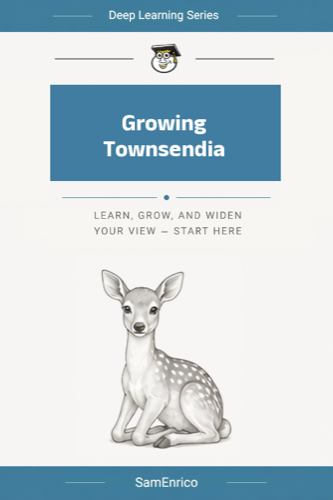
Non-FictionInformativeEducational
Growing Townsendia eBook
This publication, published by SamEnrico, covers G
This publication, published by SamEnrico, covers Growing Townsendia
Formats
Free sample
Chapter 1: The Easter Miracle...–- On a windswept talus slope at 10,000 feet in the Rocky Mountains, where the air thins to a breath and the growing season lasts barely ten weeks, a tiny rosette of silvery leaves presses flat against the gravel. To the untrained eye, it appears as nothing more than a scrap of lichen or a pebble caught in the scree. But for three weeks each spring—just as the最后一 snowbanks begin to retreat—this unassuming cushion erupts. From its center emerges a flower so disproportionately large, so impossibly vivid, that it seems to have borrowed its petals from a plant ten times its size. This is Townsendia, the Easter daisy, and its miracle is not merely one of survival, but of audacious, defiant beauty in the face of extreme adversity.The first time I witnessed this transformation, I was kneeling on a shale slope in Montana’s Lewis Range, my knees soaked through from melting snow, my fingers numb with cold.
I had read about Townsendia exscapa in obscure alpine journals, studied grainy black-and-white photographs taken decades earlier by botanists who had traversed these same ridges. But reading is not seeing. When that flower opened its lavender rays to the pale spring sun, I understood immediately why alpine enthusiasts speak of Townsendia in hushed, reverent terms. It is not merely a plant; it is a statement, a rebellion against every assumption we hold about what a daisy should be and where it should grow.Yet for all its wild glory, Townsendia carries a reputation in cultivation that borders on the infamous. Ask any rock gardener about Easter daisies, and you will hear a litany of frustrations: “They vanish after a year.” “They rot the moment I look away.” “They’re beautiful for one season, and then they’re gone.” These laments are not without merit.
Townsendia has earned its reputation as a short-lived, finicky genus that seems to delight in disappointing even experienced growers. But here is the truth that most gardening books will not tell you: the fault is not in the plant. It is in our expectations.We approach Townsendia as we would a perennial aster or a garden chrysanthemum, expecting it to settle into our borders and bloom reliably for a decade. We plant it in rich garden loam, water it with dutiful regularity, and then stare in bewilderment when it collapses into a soggy heap by midsummer. We have forgotten—or perhaps we never learned—that Townsendia is not a garden perennial in the conventional sense.
It is an alpine pioneer, a plant adapted to the harshest, leanest, most unforgiving environments on the continent. It does not want our pampering. It wants our understanding.The Genus: More Than a Pretty Face Before we can grow Townsendia successfully, we must first know Townsendia intimately. The genus belongs to the Asteraceae family, that vast and successful clan that includes sunflowers, asters, dandelions, and daisies. Within this enormous family—some 23,000 species strong—Townsendia occupies a modest but distinctive branch.
The genus comprises approximately 26 accepted species, all native to western North America, with their greatest diversity concentrated in the Rocky Mountain corridor from Canada southward into northern Mexico.The naming of the genus honors David Townsend (1787–1858), an American botanist who collected plants in the eastern United States and whose name was later applied to this western genus by the German botanist Karl Heinrich 'Theodor' Bongard in 1834. There is a certain irony in this naming, as Townsend himself never saw the plants that bear his name, but such is the curious currency of botanical honor.What distinguishes Townsendia from its daisy relatives? Three characteristics, primarily. First, the plants are almost universally dwarf, forming low rosettes or cushions that hug the ground. Even the most robust species rarely exceed six inches in height, and most are considerably smaller.
Second, the flowers are disproportionately large relative to the foliage—a feature that botanists call "heterotrichy" but that gardeners simply call "spectacular." A Townsendia rosette no larger than a silver dollar may produce a flower two inches in diameter. Third, the genus exhibits a remarkable range of life strategies, from true annuals that complete their entire lifecycle in a single season to short-lived perennials that persist for three to five years and, in rare cases, somewhat longer-lived perennials that may reach a decade under ideal conditions.This diversity of life strategies is critical to understand before we discuss cultivation. Many gardeners approach Townsendia as if all species behave identically. They do not. Townsendia annua, as its name suggests, is an annual plant native to the deserts of the southwestern United States.
It germinates in response to winter rains, flowers in spring, sets seed, and dies—all within the span of a few months. To treat it as a perennial is to court disappointment. Conversely, Townsendia condensata, the cushion Townsendia of the highest alpine zones, is a true perennial that may persist for four to six years in cultivation if given the conditions it demands. And Townsendia exscapa, the most commonly grown species, falls somewhere in between—a short-lived perennial that reliably flowers for three or four years before exhausting itself.The Species You Will Actually Grow Of the 26 species, only a handful have entered cultivation with any regularity. Understanding the distinctions among these species is not merely an exercise in botanical pedantry; it is the foundation of successful cultivation.
You cannot grow a plant well if you do not understand what it is and where it comes from.Townsendia exscapa (Stemless Easter Daisy) deserves pride of place as the most widely cultivated species. Its specific epithet "exscapa" means "without a stem," which is precisely accurate: the flower emerges directly from the center of the basal rosette on a short stalk that barely elevates it above the leaves. Native from Montana southward to New Mexico, this species inhabits dry prairies, sagebrush plains, and open pine forests from 3,000 to 9,000 feet. It is among the most adaptable of the genus, tolerating somewhat richer soils than its alpine relatives, though it will still rot in heavy clay or persistent damp. The flowers range from white to pale pink to lavender, always with the characteristic yellow central disc.
Under ideal conditions, a single rosette may produce a dozen or more flowers in succession, creating a display that rivals any showier garden plant.Townsendia hookeri (Hooker's Townsendia or simply Easter Daisy) is the species most commonly encountered in European rock gardens, having been introduced to cultivation there earlier than its relatives. Named for William Jackson Hooker, the influential British botanist and director of the Royal Botanic Gardens at Kew, this species ranges from Alberta and Saskatchewan southward to Nebraska and Colorado. It occupies somewhat drier, more exposed sites than T. exscapa, often clinging to gravelly hillsides and windswept ridges. The flowers are generally white to pale pink, somewhat smaller than those of T.
exscapa but produced in greater abundance. In cultivation, T. hookeri demands impeccable drainage and benefits from a winter rest under glass in wet climates. It is not a species for the novice, but for the dedicated alpine enthusiast, it rewards effort with exceptional floral displays.Townsendia condensata (Cushion Townsendia) represents the genus at its most…
This is the end of the free sample. Get the eBook to keep going. Buy now
About this book
Details
- Author
- Fennell Tiara
- Publisher
- SamEnrico
- Language
- English
- Genre
- Non-Fiction, Informative, Educational
- Released
- 2026-05-11
- Pages (approx.)
- 152
- Available as
- eBook, Audiobook

Read better in the ZLOADR app
Your eBooks on your phone or tablet. Sign in with your SamEnrico account and start reading.
More by Fennell Tiara
 Growth Capital Allocation GuideFennell Tiara$11.99
 The Pet Loss JournalFennell Tiara$11.99
 E Cigarette Toxin Exposure GuideFennell Tiara$11.99
 Scripting Deepener TechniquesFennell Tiara$11.99
 Childhood Trigger Healing GuideFennell Tiara$11.99
 Skin Glycation Reversal CourseFennell Tiara$11.99
 Pivot or Persevere GuideFennell Tiara$11.99
 Dreaming for Marketing CampaignsFennell Tiara$11.99
 Alcohol Recovery Goal SettingFennell Tiara$11.99
 The Siege of Candia: Venice's Last Stand (1648-1669)Fennell Tiara$11.99
 The Last Crossing: The Tragic Journey of the Silk Road NomadsFennell Tiara$11.99
 Silicon Shadow: The Billion-Dollar Betrayal of Travis KalanickFennell Tiara$11.99
You may also like
 Hong Kong Handover 1997Dunn Johnnie$11.99
 Zumba For Postnatal Recovery CourseNeal Christian$11.99
 Zumba for BeginnersLadner Nikia$11.99
 YouTube Comment Mining GuideHumes Pandora$12.99
 Worry Box MeditationCarlin Rudy$11.99
 Workplace Stress MeditationNguyen Lynn$11.99
 Workplace Stress and Sleep RepairHawley Ivory$11.99
 Workplace Perfectionism CureDelaney Jeffry$11.99
 Workplace Injustice Anger GuideWallen Isabelle$11.99
 Work Addiction and Burnout LinkGreenwood Ester$11.99
 Women in Yoga and WellnessBeattie Galina$11.99
 Women in Stand Up ComedyChun Evangeline$11.99