
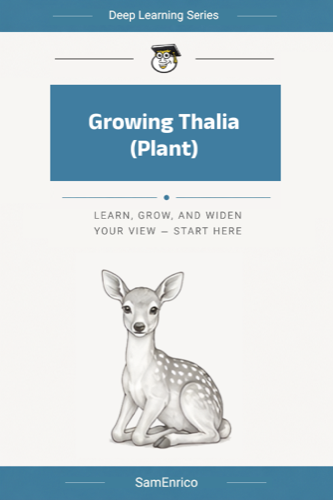
Non-FictionInformativeEducational
Growing Thalia (Plant)
This publication, published by SamEnrico, covers G
This publication, published by SamEnrico, covers Growing Thalia (Plant)
Formats
About this book
Free sample
Chapter 1: The Forgotten Giant...–- On a humid morning in the Florida Everglades, a plant that most gardeners have never heard of rises from the tea-colored water like a prehistoric sentinel. Its blue-green leaves, dusted with a waxy powder that repels both water and hungry insects, stretch toward the sky on stems that can reach the height of a basketball hoop. From late spring to early autumn, purple flowers shaped like delicate arrowheads emerge on branching stalks, each bloom opening for just a single day before being replaced by another in a summer-long performance. This is Thalia—specifically Thalia dealbata, the hardy water canna—and it is one of the most underutilized architectural plants in North American water gardening.The genus Thalia belongs to the Marantaceae family, the same family that includes the popular prayer plants grown as houseplants (Maranta and Calathea). But where its indoor relatives stay low and compact, Thalia reaches for the sky.
The genus name honors Johannes Thal, a 16th-century German physician and botanist who is sometimes called the "father of German plant geography." While Thal never saw the American swamps where these plants grow wild, his name became attached to them through the Linnaean system of classification that rewards early botanical explorers.There are two main species available to gardeners, and understanding the difference between them is the first step toward successful cultivation. The first is Thalia dealbata, known commonly as the hardy water canna, powdery alligator flag, or simply the hardy Thalia. Its specific epithet "dealbata" comes from the Latin word for "whitewashed" or "covered with white powder," referring to the distinctive pruinose coating on its leaves and stems. This waxy bloom serves multiple purposes in the wild: it reflects excess sunlight to prevent leaf burn, it makes the leaves less palatable to herbivorous insects, and it causes water to bead up and roll off, keeping the leaf surface dry and reducing fungal growth. In the garden, this powdery coating gives the plant a striking blue-gray appearance that stands out against the green of most other aquatic plants.Thalia dealbata is the cold-hardy option.
It can withstand winter temperatures down to -15°C (5°F) when properly protected, which means it can be grown as a…
This is the end of the free sample. Get the eBook to keep going. Buy now
Contents
- Chapter 1
- Chapter 2
- Chapter 3
- Chapter 4
- Chapter 5
- Chapter 6
- Chapter 7
- Chapter 8
- Chapter 9
- Chapter 10
- Chapter 11
- Chapter 12
Details
- Author
- Kowalski Shena
- Publisher
- SamEnrico
- Language
- English
- Genre
- Non-Fiction, Informative, Educational
- Released
- 2026-06-02
- Pages (approx.)
- 155
- Available as
- eBook, Audiobook

Read better in the ZLOADR app
Your eBooks on your phone or tablet. Sign in with your SamEnrico account and start reading.
More by Kowalski Shena
 Postpartum Weight Loss Realistic GuideKowalski Shena$11.99
 Lost Child DreamsKowalski Shena$11.99
 ABCDE Method Priority SystemKowalski Shena$11.99
 Ideation Brainstorming MethodsKowalski Shena$11.99
 Bipolar Dark TherapyKowalski Shena$11.99
 Transcendental Meditation for Remote WorkersKowalski Shena$11.99
 Tea Bag Microplastic GuideKowalski Shena$11.99
 Sheppard Case Coroner DisputeKowalski Shena$11.99
 Dream Recall Enhancement CourseKowalski Shena$11.99
 The Great Balloon Race: How a Tiny Town Saved the World’s First Space RaceKowalski Shena$11.99
 The Last Blockbuster: When Video Stores Refused to DieKowalski Shena$11.99
 Frozen Ambition: The Forgotten Arctic Voyages of Juan PizarroKowalski Shena$11.99
You may also like
 Hong Kong Handover 1997Dunn Johnnie$11.99
 Zumba For Postnatal Recovery CourseNeal Christian$11.99
 Zumba for BeginnersLadner Nikia$11.99
 YouTube Comment Mining GuideHumes Pandora$12.99
 Worry Box MeditationCarlin Rudy$11.99
 Workplace Stress MeditationNguyen Lynn$11.99
 Workplace Stress and Sleep RepairHawley Ivory$11.99
 Workplace Perfectionism CureDelaney Jeffry$11.99
 Workplace Injustice Anger GuideWallen Isabelle$11.99
 Work Addiction and Burnout LinkGreenwood Ester$11.99
 Women in Yoga and WellnessBeattie Galina$11.99
 Women in Stand Up ComedyChun Evangeline$11.99