
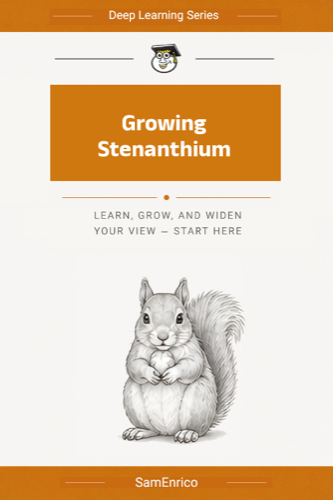
Growing Stenanthium Audiobook
This publication, published by SamEnrico, covers G
This publication, published by SamEnrico, covers Growing Stenanthium
Formats
Free sample
Chapter 1: The Crown of the Meadow...--–- I didn't know I had been poisoned until my fingers went numb.It was a humid July morning in the Pine Barrens of New Jersey, and I had been pulling what I thought was a harmless wild onion from a damp roadside ditch. The plant had grass-like leaves and a delicate cluster of white-green flowers nodding in the heat. Twenty minutes later, my pulse was irregular, my vision blurred at the edges, and the park ranger who found me was asking calmly but urgently if I had touched "any pretty white flowers with leaves like grass."I had. And I had handled them without gloves.The plant was Stenanthium gramineum – Featherbells, yes, but also known in older field guides as Death Camas. The alkaloid in its leaves and rhizomes, a compound called zygacine, is potent enough to slow a human heart to a dangerous rhythm.
The emergency room doctor called it "a close call." I called it the moment I fell in love.That confession may sound strange coming from someone who nearly became a botanical casualty. But here is the truth that most gardening books will not tell you: the most beautiful plants are often the most dangerous, and the most dangerous are often the most worth growing. Stenanthium is not a plant for the timid. It is not a plant for the gardener who wants predictable petunias and obedient marigolds. It is a plant for the rebel, the ecologist, the patient observer, and the person who understands that nature's most exquisite creations do not exist to serve us.
They exist on their own terms, and we are lucky to be invited into their world.This book is that invitation.The Genus That History Forgot Stenanthium belongs to the Melanthiaceae family, a lineage of flowering plants that diverged from the lilies nearly 80 million years ago. Its closest relatives include Veratrum (false hellebore) and the true death camas genus Zigadenus, but Stenanthium occupies its own ecological and morphological niche. The name itself comes from the Greek stenos (narrow) and anthos (flower), referring to the slender, almost thread-like petals that give the inflorescence its characteristic feathery appearance.The genus was first described in 1832 by the German botanist Karl Sigismund Kunth, who worked from specimens collected in the southeastern United States. For most of the nineteenth and twentieth centuries, Stenanthium languished in botanical obscurity –…
This is the end of the free sample. Get the Audiobook to keep going. Buy now
About this book
Details
- Author
- Collier Emmett
- Publisher
- SamEnrico
- Language
- English
- Genre
- Non-Fiction, Informative, Educational
- Released
- 2026-06-02
- Pages (approx.)
- 137
- Available as
- eBook, Audiobook

Listen in the VoxFlicks app
Audiobooks and audio dramas wherever you go. Sign in with your SamEnrico account and press play.
More by Collier Emmett
 Rockefeller and Flagler PartnershipCollier Emmett$11.99
 Sonia Sotomayor WiseCollier Emmett$11.99
 Social Media Comparison and SleepCollier Emmett$11.99
 Secret Cove GuideCollier Emmett$11.99
 Observing Mind Through BreathCollier Emmett$11.99
 Affirmations for Empath ProtectionCollier Emmett$11.99
 Household Chemical Toxin GuideCollier Emmett$11.99
 Sunscreen Anti Aging Protection GuideCollier Emmett$11.99Sunscreen Anti Aging Protection GuideCollier Emmett$11.99
 Coroner Stress ManagementCollier Emmett$11.99
 The Forgotten General: James Armistead Lafayette and the Spies Who Won the RevolutionCollier Emmett$11.99
 Seams of Power: The Untold Story of Pierre Balmain and Post-War ParisCollier Emmett$11.99