
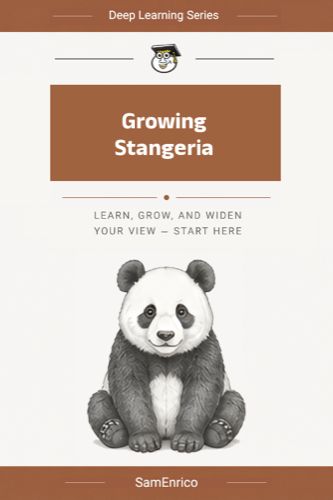
Growing Stangeria
This publication, published by SamEnrico, covers G
This publication, published by SamEnrico, covers Growing Stangeria
Formats
About this book
Free sample
Chapter 1: The Botanical Unicorn...--The first time I saw a living Stangeria eriopus, I didn’t believe what I was looking at.It was growing in the shade house of a private collector in Miami, a man who had spent forty years accumulating cycads from every continent. The plant was unremarkable at first glance—a cluster of fern-like leaves emerging from what looked like a half-buried sweet potato. I leaned closer, running my fingers along the leaf surface. It was not soft like a fern. It was leathery, almost waxy, with a prominent midrib that no true fern possesses.
The collector watched me from across the bench and laughed. “Tricky, isn’t it?” he said. “Looks like one thing, acts like another. That’s the Stangeria curse.”He was right. For nearly a century after its discovery, botanists could not agree on where this plant belonged.
Fern experts claimed it was a fern. Cycad specialists insisted it was a cycad. The argument grew so heated that for a time, the plant was placed in its own family, Stangeriaceae, with no close relatives at all—a botanical orphan. Only in the late twentieth century did DNA sequencing finally resolve the mystery, revealing that Stangeria eriopus is not only a cycad but one of the most ancient and isolated members of the entire group, with a lineage stretching back to the Permian period, more than 250 million years ago.This chapter is the foundation of everything that follows. Before you can grow a Stangeria successfully, you must understand what it is—not just in terms of taxonomy, but in terms of its evolutionary strategy, its anatomy, and its deep-time survival instincts.
A Stangeria does not grow like a fern. It does not behave like a palm. It operates on a timescale that most gardeners find incomprehensible. If you come to this plant expecting rapid growth, instant gratification, or the forgiving nature of a common houseplant, you will fail. But if you understand the botanical unicorn you are inviting into your home, you will discover one of the most rewarding and conversation-starting plants on…
This is the end of the free sample. Get the eBook to keep going. Buy now
Contents
- Chapter 1
- Chapter 2
- Chapter 3
- Chapter 4
- Chapter 5
- Chapter 6
- Chapter 7
- Chapter 8
- Chapter 9
- Chapter 10
- Chapter 11
- Chapter 12
Details
- Author
- Dailey Dortha
- Publisher
- SamEnrico
- Language
- English
- Genre
- Non-Fiction, Informative, Educational
- Released
- 2026-06-02
- Pages (approx.)
- 142
- Available as
- eBook, Audiobook

Read better in the ZLOADR app
Your eBooks on your phone or tablet. Sign in with your SamEnrico account and start reading.
More by Dailey Dortha
 The Childhood Apology Never GivenDailey Dortha$11.99
 Short Breath AwarenessDailey Dortha$11.99
 Comparison Culture for ArtistsDailey Dortha$11.99
 Misty Morning LakeDailey Dortha$11.99
 John Marshall ChiefDailey Dortha$11.99
 Telling Friends About LossDailey Dortha$11.99
 The Self Talk for New Moms GuideDailey Dortha$11.99
 The HIV Vaccine ResearchDailey Dortha$11.99
 Rockefeller University StoryDailey Dortha$11.99
 The Billion-Dollar Bubble: How a Tech Guru Fooled the WorldDailey Dortha$11.99
 The Last Trial of Hypatia: Logic vs. Faith in AlexandriaDailey Dortha$11.99
 Chisel and Charm: The Sculptors Who Defined Western BeautyDailey Dortha$11.99