
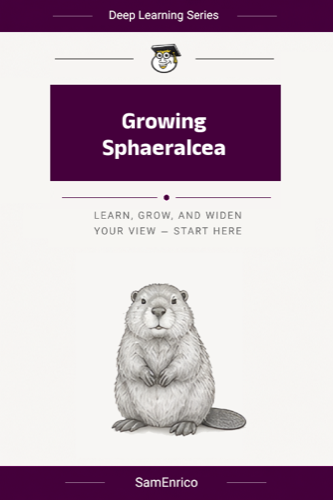
Non-FictionInformativeEducational
Growing Sphaeralcea eBook
This publication, published by SamEnrico, covers G
by Slater Paz
This publication, published by SamEnrico, covers Growing Sphaeralcea
Formats
Free sample
Chapter 1: The Desert’s Secret--–- The first time I killed a globemallow, I was trying to save it. That sentence, more than any botanical data or horticultural credential, is why I wrote this book. I had read the nursery tag that said “drought tolerant” and assumed that meant the plant wanted water—just not too much. So I watered it every few days, the way I watered my tomatoes and my roses. I mulched around its base to keep the soil moist and cool.
I fertilized it with a gentle organic blend because that’s what good gardeners do for their plants. Within six weeks, the once-vibrant orange flowers had faded to brown crisps. The fuzzy gray-green leaves turned yellow, then black at the edges. The stem went soft and collapsed. I had drowned a plant that was evolutionarily designed to thrive in places where rain falls only a few times per year.That failure was my first real lesson in what this book is actually about.
It is not about learning to water less. It is not about memorizing a list of care instructions. It is about unlearning everything that conventional gardening has taught you. The lawn, with its weekly soaking and its perfect green carpet, is a lie we have told ourselves for generations—that nature can be controlled, that water is infinite, that beauty requires struggle. The globemallow exposes that lie.
It asks nothing of you except to be left alone. And in return, it offers something that no amount of fertilizer or irrigation can produce: a genuine, untamed, breathtaking beauty that belongs to the place where you live, not to some English countryside or suburban ideal.This is the promise of Growing Sphaeralcea. By the time you finish this book, you will understand not just how to keep this plant alive, but why it wants to live for you. You will learn to see your yard—whether it is a quarter-acre suburban lot, a rocky hillside, a narrow hell strip between sidewalk and curb, or a collection of pots on an apartment balcony—as the perfect habitat for a plant that has spent millions of years perfecting the art of survival. And you will discover, perhaps for the first time, what it feels like to garden with the land instead of against it.The Misunderstood Mallow Let us begin with the name itself, because it causes no small amount of confusion.
Sphaeralcea belongs to the Malvaceae family, the same family that includes the common marsh mallow (Althaea officinalis), the plant whose mucilaginous roots originally gave us the confection we now call marshmallow. It also includes hollyhocks, hibiscus, and okra. These are plants that, by and large, love water. They grow in ditches, along stream banks, in richly irrigated flower borders. So when a gardener hears “mallow,” they picture moisture.
They picture soft, lush growth. They picture a plant that will wilt dramatically if you forget to water for two days.Sphaeralcea is none of those things.The name itself comes from Greek: sphaira meaning “sphere” and alkea meaning “mallow.” The “sphere” refers to the rounded shape of its seed capsules, not to any plumpness in the leaves or stems. And the “mallow” is a taxonomic convenience, not an ecological indicator. This plant diverged from its water-loving cousins millions of years ago, adapting to the increasingly arid climate of the American Southwest as the Rocky Mountains rose and redirected weather patterns. While its relatives stayed in the wet places, Sphaeralcea moved into the dry washes, the rocky slopes, the sun-baked plains where summer temperatures regularly exceed 100 degrees Fahrenheit and annual rainfall rarely reaches fifteen inches.To understand this plant, you must understand that its entire evolutionary strategy is built around scarcity.
Every leaf, every stem, every root, every flower petal has been shaped by the pressure to survive with almost nothing. The fuzzy gray-green leaves, for example, are covered in tiny star-shaped hairs called trichomes. Under a microscope, these hairs look like little white stars. Their function is not decoration. They reflect sunlight, reducing the amount of heat absorbed by the leaf.
They trap a thin layer of humid air against the leaf surface, reducing water loss through transpiration. And they give the plant its distinctively soft, gray appearance—a color that blends into the limestone and granite of its native habitat, making it less visible to browsing animals.The deep taproot, which can reach fifteen feet into the earth in its natural habitat, is not an accident. It is a well. During the rare desert rains, water percolates deep into the soil profile. The taproot follows it down, accessing moisture that shallower-rooted plants cannot reach.
Then, during the long dry months, the plant draws on that deep reservoir, slowly, efficiently, without any visible sign of stress. Above ground, the plant may look like it is barely hanging on. The leaves may curl slightly. The stems may lean. But below ground, a vast network of roots is sustaining life on a budget that would kill a rosebush in a week.The Flowers That Fool You And then there are the flowers.
If the rest of the plant is an exercise in restraint, the flowers are an explosion of profligacy. They arrive in spring, typically February through May depending on the species and elevation, and they are astonishing. The petals are thin as crepe paper, translucent when backlit by the morning sun, in colors that range from blazing orange to soft apricot to magenta to lavender to pure white. Each flower lasts only a day or two, but the plant produces them in such succession that the blooming period can stretch for ten weeks or more.This floral strategy is also an adaptation to scarcity. In an environment where pollinators are unpredictable and rainfall is sporadic, the plant cannot afford to produce a single massive bloom that might be missed by bees or killed by an untimely heat wave.
Instead, it produces a continuous stream of flowers, each one a small bet on the future. Some will be pollinated. Some will not. Some will set seed. Some will wither.
But the overall strategy ensures that no matter what the weather does, at least some of the flowers will succeed.The flowers have another secret. They are not actually orange. Or rather, they are orange in a way that our eyes perceive but that bees perceive entirely differently. Bees see in the ultraviolet spectrum, and the petals of Sphaeralcea flowers have ultraviolet patterns—landing guides—that are invisible to us but glow like runway lights to a bee. What looks to us like a solid orange petal is, to a bee, a map leading straight to the nectar.
This is why globemallow flowers are always buzzing with native bees, even on days when other flowers in the garden seem ignored. The plant has evolved a communication system with its pollinators that bypasses human perception entirely.The Geography of Resilience Before we go any further, let me tell you where this plant comes from. Sphaeralcea is native to western North America, from the dry side of the Cascade Range in the Pacific Northwest, down through the Great Basin, across the…
This is the end of the free sample. Get the eBook to keep going. Buy now
About this book
Details
- Author
- Slater Paz
- Publisher
- SamEnrico
- Language
- English
- Genre
- Non-Fiction, Informative, Educational
- Released
- 2026-05-11
- Pages (approx.)
- 129
- Available as
- eBook, Audiobook

Read better in the ZLOADR app
Your eBooks on your phone or tablet. Sign in with your SamEnrico account and start reading.
More by Slater Paz
 Writing Platform Comparison GuideSlater Paz$11.99
 Gambling Employment Risk GuideSlater Paz$11.99
 Financial Stress And Tax Anxiety GuideSlater Paz$11.99
 Cultural Trauma Dream ThemesSlater Paz$11.99
 Henry Ford BiographySlater Paz$11.99
 Imposter Syndrome And Childhood TraumaSlater Paz$11.99
 The Parent as Therapist ChildSlater Paz$11.99
 The Booster Shot ScheduleSlater Paz$11.99
 Secondary Infertility After LossSlater Paz$11.99
 Caesar and Pompey: The Blood Feud That Shattered RomeSlater Paz$11.99
 The Last Dive: The Unsinkable Truth of the USS ScorpionSlater Paz$11.99
 The Great Space Potato Rescue: How Scientists Saved a Cosmic Spud!Slater Paz$11.99
You may also like
 Hong Kong Handover 1997Dunn Johnnie$11.99
 Zumba For Postnatal Recovery CourseNeal Christian$11.99
 Zumba for BeginnersLadner Nikia$11.99
 YouTube Comment Mining GuideHumes Pandora$12.99
 Worry Box MeditationCarlin Rudy$11.99
 Workplace Stress MeditationNguyen Lynn$11.99
 Workplace Stress and Sleep RepairHawley Ivory$11.99
 Workplace Perfectionism CureDelaney Jeffry$11.99
 Workplace Injustice Anger GuideWallen Isabelle$11.99
 Work Addiction and Burnout LinkGreenwood Ester$11.99
 Women in Yoga and WellnessBeattie Galina$11.99
 Women in Stand Up ComedyChun Evangeline$11.99