
Non-FictionInformativeEducational
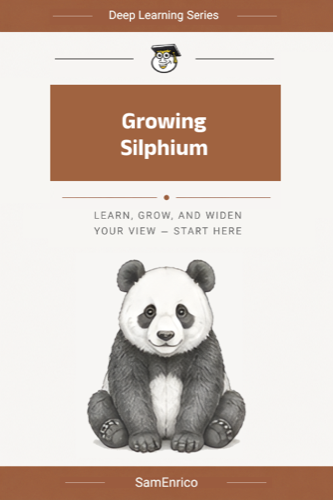
Growing Silphium eBook
This publication, published by SamEnrico, covers G
by Hopper Nyla
This publication, published by SamEnrico, covers Growing Silphium
Formats
Free sample
Chapter 1: The Tallgrass Invitation...--For most gardeners, the journey toward a deeper relationship with the land begins not with a grand revelation but with a quiet disappointment. You plant your tomatoes, water your roses, and tend your annuals with the devotion of a new parent, only to watch them wilt under the July sun or succumb to the first autumn frost. You read the catalogs with their glossy photographs and breathless promises, and you order the perennials that are supposed to return year after year, only to discover that "perennial" in the nursery trade often means "lives for three seasons if you are very lucky and pray for rain." You begin to suspect that the gardening industry has sold you a fantasy: that the path to a beautiful, resilient landscape is paved with constant intervention, endless watering, and an annual pilgrimage to the garden center to replace everything that died.You are not wrong.The modern ornamental gardening industry, for all its virtues, has largely abandoned the plants that once formed the backbone of North America's landscapes. In their place, we have been offered a revolving door of exotic species—Asian azaleas, European boxwoods, South American verbenas—that require precisely the conditions of their homelands to thrive. When those conditions do not materialize (and they rarely do without extensive amendment), these plants falter.
We blame ourselves. We buy more fertilizer, more compost, more irrigation timers. We spend our weekends coaxing life from soil that was never meant to support these botanical tourists. And we never stop to ask the obvious question: what if we grew the plants that actually want to be here?This book is an answer to that question. It is an invitation to meet the genus Silphium, a group of native North American perennials that ask almost nothing of you and give everything back.
They are called compass plants, cup plants, rosinweeds, and prairie docks—names that hint at their strangeness and their utility. They are giants of the tallgrass prairie, the ecological engineers that once held together the most biodiverse grassland ecosystem on the continent. They have taproots that plunge fifteen feet into the earth, stems that hold rainwater for birds, and resinous sap that repels pests without the need for sprays or powders. They bloom for weeks in high summer with sun-yellow flowers that draw bees, butterflies, and beneficial wasps by the dozens. They live for decades, require no division, no staking (if grown correctly), and no irrigation after their third year.
They are, quite simply, the most forgiving, resilient, and ecologically valuable perennials that most gardeners have never heard of.And that is a tragedy. But it is also an opportunity.The Weed Versus the Wildflower Before we can appreciate what Silphium offers, we must confront a prejudice that runs deep in the American gardening psyche: the distinction between a "weed" and a "wildflower." This distinction has almost nothing to do with botany and almost everything to do with cultural fashion. A weed, in the conventional definition, is simply a plant growing where it is not wanted. But the term carries a heavier load than that. Weeds are plants we have decided are ugly, aggressive, or worthless.
They are the plants we spray, pull, and curse. They are the plants we assume have no value because we have never been taught otherwise.Silphium species have suffered from this prejudice for generations. Drive through the rural Midwest in late summer, and you will see Silphium growing in roadside ditches, along fencerows, and at the edges of agricultural fields. To the untrained eye, these plants look like large, coarse weeds—tall, rough-leaved, and unapologetically wild. They do not have the cultivated refinement of a hybrid tea rose or the tidy habit of a boxwood hedge.
Their leaves are often sandpapery to the touch. Their stems exude a sticky gum that can cling to your fingers. Their flower heads, while bright yellow, are smaller and more modest than the dinner-plate blooms of domesticated sunflowers.But these superficial judgments miss everything that matters. The same plants that look like weeds to a passing motorist are, upon closer inspection, botanical marvels. The rough leaves of the compass plant orient themselves north-south to reduce water loss.
The sticky gum of the rosinweed is a natural insecticide. The water-holding cups of the cup plant create miniature wetlands that sustain birds and beneficial insects through the driest months. These are not flaws. These are adaptations honed over millions of years of evolution in a landscape defined by fire, drought, grazing, and extreme temperature swings.The question, then, is not whether Silphium is a weed. The question is whether we are willing to see it differently.The Lost World of the Tallgrass Prairie To understand Silphium, you must understand the world that shaped it.
That world no longer exists, except in scattered fragments. The tallgrass prairie once stretched from what is now Indiana west to Kansas, and from Canada south to Texas—a vast sea of grasses and wildflowers covering approximately 170 million acres. This was not the monotonous grassland that early European settlers described in their journals as "a desert of weeds" or "an ocean of grass." The tallgrass prairie was one of the most biodiverse ecosystems on Earth, supporting over three hundred species of plants per acre in some areas, along with bison, elk, prairie chickens, and countless smaller animals. Beneath the surface, a hidden world of roots and mycorrhizae held the soil in place, storing carbon and water in quantities that modern agricultural soils can only dream of matching.Silphium was a keystone genus in this system—a term ecologists use to describe a species whose presence shapes the entire community around it. In the tallgrass prairie, Silphium plants served as structural pillars.
Their deep taproots held the soil against wind and water erosion. Their tall stems (some reaching twelve feet) provided perches for songbirds and nesting sites for solitary bees. Their flowers produced nectar and pollen during the hottest, driest part of the summer, when many other plants had already gone to seed. Their leaves and stems, even after death, remained standing through the winter, catching snow that would otherwise blow away and melting into the soil come spring.The prairie was also a system defined by disturbance. Fires, started by lightning or by Indigenous peoples, swept across the landscape every one to three years, killing tree seedlings and woody shrubs while leaving prairie plants largely unharmed.
Grazing by bison and elk cropped the grasses to the ground, recycling nutrients and opening space for new growth. Droughts, sometimes lasting multiple years, tested every plant's ability to find water. Silphium evolved in this crucible of fire, hooves, and aridity. The deep taproot that seems excessive for a garden perennial was, in the prairie, a survival necessity. The resin that makes the plant sticky and unpalatable was a defense against grazing insects and mammals.
The late spring emergence (Silphium often does not appear above ground until May, long after most perennials have leafed out) was an adaptation to fire—by staying dormant underground through the early spring burn season, Silphium avoided having its new growth incinerated.Less than four percent of the original tallgrass…
This is the end of the free sample. Get the eBook to keep going. Buy now
About this book
Details
- Author
- Hopper Nyla
- Publisher
- SamEnrico
- Language
- English
- Genre
- Non-Fiction, Informative, Educational
- Released
- 2026-05-07
- Pages (approx.)
- 142
- Available as
- eBook, Audiobook

Read better in the ZLOADR app
Your eBooks on your phone or tablet. Sign in with your SamEnrico account and start reading.
More by Hopper Nyla
 The HPV Vaccination GuideHopper Nyla$11.99
 Side Hustle For Stress Relief GuideHopper Nyla$11.99
 The Affirmation Visualization ComboHopper Nyla$11.99
 Food Blogger Recipe PerfectionismHopper Nyla$11.99
 Childhood Physical Punishment WoundsHopper Nyla$11.99
 Imposter Syndrome For New ParentsHopper Nyla$11.99
 Thunberg Documentary FilmsHopper Nyla$11.99
 Manson Family EscapeeHopper Nyla$11.99
 Adversity Growth GuideHopper Nyla$11.99
 The Chrononaut's Paradox: How Einstein's Twin Experiment Split Physics ForeverHopper Nyla$11.99
 The Serpent’s Gambit: How a Trickster God Forged the WorldHopper Nyla$11.99
 The Hollow Crown: Merlin’s Last SecretHopper Nyla$11.99
You may also like
 Hong Kong Handover 1997Dunn Johnnie$11.99
 Zumba For Postnatal Recovery CourseNeal Christian$11.99
 Zumba for BeginnersLadner Nikia$11.99
 YouTube Comment Mining GuideHumes Pandora$12.99
 Worry Box MeditationCarlin Rudy$11.99
 Workplace Stress MeditationNguyen Lynn$11.99
 Workplace Stress and Sleep RepairHawley Ivory$11.99
 Workplace Perfectionism CureDelaney Jeffry$11.99
 Workplace Injustice Anger GuideWallen Isabelle$11.99
 Work Addiction and Burnout LinkGreenwood Ester$11.99
 Women in Yoga and WellnessBeattie Galina$11.99
 Women in Stand Up ComedyChun Evangeline$11.99