
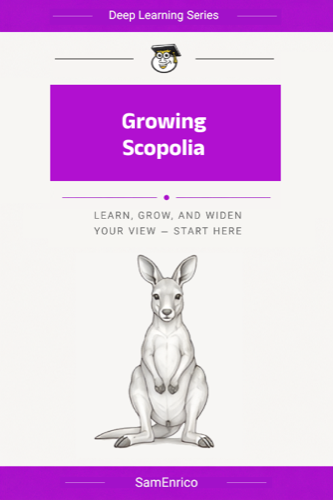
Non-FictionInformativeEducational
Growing Scopolia Audiobook
This publication, published by SamEnrico, covers G
by Hiatt Celina
This publication, published by SamEnrico, covers Growing Scopolia
Formats
Free sample
Chapter 1: The Forgotten Nightshade...-- The first time I held a Scopolia seed, I nearly threw it away. It was the size of a poppy seed, brownish-gray, unremarkable—the kind of thing you'd brush off a kitchen counter without a second thought. But inside that speck of organic matter lay a genetic legacy stretching back millions of years, a chemical arsenal capable of stopping a human heart, and a mystery that had confounded botanists, pharmacists, and poison enthusiasts for two centuries. This was not Atropa belladonna. This was not henbane or mandrake or angel's trumpet.
This was Scopolia—the nightshade that history forgot.The Plant That Has Everything Except Fame In the vast and infamous family Solanaceae, certain members have achieved celebrity status. Belladonna appears in Shakespeare and Gothic novels. Henbane was a staple of medieval witchcraft trials. Mandrake screams (allegedly) when uprooted, fetching astronomical prices in Harry Potter films and actual Renaissance apothecaries. Tobacco built empires.
Potatoes and tomatoes fed continents. Even the lowly petunia, a Solanaceae cousin, decorates millions of suburban gardens.Scopolia has none of this name recognition. Yet it possesses everything that makes the nightshade family simultaneously alluring and dangerous: tropane alkaloids that hijack the nervous system, a history of medical use stretching back to the Habsburg Empire, and cultivation requirements that reward patience with breathtaking spring flowers. The genus Scopolia—named for the Tyrolean naturalist Giovanni Antonio Scopoli, a contemporary and rival of Carl Linnaeus—contains three primary species distributed across southeastern Europe, Japan, and the Caucasus. These perennial herbs have evolved to thrive in the dappled shade of deciduous forests, emerging early in spring before the canopy closes, flowering in a riot of purple and yellow-brown bells, then retreating into underground rhizomes during summer heat or winter cold.But why has Scopolia remained obscure while its cousins bask in notoriety?
The answer lies in a perfect storm of geographic isolation, regulatory accident, and sheer horticultural snobbery.The Geographic Accident Scopolia carniolica, the type species, grows wild in a narrow band of southeastern Europe stretching from northern Italy through Slovenia, Croatia, Bosnia, and into Romania. This region—the Dinaric Alps and the Carpathian foothills—has never been a botanical crossroads. Unlike the Mediterranean basin, which has been scoured by plant collectors for centuries, the interior Balkans remained linguistically fractured, politically turbulent, and logistically difficult for Western European naturalists. Scopoli himself described the genus from specimens collected near Ljubljana…
This is the end of the free sample. Get the Audiobook to keep going. Buy now
About this book
Details
- Author
- Hiatt Celina
- Publisher
- SamEnrico
- Language
- English
- Genre
- Non-Fiction, Informative, Educational
- Released
- 2026-05-11
- Pages (approx.)
- 158
- Available as
- eBook, Audiobook

Listen in the VoxFlicks app
Audiobooks and audio dramas wherever you go. Sign in with your SamEnrico account and press play.
More by Hiatt Celina
 Thunberg Sailing AtlanticHiatt Celina$11.99
 Student Social Anxiety GuideHiatt Celina$11.99
 Nicotine Cessation Mobile Apps GuideHiatt Celina$11.99
 The Self Kindness PracticeHiatt Celina$11.99
 The Collaborative Problem ReversalHiatt Celina$11.99
 Daniel Webster LibertyHiatt Celina$11.99
 Habit Visualization GuideHiatt Celina$11.99
 Customer Service Burnout ShieldHiatt Celina$11.99
 The Southern Lights: New Zealand's Pioneers of the StarsHiatt Celina$11.99
 The Last Charge of the Red Lancers: Love and Valor on the Steppes (1812)Hiatt Celina$11.99
 How to Become a Sanding-machine OperatorHiatt Celina$11.99
 Contract Risk AnalysisHiatt Celina$11.99
You may also like
 Hong Kong Handover 1997Dunn Johnnie$11.99
 Zumba For Postnatal Recovery CourseNeal Christian$11.99
 Zumba for BeginnersLadner Nikia$11.99
 YouTube Comment Mining GuideHumes Pandora$12.99
 Worry Box MeditationCarlin Rudy$11.99
 Workplace Stress MeditationNguyen Lynn$11.99
 Workplace Stress and Sleep RepairHawley Ivory$11.99
 Workplace Perfectionism CureDelaney Jeffry$11.99
 Workplace Injustice Anger GuideWallen Isabelle$11.99
 Work Addiction and Burnout LinkGreenwood Ester$11.99
 Women in Yoga and WellnessBeattie Galina$11.99
 Women in Stand Up ComedyChun Evangeline$11.99