

Non-FictionInformativeEducational
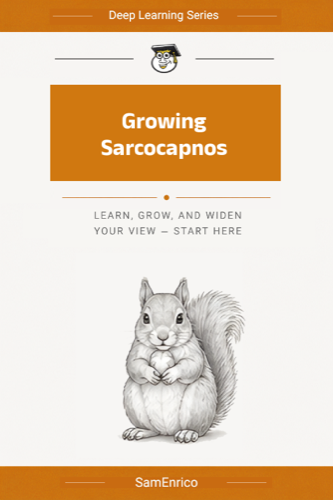
Growing Sarcocapnos eBook
This publication, published by SamEnrico, covers G
This publication, published by SamEnrico, covers Growing Sarcocapnos
Formats
Free sample
Chapter 1: The Limestone Eaters--–- Most gardeners kill Sarcocapnos with kindness. They water it like a petunia, plant it in rich loam like a tomato, and fertilize it like a rose. Then they watch in confusion as the ethereal blue-grey foliage turns yellow, collapses into a wet mush, and dies within a single season. The plant is not difficult. It is simply misunderstood.
Sarcocapnos does not want what other plants want. It does not crave deep organic soil. It does not need weekly feeding. It does not appreciate afternoon shade in the same way a hosta does. What Sarcocapnos wants is to eat stone.This opening chapter establishes the fundamental truth that underpins everything else in this book: Sarcocapnos is a lithophyte, a plant that lives on rock.
Not in rock crevices incidentally, not tolerating poor soil as a survival strategy, but actively, aggressively, and obligately adapted to dissolve limestone with its own roots. Understanding what that means transforms every subsequent decision you will make as a gardener – where you plant, what you plant in, how much water you give, and whether you ever reach for a fertilizer bottle again.Before we dive into the practical mechanics of cultivation, we must first understand the plant’s identity, its evolutionary heritage, its native habitats, and the three species most likely to appear in your garden. This chapter provides the taxonomic foundation, the geographic context, and the species-level choices that will determine your success. By the end, you will not only know what Sarcocapnos is but also why it behaves the way it does – and why the standard rulebook of gardening does not apply.A Family Secret: The Poppy Connection The first surprise awaiting most new growers is that Sarcocapnos belongs to the poppy family. Not the Fumariaceae, as many older references claim, but the Papaveraceae – the same family that brings us the opium poppy, the California poppy, and the familiar red corn poppy of European fields.
This taxonomic placement was settled definitively by molecular phylogenetic studies in the early twenty-first century, which demonstrated that the fumitories (including Sarcocapnos, Corydalis, and Fumaria) are deeply nested within the poppy lineage rather than forming a separate family.Why does this matter to the gardener? Because the poppy family has consistent traits that manifest in Sarcocapnos in unexpected ways. All Papaveraceae produce milky or colored sap – Sarcocapnos exudes a clear, slightly sticky fluid from broken stems, a defense against herbivores. All produce flowers with twice the number of petals as sepals – Sarcocapnos has four petals, two small outer ones and two larger inner ones that form the characteristic spur. And perhaps most relevant for the grower, all poppy family members despise transplanting.
Their taproots, even when reduced to the shallow fibrous system of Sarcocapnos, resent disturbance. This is one reason why seeds and cuttings outperform purchased mature plants, a topic we will explore fully in Chapter 5.The confusion with Fumariaceae persists in older horticultural literature because Sarcocapnos shares several superficial traits with true fumitories: finely divided leaves, spurred flowers, and a preference for calcareous habitats. But the fruit tells the true story. Corydalis produces a capsule that splits open along seams. Fumaria produces a single-seeded nutlet.
Sarcocapnos produces a long, necklace-like pod that dehisces explosively, each segment containing a single seed equipped with a fleshy appendage called an elaiosome. This elaiosome attracts ants, which carry the seeds back to their nests, eat the fatty appendage, and deposit the seed in a nutrient-rich underground chamber. This myrmecochory – seed dispersal by ants – is a sophisticated adaptation to cliff life. The ants do the work of finding crevices for the next generation.Where They Come From: The Limestone Cliffs of the Western Mediterranean To understand Sarcocapnos, you must visit its homeland in your imagination if not in person. The genus is restricted to the western Mediterranean basin, with a distribution that traces the ancient coastlines of the Tethys Sea.
The highest diversity occurs in the Baetic Mountains of southern Spain, particularly the Sierra Nevada, where limestone outcrops rise from near sea level to over three thousand meters. From there, the range extends northward into the Pyrenees, westward across the Atlas Mountains of Morocco, and eastward along the limestone gorges of southern France and the Ligurian coast of Italy.Every native habitat shares three non-negotiable characteristics. First, the bedrock is limestone or dolomite – calcium carbonate or magnesium calcium carbonate. Sarcocapnos does not occur on granite, sandstone, shale, or any other rock type. It is an obligate calcicole, a calcium-lover, and it will not thrive in its absence.
Second, the habitat is vertical or near-vertical. You will find Sarcocapnos on cliff faces, gorge walls, overhanging rock shelters, and ancient mortared walls – anywhere that rain does not pool and organic matter does not accumulate. Third, the exposure is neither full sun nor deep shade but something in between. Most populations face east or west, receiving direct morning or evening sun but protected from the scorching midday rays. South-facing cliffs in the Mediterranean are too hot and dry; north-facing cliffs are too dark and damp.In the Sierra Nevada, Sarcocapnos enneaphylla grows between 800 and 2,200 meters elevation, clinging to dolomitic limestone crevices that receive only a few hours of direct sun per day.
The plants share their habitat with a remarkable assemblage of endemic alpines: the blue-flowered Gentiana sierrae, the cushion-forming Arenaria tetraquetra, and the bizarre, fleshy Sedum dasyphyllum. Winter temperatures drop below freezing, and snow cover persists for weeks or months. Summer temperatures exceed 30°C, and rain may not fall for two or three consecutive months. Sarcocapnos survives these extremes not by brute tolerance but by strategic withdrawal. During the hot, dry summer, it enters a restive phase – not true dormancy, but a dramatic slowing of metabolic activity.
The leaves take on a greyish, waxy appearance as they reduce water loss. New growth ceases. The plant waits.In the Pyrenees, Sarcocapnos crassifolia occupies a slightly different niche: lower elevations, warmer winters, and slightly more organic accumulation in crevices. This species has thicker, more succulent leaves than S. enneaphylla, an adaptation to slightly drier conditions.
It also tolerates a broader range of exposures, including nearly full sun in the cool, cloudy climate of the Basque Country.In the Atlas Mountains of Morocco, a third species, Sarcocapnos speciosa, occupies the most extreme habitat of all: vertical limestone faces in semi-arid gorges where summer temperatures exceed 40°C and rain falls only during winter storms. This species has the largest flowers of the genus, pinkish-white with a prominent spur, and it is also the rarest and most threatened.Understanding these native habitats is not an academic exercise. It is the key to successful cultivation. When you recreate a plant's native conditions, you stop fighting biology and start working with it. A Sarcocapnos planted in rich, water-retentive soil is a Sarcocapnos that will rot.
A Sarcocapnos planted in a vertical crevice of limestone grit, receiving morning sun and afternoon shade, watered deeply but infrequently, is a Sarcocapnos that will thrive for decades.The Three Species You Will Actually Grow The genus Sarcocapnos contains approximately seven recognized species, depending on which taxonomist you consult. Three of them appear regularly in cultivation. The others are either impossibly rare, indistinguishable from…
This is the end of the free sample. Get the eBook to keep going. Buy now
About this book
Details
- Author
- Roberts Julius
- Publisher
- SamEnrico
- Language
- English
- Genre
- Non-Fiction, Informative, Educational
- Released
- 2026-06-02
- Pages (approx.)
- 156
- Available as
- eBook, Audiobook

Read better in the ZLOADR app
Your eBooks on your phone or tablet. Sign in with your SamEnrico account and start reading.
More by Roberts Julius
 Group Project Conflict ResolutionRoberts Julius$11.99
 The Group Voting TournamentRoberts Julius$11.99
 Dream Journaling for RetreatsRoberts Julius$11.99
 Social Media Self Esteem FixRoberts Julius$11.99
 HGH and Menopause TransitionRoberts Julius$11.99
 TM for Software DevelopersRoberts Julius$11.99
 Bipolar Advanced Directive CourseRoberts Julius$11.99
 HGH And ZincRoberts Julius$11.99
 Bulgarian Green Tax CreditsRoberts Julius$11.99
 The Shadow Cabinet: How the Earl of Liverpool Secretly Ruled BritainRoberts Julius$11.99
 The Velvet Underground & Nico: Exploding the Art of SoundRoberts Julius$11.99
 Lost and Found: Stanley, Livingstone, and the Secret Maps of AfricaRoberts Julius$11.99
You may also like
 Hong Kong Handover 1997Dunn Johnnie$11.99
 Zumba For Postnatal Recovery CourseNeal Christian$11.99
 Zumba for BeginnersLadner Nikia$11.99
 YouTube Comment Mining GuideHumes Pandora$12.99
 Worry Box MeditationCarlin Rudy$11.99
 Workplace Stress MeditationNguyen Lynn$11.99
 Workplace Stress and Sleep RepairHawley Ivory$11.99
 Workplace Perfectionism CureDelaney Jeffry$11.99
 Workplace Injustice Anger GuideWallen Isabelle$11.99
 Work Addiction and Burnout LinkGreenwood Ester$11.99
 Women in Yoga and WellnessBeattie Galina$11.99
 Women in Stand Up ComedyChun Evangeline$11.99