
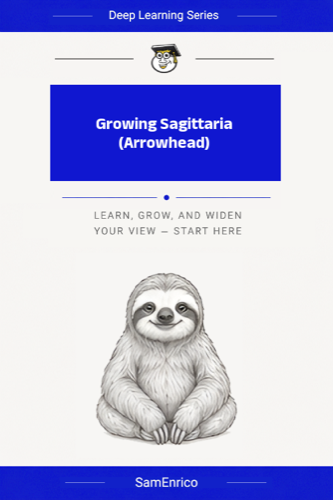
Non-FictionInformativeEducational
Growing Sagittaria (Arrowhead)
This publication, published by SamEnrico, covers G
This publication, published by SamEnrico, covers Growing Sagittaria (Arrowhead)
Formats
About this book
Free sample
Chapter 1: The Arrow That Feeds...--In the shallow, muddy margins of North American rivers, where herons stalk and turtles bask, grows a plant that has quietly sustained civilizations, decorated the world's most beautiful aquariums, and puzzled botanists for centuries. Its leaves rise from the water like green spearpoints, unmistakable once seen, unforgettable once known. Its underground tubers, harvested by Indigenous peoples for millennia, contain enough starch to rival the potato. Its dwarf cousin, no taller than a finger, carpets the floors of Japanese-inspired aquascapes, winning international competitions. This plant, this single genus, is Sagittaria—commonly known as Arrowhead, Duck Potato, or, in the aquarium trade, the humble "carpet plant" that refuses to behave like one.If you are reading this book, you have likely encountered Sagittaria already.
Perhaps you bought a small pot of Sagittaria subulata from an aquarium store, planted it in your nano tank, and watched in confusion as its slender green blades melted into brown slime within a week. Perhaps you planted Sagittaria latifolia along the edge of your backyard pond, hoping for those dramatic arrowhead leaves, only to see it spread like a green invasion across every square inch of available mud. Or perhaps you have never grown it at all, but you have tasted its tuber in a Chinese stir-fry (ci gu) or read about "wapato" in foraging guides and wondered: could this be the perennial starch crop my permaculture garden is missing?Whatever brought you here, you have come to the right place. But before we dive into propagation, water chemistry, or harvest techniques, we must first answer a more fundamental question: What is Sagittaria, really? And why does the answer to that question determine whether you succeed or fail?The Genus That Bridges Three Worlds Sagittaria belongs to the Alismataceae family, the water plantains—a lineage of aquatic and semi-aquatic flowering plants that have existed since the late Cretaceous period, roughly 70 million years ago.
Fossil evidence places ancestral Sagittaria in North America and Eurasia during the Paleocene, suggesting that the genus survived the asteroid impact that killed the dinosaurs. This is not a…
This is the end of the free sample. Get the eBook to keep going. Buy now
Contents
- Chapter 1
- Chapter 2
- Chapter 3
- Chapter 4
- Chapter 5
- Chapter 6
- Chapter 7
- Chapter 8
- Chapter 9
- Chapter 10
- Chapter 11
- Chapter 12
Details
- Author
- Tiller Hermina
- Publisher
- SamEnrico
- Language
- English
- Genre
- Non-Fiction, Informative, Educational
- Released
- 2026-05-18
- Pages (approx.)
- 149
- Available as
- eBook, Audiobook

Read better in the ZLOADR app
Your eBooks on your phone or tablet. Sign in with your SamEnrico account and start reading.
More by Tiller Hermina
 HGH Myths Debunked GuideTiller Hermina$11.99
 Team Visual Metaphor MethodTiller Hermina$11.99
 Student Depression Management GuideTiller Hermina$11.99
 Diamond Heist Masterpiece ComparisonTiller Hermina$11.99
 Customer Name Peg SystemTiller Hermina$11.99
 TM for University ProfessorsTiller Hermina$11.99
 IGF-1 And AgingTiller Hermina$11.99
 Finnish Green Incentives GuideTiller Hermina$11.99
 Training Camp Grit ManualTiller Hermina$11.99
 The Lost Codex of the Forgotten PharaohTiller Hermina$11.99
 The Invisible Shield: How a Forgotten Patent Saved Millions from RadiationTiller Hermina$11.99
 Claude Debussy: The Impressionist Who Painted with SoundTiller Hermina$11.99
You may also like
 Hong Kong Handover 1997Dunn Johnnie$11.99
 Zumba For Postnatal Recovery CourseNeal Christian$11.99
 Zumba for BeginnersLadner Nikia$11.99
 YouTube Comment Mining GuideHumes Pandora$12.99
 Worry Box MeditationCarlin Rudy$11.99
 Workplace Stress MeditationNguyen Lynn$11.99
 Workplace Stress and Sleep RepairHawley Ivory$11.99
 Workplace Perfectionism CureDelaney Jeffry$11.99
 Workplace Injustice Anger GuideWallen Isabelle$11.99
 Work Addiction and Burnout LinkGreenwood Ester$11.99
 Women in Yoga and WellnessBeattie Galina$11.99
 Women in Stand Up ComedyChun Evangeline$11.99