
Non-FictionInformativeEducational
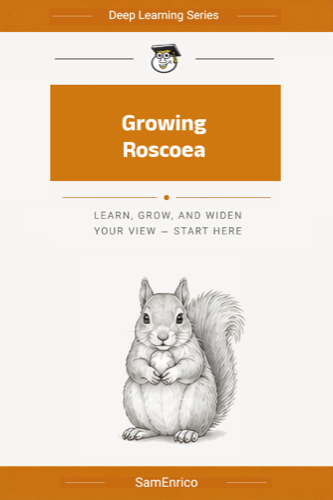
Growing Roscoea eBook
This publication, published by SamEnrico, covers G
by Elrod Dong
This publication, published by SamEnrico, covers Growing Roscoea
Formats
Free sample
Chapter 1: The Orchid Lie--– Every gardener remembers the moment they were fooled. For me, it was a damp April afternoon at a rural nursery in the Hudson Valley, a place known for its eccentric selection of woodland perennials. Tucked between a stand of epimediums and a fading trillium, I spotted a plant that stopped me mid-stride. Its flowers—just beginning to unfurl from tight buds—were unmistakably orchid-like: a broad, lip-shaped petal in deep purple, flanked by two smaller wings, all emerging from a cluster of narrow, bamboo-like leaves. The price tag read "Hardy Orchid Mix – $24.99." I bought two without hesitation, imagining myself as the gardener who had cracked the code on growing tropical orchids outdoors in a New York winter.That first growing season was a triumph.
The plants bloomed steadily through June and July, drawing comments from every visitor. "Is that really an orchid?" they would ask. "It must be in a greenhouse." I would smile and explain, with more confidence than knowledge, that I had simply found a hardy variety. Then autumn came. The leaves yellowed, the stems collapsed, and by November, both plants had vanished completely—not a trace of green above the soil line.
I assumed the worst. A mild winter followed by a warm March prompted me to dig up the "dead" roots to make room for annuals. My trowel hit something fleshy. I pulled up a cluster of pale, worm-like tubers, still firm and alive. I had just destroyed my plants through impatience.That moment of loss and embarrassment became the beginning of an obsession.
I learned that the plant I had killed was not an orchid at all. It belonged to the ginger family, Zingiberaceae, the same botanical tribe that gives us culinary ginger, turmeric, and cardamom. But unlike its tropical cousins, this ginger had evolved in the high mountains of the Himalayas and China, where summers are wet and cool, winters are dry and brutally cold, and the soil drains as sharply as a scree slope. The plant I had buried in my heavy, wet, clay-based garden soil—and then dug up in spring—had been trying to survive conditions exactly opposite to what it needed. It never had a chance.That plant was a Roscoea.
And the reason most gardeners have never heard of it, despite its extraordinary beauty and surprising hardiness, is precisely because of the mistake I made. Roscoea suffers from what I have come to call the Orchid Lie—the persistent, misleading belief that because its flowers resemble orchids, it must be grown like one. Nothing could be further from the truth. Orchids, for the most part, are epiphytes that grow on trees, require air circulation around their roots, and demand specific humidity and temperature ranges. Roscoea is a terrestrial perennial that grows in mountain meadows and forest clearings, pushing its fleshy roots through gravelly, humus-rich soil while its shoots emerge through last year's dead grass.
Treating Roscoea like an orchid is a recipe for rot, frustration, and the compost heap.This book exists to correct that error and to do something more: to introduce a wider audience to a genus that deserves a place in every shade garden, rock garden, and collector's trough from the Pacific Northwest to the English countryside. Roscoea is not a plant for the faint of heart or the gardener who demands instant gratification. It is slow to emerge in spring, finicky about soil, and unforgiving of poor drainage. But for those who meet its requirements, Roscoea rewards with flowers that stop traffic, a story that fascinates every visitor, and the quiet satisfaction of growing something that remains, even among experienced gardeners, deliciously obscure.The Orchid Lie has held Roscoea back for decades. Walk into any mainstream garden center, and you will find dozens of hostas, heucheras, and hydrangeas.
You will almost never find a Roscoea. Even specialty nurseries often relegate it to a back table labeled "Oddities" or "Advanced Collectors." This obscurity is not because the plant is difficult to grow—it is not, once you understand its few non-negotiable rules. It is obscure because the horticultural trade has not known what to do with a plant that looks like an orchid, acts like a ginger, and survives winters that would kill both.This chapter begins the process of unpacking that confusion. We start with the most important revelation: where Roscoea comes from, why it looks the way it does, and who first brought it to the attention of Western science. Understanding the plant's evolutionary history and its namesake is not botanical trivia.
It is the foundation upon which every successful cultivation decision rests.The Mountain Home To understand Roscoea, you must leave your garden behind and travel, at least in imagination, to the high ranges of the Himalayan massif. The genus is native to a broad arc stretching from northern India and Nepal, through Bhutan and Tibet, and into the southwestern provinces of China, particularly Yunnan and Sichuan. Across this entire range, Roscoea species occupy elevations between 1,500 and 4,000 meters (5,000 to 13,000 feet). At these altitudes, the environment is defined by extremes that most garden plants would find unlivable.Let us take a representative location: the Yulong Mountains in Yunnan, China, a habitat for Roscoea cautleyoides and Roscoea humeana. At 3,000 meters, the growing season lasts barely four months.
Snow can fall in any month of the year. Summer temperatures rarely exceed 20°C (68°F), and nights often drop below 10°C (50°F). Winters are long, dry, and cold, with temperatures falling below -15°C (5°F) for weeks at a time. The soil is a thin layer of decomposed granite and leaf litter over bedrock, draining so quickly that a heavy rain disappears within hours.Yet from June through August, the mountainsides erupt with Roscoea flowers. The plants have adapted to this brutal environment in three crucial ways.
First, they store water and carbohydrates in fleshy, tuberous roots that survive underground during the long winter dormancy. Second, they emerge late—often not until the snow has melted and the soil has begun to warm, which in some years means June—to avoid the killing frosts of early spring. Third, they flower quickly and prolifically, completing their reproductive cycle in the narrow window between the last frost and the first autumn snow.The Himalayan monsoon is the other key piece of the puzzle. From June through September, the region receives torrential rainfall—often more than 1,000 millimeters (40 inches) in four months. This summer monsoon provides the consistent moisture that Roscoea requires during its active growth.
Then, from October through May, the region is almost completely dry. The winter months are a drought, with the ground frozen and no precipitation beyond occasional snow that evaporates rather than soaks into the soil.This seasonal rhythm—wet summer, dry winter—is the single most important environmental factor shaping Roscoea's needs in cultivation. Most gardeners are accustomed to plants that want consistent moisture year-round or that go completely dry in winter (like cacti) or that require protection from winter wet (like alpines). Roscoea demands something more specific: constant summer moisture followed by an almost completely dry winter dormancy. Get the summer wrong, and the plant weakens, refuses to flower, and becomes susceptible to disease.…
This is the end of the free sample. Get the eBook to keep going. Buy now
About this book
Details
- Author
- Elrod Dong
- Publisher
- SamEnrico
- Language
- English
- Genre
- Non-Fiction, Informative, Educational
- Released
- 2026-05-08
- Pages (approx.)
- 150
- Available as
- eBook, Audiobook

Read better in the ZLOADR app
Your eBooks on your phone or tablet. Sign in with your SamEnrico account and start reading.
More by Elrod Dong
 International Student StressElrod Dong$11.99
 Bar Exam Loci MethodElrod Dong$11.99
 Acromegaly Excess HGH RiskElrod Dong$11.99
 Red Zone Efficiency PlaybookElrod Dong$11.99
 Diamond Heist Urban LegendElrod Dong$11.99
 TM Verified Teacher GuideElrod Dong$11.99
 Addressing Coworker ConflictElrod Dong$11.99
 HGH And Cognitive FunctionElrod Dong$11.99
 Acupuncture For PMS ReliefElrod Dong$11.99
 The Silent Revolution: How a 19th-Century Typist Changed the WorldElrod Dong$11.99
 Enki’s Forbidden Code: The Tablet That Shattered CivilizationElrod Dong$11.99
 Obligation Register AutomationElrod Dong$12.99
You may also like
 Hong Kong Handover 1997Dunn Johnnie$11.99
 Zumba For Postnatal Recovery CourseNeal Christian$11.99
 Zumba for BeginnersLadner Nikia$11.99
 YouTube Comment Mining GuideHumes Pandora$12.99
 Worry Box MeditationCarlin Rudy$11.99
 Workplace Stress MeditationNguyen Lynn$11.99
 Workplace Stress and Sleep RepairHawley Ivory$11.99
 Workplace Perfectionism CureDelaney Jeffry$11.99
 Workplace Injustice Anger GuideWallen Isabelle$11.99
 Work Addiction and Burnout LinkGreenwood Ester$11.99
 Women in Yoga and WellnessBeattie Galina$11.99
 Women in Stand Up ComedyChun Evangeline$11.99