
Non-FictionInformativeEducational
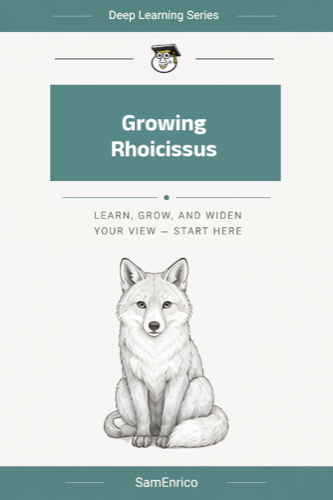
Growing Rhoicissus
This publication, published by SamEnrico, covers G
This publication, published by SamEnrico, covers Growing Rhoicissus
Formats
About this book
Free sample
Chapter 1: The Baboon’s Secret...--The first time I saw a mature Rhoicissus capensis in full glory, it was not in a botanical garden or a rare plant collector’s greenhouse. It was in the old, slightly musty conservatory of a retired plant pathologist in Devon, England. The vine had been in his family for three generations, brought over from the Eastern Cape of South Africa by his grandfather in 1927. It covered an entire 4-meter wall, its glossy, kidney-shaped leaves catching the weak English sunlight like polished emeralds. The stems were as thick as my thumb, and the tendrils had dug into the old brick mortar with a determination that spoke of decades of quiet conquest.
“They don’t grow them like this anymore,” he said, running a hand along a leaf. “Nobody remembers the secret.”That secret, as I would come to learn over the next twenty years of horticultural practice, is not a single trick or a miracle fertilizer. It is a fundamental understanding of where these plants come from and what they have evolved to expect. The secret of the baboon, you might call it—because in the wild, it is the chacma baboon, Papio ursinus, that is the primary seed disperser of the Rhoicissus genus. These intelligent, opportunistic primates feast on the small, purple-black berries that ripen in late summer, clambering through the tangled vines of the Afromontane forests and the thickets of the Cape Floristic Region.
They swallow the seeds whole, travel miles across the landscape, and deposit them in a fresh pile of nitrogen-rich fertilizer, often in a completely different microclimate. The baboon’s digestive tract lightly scarifies the seed coat. The droppings provide a starter kit of nutrients. And the seed, having passed through the gut of a primate, lands exactly where the forest’s dappled light and seasonal rains can do their work.If you want to grow Rhoicissus well, you must think like a baboon. Not literally, of course.
But you must understand the journey: the dry winter of the Eastern Cape, the explosive wet summer, the filtered light beneath taller…
This is the end of the free sample. Get the eBook to keep going. Buy now
Contents
- Chapter 1
- Chapter 2
- Chapter 3
- Chapter 4
- Chapter 5
- Chapter 6
- Chapter 7
- Chapter 8
- Chapter 9
- Chapter 10
- Chapter 11
- Chapter 12
Details
- Author
- Camarillo Twanda
- Publisher
- SamEnrico
- Language
- English
- Genre
- Non-Fiction, Informative, Educational
- Released
- 2026-06-02
- Pages (approx.)
- 130
- Available as
- eBook, Audiobook

Read better in the ZLOADR app
Your eBooks on your phone or tablet. Sign in with your SamEnrico account and start reading.
More by Camarillo Twanda
 IGF 1 Aging BiomarkerCamarillo Twanda$11.99
 Physics Formula PegsCamarillo Twanda$11.99
 Bipolar Psychosis Recognition GuideCamarillo Twanda$11.99
 Active Listening in Tough TalksCamarillo Twanda$11.99
 Imposter Syndrome Student GuideCamarillo Twanda$11.99
 Fake Security Guard Diamond HeistCamarillo Twanda$11.99
 PMS Cravings ControlCamarillo Twanda$11.99
 Iran Hostage SurvivorCamarillo Twanda$11.99
 The Sound of a Revolution: How a Single Recording Changed the Civil Rights MovementCamarillo Twanda$11.99
 The Skyfire Chronicles: The Ancient Balloon Pioneers of the AmericasCamarillo Twanda$11.99
 The Velvet Underground's Exploding Star: How Nico Shaped Rock's Darkest EdgeCamarillo Twanda$11.99
 The Dancer's Guide to KoloCamarillo Twanda$11.99
You may also like
 Hong Kong Handover 1997Dunn Johnnie$11.99
 Zumba For Postnatal Recovery CourseNeal Christian$11.99
 Zumba for BeginnersLadner Nikia$11.99
 YouTube Comment Mining GuideHumes Pandora$12.99
 Worry Box MeditationCarlin Rudy$11.99
 Workplace Stress MeditationNguyen Lynn$11.99
 Workplace Stress and Sleep RepairHawley Ivory$11.99
 Workplace Perfectionism CureDelaney Jeffry$11.99
 Workplace Injustice Anger GuideWallen Isabelle$11.99
 Work Addiction and Burnout LinkGreenwood Ester$11.99
 Women in Yoga and WellnessBeattie Galina$11.99
 Women in Stand Up ComedyChun Evangeline$11.99