
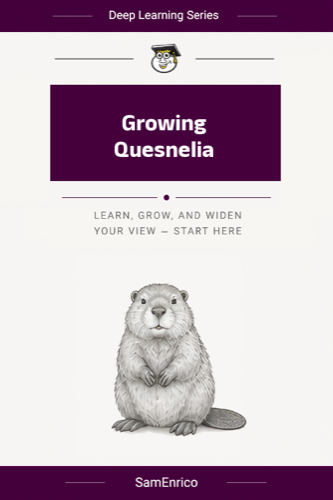
Non-FictionInformativeEducational
Growing Quesnelia eBook
This publication, published by SamEnrico, covers G
by Gee Kym
This publication, published by SamEnrico, covers Growing Quesnelia
Formats
Free sample
Chapter 1: The Brazilian Stranger...--–- Most people buy their first Quesnelia by accident.You walk past a nursery display, and something stops you. It is not the soft, predictable symmetry of a peace lily or the cheerful ordinariness of a pothos. This plant is different. Its leaves are stiff, almost aggressive, arranged in a perfect spiral that seems both mathematical and wild. The colors catch your eye—deep greens marbled with cream or silver, sometimes flushed with bronze or burgundy near the center.
The edges are armed with small but determined spines, a quiet warning that this is not a plant to be brushed against carelessly. And at its heart, a deep cup holds water like a secret, reflecting light back up toward you.You buy it because it looks interesting. You bring it home because you want something that feels alive in a way that ordinary houseplants do not. You have no idea, yet, that you have just invited a piece of Brazilian evolutionary history into your living room. You have no idea that this plant—this Quesnelia—has been perfected over millions of years to survive on almost nothing, to thrive on neglect, and to reward patience with a bloom so spectacular that it will change how you think about what a houseplant can be.This chapter is not a care guide.
It is an origin story. Before you learn how to water, mount, or propagate your Quesnelia, you need to understand where it came from, why it looks the way it does, and why—unlike almost every other plant you have ever owned—it will flourish when you learn to leave it alone.The Forest That Made the Monster Close your eyes and imagine a forest that is not the Amazon.The Amazon is flat, wet, and impossibly vast. It is the forest everyone pictures when they think of Brazil—dark green canopies, slow rivers, jaguars sleeping in the crooks of ceiba trees. The Atlantic Forest, or Mata Atlântica, is different. It runs along Brazil's eastern coast, squeezed between the ocean and the mountains, and it is one of the most biologically diverse places on Earth despite being reduced to less than fifteen percent of its original size.
This is where Quesnelia comes from.The Atlantic Forest is steep. Ridges rise sharply from the coast, catching moisture from the sea and wringing it out as fog and rain. Temperatures swing wildly from day to night—warm and humid in the afternoon, cool enough to feel the edge of winter by midnight. The canopy is broken, full of gaps where light pours down in bright patches and deep shadow in equal measure. Trees grow at odd angles.
Moss covers everything. And in the crooks of branches, on rocky outcroppings, and sometimes in the shallow soil between tree roots, bromeliads cling to life.Quesnelia evolved in this chaos. It adapted to survive where other plants could not. Where orchids demand perfect air circulation and precise watering, Quesnelia developed a tank. Where ferns shrivel in dry spells, Quesnelia stored water in its central cup and learned to wait.
Where the soil is thin or nonexistent, Quesnelia's roots stopped trying to absorb nutrients and became anchors instead.This is the first thing you must understand: Quesnelia is not a demanding plant. It is a survivor. It does not need daily attention. It does not need a greenhouse. It needs you to understand its instincts and then get out of its way.The Two Ways of Growing Within the genus Quesnelia—named, as most bromeliads are, after a nineteenth-century French naval officer and botanist, Edouard Quesnel—there are two distinct growth habits.
Understanding the difference between them is the difference between keeping a plant alive and watching it thrive.Epiphytic species grow on trees. Their roots never touch soil. In the Atlantic Forest, a seed from an epiphytic Quesnelia lands in the crook of a branch, where decaying leaves and bark chips have collected over years. The seed germinates, sends out roots that grip the bark but do not penetrate it, and begins to form the rosette. The plant lives entirely on whatever falls into its central tank—rainwater, insect debris, bird droppings, disintegrating leaves.
The roots are not for feeding. They are for holding on.The most common epiphytic Quesnelia in cultivation is Quesnelia liboniana. Its leaves are narrow, spiky, and form a relatively open rosette compared to its terrestrial cousins. The bloom stalk rises high above the plant, sometimes two feet or more, and produces coral-red bracts that last for months. In nature, it grows high in the canopy, where light is brighter and air moves freely.Terrestrial species grow in soil—but not the rich, dark garden soil you might imagine.
They root in shallow deposits of leaf litter on rocky slopes, or in the thin, sandy soil between boulders. They are not demanding about soil composition, because they are adapted to very little of it. Their roots spread laterally, never deeply, and they rely on the same tank system as their epiphytic cousins for most of their water and nutrients.Quesnelia arvensis is the most widely grown terrestrial species. It is vigorous, spreading via stolons (horizontal runners) to form dense colonies in frost-free gardens. Its leaves are broader than those of Q.
liboniana, often with striking marbling. It blooms reliably in late spring, with a shorter spike that sits closer to the foliage.Here is the secret that most books get wrong: the care for epiphytic and terrestrial Quesnelias is almost identical. Both want the same light, the same humidity, the same watering routine. The only difference is the substrate. Epiphytic species mounted on wood or grown in bare-root conditions want no soil at all.
Terrestrial species want a shallow, fast-draining mix that mimics the rocky slopes of their homeland. But both will protest loudly—with yellowing leaves, rot, and death—if you put them in standard potting soil.We will return to substrate in Chapter 2. For now, simply know that your Quesnelia, whether epiphytic or terrestrial, does not want to sit in wet dirt.Why Quesnelia Is Not a Guzmania If you have ever owned a bromeliad before, it was probably a Guzmania. Garden centers sell them by the thousands—those glossy, spineless leaves arranged in a perfect rosette, topped with a bright red or orange or yellow bloom spike that lasts for months. Guzmanias are beautiful.
They are also, to be honest, a little boring. They require almost nothing from their owner beyond occasional tank refills, and when they die after blooming, most people throw them away without a second thought.Quesnelia is not a Guzmania.First, the leaves. Guzmania leaves are soft, smooth-edged, and solid green or lightly banded. Quesnelia leaves are stiff, often marbled or mottled, and armed with sharp spines along the margins. Touch a Quesnelia leaf without paying attention, and you will know it immediately.
This is not a plant for the back of a bookshelf where it will be brushed by passing elbows. This is a plant that demands to be seen and respected.Second, the bloom. Guzmania produces a single, simple spike of colorful bracts—showy, yes, but structurally basic.…
This is the end of the free sample. Get the eBook to keep going. Buy now
About this book
Details
- Author
- Gee Kym
- Publisher
- SamEnrico
- Language
- English
- Genre
- Non-Fiction, Informative, Educational
- Released
- 2026-05-06
- Pages (approx.)
- 138
- Available as
- eBook, Audiobook

Read better in the ZLOADR app
Your eBooks on your phone or tablet. Sign in with your SamEnrico account and start reading.
More by Gee Kym
 Bicycle Rider Patience GuideGee Kym$11.99
 Peer Support for Imposter GroupsGee Kym$11.99
 Inside Antwerp Diamond VaultGee Kym$11.99
 Cocaine Recovery for LGBTGee Kym$11.99
 Retirement Asset Trust GuideGee Kym$11.99
 FCPA Retrial Appeal CasesGee Kym$11.99
 Gaddafi LibyaGee Kym$11.99
 Bipolar I Distinguishing Features ManualGee Kym$11.99
 Leg Elevation TechniqueGee Kym$11.99
 The Last Message from the Deep: The Sinking of the USS ScorpionGee Kym$11.99
 The Celestial Cartographers: When Aliens Drew Our StarsGee Kym$11.99
 Odin’s Lost Oracle: The Runes of DelphiGee Kym$11.99
You may also like
 Hong Kong Handover 1997Dunn Johnnie$11.99
 Zumba For Postnatal Recovery CourseNeal Christian$11.99
 Zumba for BeginnersLadner Nikia$11.99
 YouTube Comment Mining GuideHumes Pandora$12.99
 Worry Box MeditationCarlin Rudy$11.99
 Workplace Stress MeditationNguyen Lynn$11.99
 Workplace Stress and Sleep RepairHawley Ivory$11.99
 Workplace Perfectionism CureDelaney Jeffry$11.99
 Workplace Injustice Anger GuideWallen Isabelle$11.99
 Work Addiction and Burnout LinkGreenwood Ester$11.99
 Women in Yoga and WellnessBeattie Galina$11.99
 Women in Stand Up ComedyChun Evangeline$11.99