
Non-FictionInformativeEducational
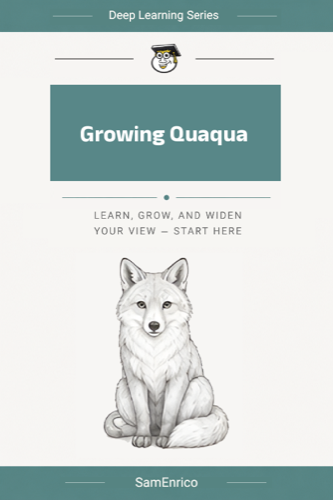
Growing Quaqua
This publication, published by SamEnrico, covers G
by Snell Xiao
This publication, published by SamEnrico, covers Growing Quaqua
Formats
About this book
Free sample
Chapter 1: The Collector's Disease...--–- It began, as these things often do, with a photograph. Not a glossy, professional image from a coffee table book, but a grainy, poorly lit snapshot on an obscure Internet forum dedicated to "Stapeliads and Other Botanical Oddities." I was twenty-three years old, living in a cramped studio apartment that faced north and received approximately three hours of indirect sunlight per day, and I had just killed my third succulent—a common jade plant that supposedly could survive a nuclear winter. I was not, by any reasonable measure, qualified to be looking at rare African succulents. And yet there it was: a plant that looked like nothing I had ever seen on this planet. Its stems were not green but a dusty, muted purple-gray, rising in uneven columns like the fingers of a creature buried just beneath the soil.
Along each ridge sat rows of conical, tooth-like projections—not quite spines, not quite leaves, something entirely other. The caption read simply: "Quaqua mammillaris, Namaqualand."For the next six hours, I fell down a rabbit hole that would ultimately consume the better part of my adult life. I learned that Quaqua (pronounced KWA-kwa, though I spent an embarrassing month saying KWAH-kwah) belongs to the Apocynaceae family, the dogbanes, and within that to the Asclepiadoideae subfamily—the milkweeds. I learned that its name derives from a Khoisan word, one of the click languages of southern Africa, though the exact meaning has been lost to botanical history. I learned that it grows exclusively in the winter-rainfall regions of South Africa and Namibia, in the rocky deserts of Namaqualand and the Karoo, where summer temperatures routinely exceed 100 degrees Fahrenheit and rain falls only in the coolest months.
I learned that it smells like death when it flowers—deliberately, specifically, as an evolutionary strategy to attract flies rather than bees. And I learned that almost no one in the United States grew it. There were no books about it. There were no You Tube tutorials. There was a single Facebook group with 147 members, most of whom had never posted.That…
This is the end of the free sample. Get the eBook to keep going. Buy now
Contents
- Chapter 1
- Chapter 2
- Chapter 3
- Chapter 4
- Chapter 5
- Chapter 6
- Chapter 7
- Chapter 8
- Chapter 9
- Chapter 10
- Chapter 11
- Chapter 12
Details
- Author
- Snell Xiao
- Publisher
- SamEnrico
- Language
- English
- Genre
- Non-Fiction, Informative, Educational
- Released
- 2026-06-02
- Pages (approx.)
- 151
- Available as
- eBook, Audiobook

Read better in the ZLOADR app
Your eBooks on your phone or tablet. Sign in with your SamEnrico account and start reading.
More by Snell Xiao
 High Beam Blindness Rage GuideSnell Xiao$11.99
 Imposter Syndrome for Late CareerSnell Xiao$11.99
 401k Estate Planning GuideSnell Xiao$11.99
 Opioid Recovery and BoredomSnell Xiao$11.99
 Duvalier Baby DocSnell Xiao$11.99
 Dream Recall SupplementsSnell Xiao$11.99
 Social Jet Lag MemorySnell Xiao$11.99
 Vaping Lung Recovery PlanSnell Xiao$11.99
 Massage for RLS LegsSnell Xiao$11.99
 The Billionaire's Playground: How Monaco Became the Ultimate Status SymbolSnell Xiao$11.99
 Into the Abyss: The Unsung Heroes of the Arctic TrenchSnell Xiao$11.99
 The Serpent’s Gambit: How a Forgotten Pharaoh’s Curse Shaped the Rise of EgyptSnell Xiao$11.99
You may also like
 Hong Kong Handover 1997Dunn Johnnie$11.99
 Zumba For Postnatal Recovery CourseNeal Christian$11.99
 Zumba for BeginnersLadner Nikia$11.99
 YouTube Comment Mining GuideHumes Pandora$12.99
 Worry Box MeditationCarlin Rudy$11.99
 Workplace Stress MeditationNguyen Lynn$11.99
 Workplace Stress and Sleep RepairHawley Ivory$11.99
 Workplace Perfectionism CureDelaney Jeffry$11.99
 Workplace Injustice Anger GuideWallen Isabelle$11.99
 Work Addiction and Burnout LinkGreenwood Ester$11.99
 Women in Yoga and WellnessBeattie Galina$11.99
 Women in Stand Up ComedyChun Evangeline$11.99