
Non-FictionInformativeEducational
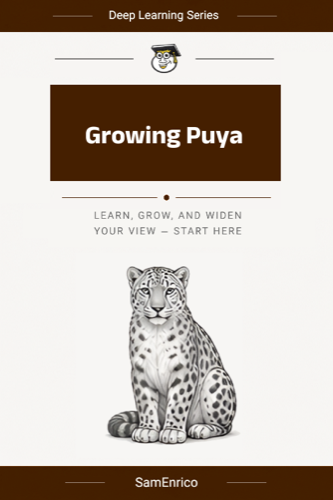
Growing Puya eBook
This publication, published by SamEnrico, covers G
by Michael Kasi
This publication, published by SamEnrico, covers Growing Puya
Formats
Free sample
Chapter 1: The Ironclad Bromeliad--–- It begins, as most obsessions do, with a single image. For me, it was a photograph taken inside a Chilean botanical garden in 2019: a creature that appeared less like a plant and more like a frozen explosion of turquoise fireworks, each blossom a metallic dagger pointing toward an indifferent sky. The caption read simply: Puya alpestris – Sapphire Tower, bloom after eleven years. Eleven years. I had killed a succulent in six months.
And yet, something about that number—eleven years of waiting for a flower that looks like it was machined in a science fiction prop shop—lodged itself in my chest like a spine. This book is what happened next.Welcome to the world of Puya, the most misunderstood genus in the bromeliad family and quite possibly the only plant that will outlive your mortgage, your marriage (statistically speaking), and your patience. If you are holding this book, you have likely seen the images: the impossible turquoise blooms of Puya alpestris, the skyscraper-like inflorescence of Puya raimondii that can reach thirty feet into the air, or the silver, spiked rosettes that look like a dragon decided to become a garden ornament. You are intrigued. You may even be a little afraid.
Good. Fear is the appropriate first response to a plant that has evolved to thrive where most life merely endures.This chapter dismantles everything you think you know about bromeliads. We will bury the misconception that all members of this family are soft, tropical, epiphytic creatures that cling to rainforest trees and collect water in their cups. The Puya genus is the rebellious cousin who left the jungle party, climbed into the high Andes, learned to survive freezing nights and blazing days, and developed spines sharp enough to draw blood from an unprepared gardener. We will explore the three major growth habits that define the genus, confront the psychological weight of the "monocarpic commitment"—the knowledge that your plant will die after flowering—and answer the essential question: why would any sane person choose to grow something so slow, so dangerous, and so demanding?By the end of this chapter, you will understand that growing Puya is not gardening.
It is a philosophy, a legacy project, and—if you do it right—a conversation piece that will make your neighbors question your sanity in the best possible way.The Great Bromeliad Lie Let us begin with heresy: the pineapple is a bromeliad. So is Spanish moss. And so, yes, is the cheerful Guzmania you bought at the grocery store, which promptly died because you overwatered its central cup and rotted its heart. The bromeliad family (Bromeliaceae) is vast, containing approximately 3,700 species spread across eight subfamilies. They are masters of adaptation, found everywhere from cloud forests to deserts to the rocky scree of mountains.But here is the lie: most gardeners assume that all bromeliads are epiphytes—plants that grow on other plants, absorbing water and nutrients through their leaves rather than their roots.
This assumption is wrong, and it kills more Puya specimens than any other single mistake. The Puya genus belongs to the subfamily Puyoideae, and every single one of its approximately 200 species is terrestrial. They grow in soil. They develop root systems that, in some species, rival the depth of small trees. They do not want to hang from a piece of bark in your living room.This terrestrial adaptation is the key to understanding everything that follows.
When you look at a Puya, you are not looking at a rainforest refugee. You are looking at a mountain warrior, a desert survivor, a plant that evolved in environments where water is scarce, temperatures swing wildly, and competition comes in the form of grazing animals with teeth. The spines, the silver leaves, the slow growth, the explosive flowering—all of it is a response to a world that tried very hard to kill the genus, and failed.Consider the habitats where Puya species are found in the wild. Puya raimondii, the Queen of the Andes, grows between 3,000 and 4,800 meters (10,000 to 15,700 feet) above sea level in Peru and Bolivia. At these altitudes, the air is thin, ultraviolet radiation is intense, and nighttime temperatures regularly drop below freezing.
The soil is thin, rocky, and often alkaline—the decomposed remains of volcanic activity and ancient seabeds. Rain falls seasonally, and for months at a time, the plants survive on nothing but condensation from fog and dew. This is not a gentle environment. This is a place where only the stubborn survive.Contrast this with Puya venusta, a coastal species found in the fog belts of central Chile. This plant never sees a hard freeze, but it also rarely sees rain.
Its water comes almost entirely from the camanchaca—the dense coastal fog that rolls in from the Pacific Ocean, blanketing the hillsides in cold, wet air. The plant's leaves are covered in specialized hairs (trichomes, which we will explore in Chapter 2) that absorb moisture directly from the atmosphere. The roots are primarily anchors, not water collectors.And then there are the species that fall somewhere in between: Puya alpestris, the Sapphire Tower, which grows in the Chilean desert's fog-influenced margins; Puya chilensis, which haunts the dry, rocky slopes of the coastal mountains; and Puya mirabilis, a dwarf species that somehow survives in the rain shadow of the Andes.Three different habitat types. Three different sets of survival strategies. And yet, all of them share one thing in common: they will die in your living room.
They will rot in your standard potting mix. They will languish in your shady, humid bathroom. To grow Puya, you must first understand that you are not bringing a houseplant into your home. You are building a small, artificial slice of the Andes, the Chilean desert, or the coastal fog belt. This book will teach you how to do that.
But the first step is accepting that everything you know about bromeliads is probably wrong.The Spectrum of Spikes: Three Growth Habits The Puya genus is not a monolith. Trying to grow Puya raimondii with the same techniques as Puya mirabilis would be like trying to raise a great white shark in a goldfish bowl. Both are fish. Both will die. The details matter.Based on extensive field observation and cultivation data, the genus divides neatly into three growth habit categories.
Understanding which category your chosen species falls into is the single most important decision you will make before acquiring a plant.Category One: The High-Altitude Giants Representative species: Puya raimondii, Puya herzogii These are the extremophiles of the genus. Puya raimondii is the largest bromeliad in the world, producing a trunk that can reach fifteen feet in height before the flowering spike adds another thirty feet on top. The entire plant can exceed forty-five feet—taller than a four-story building. It produces an estimated 8,000 to 20,000 flowers per inflorescence, followed by up to 12 million seeds. And then it dies.The growth rate of these giants is measured in inches per year, not feet.
A cultivated P. raimondii might add one centimeter of trunk height per month under ideal conditions. To reach flowering size, the plant requires between forty and eighty…
This is the end of the free sample. Get the eBook to keep going. Buy now
About this book
Details
- Author
- Michael Kasi
- Publisher
- SamEnrico
- Language
- English
- Genre
- Non-Fiction, Informative, Educational
- Released
- 2026-06-02
- Pages (approx.)
- 158
- Available as
- eBook, Audiobook

Read better in the ZLOADR app
Your eBooks on your phone or tablet. Sign in with your SamEnrico account and start reading.
More by Michael Kasi
 FCPA Obstruction of Justice CasesMichael Kasi$11.99
 Antwerp Diamond Vault Breach StoryMichael Kasi$11.99
 Visualization Calm Driving GuideMichael Kasi$11.99
 Anger Management Low Cost InterventionMichael Kasi$11.99
 Pattern Recognition in LawMichael Kasi$11.99
 Imposter Syndrome in WomenMichael Kasi$11.99
 Castro CubaMichael Kasi$11.99
 Understanding Bipolar Triggers CourseMichael Kasi$11.99
 TM For JealousyMichael Kasi$11.99
 Silent Signals: The Radio War That Never WasMichael Kasi$11.99
 Operation Emu: The Feathered UprisingMichael Kasi$11.99
 The Sun King's Grandeur: Versailles and the Birth of Modern EleganceMichael Kasi$11.99
You may also like
 Hong Kong Handover 1997Dunn Johnnie$11.99
 Zumba For Postnatal Recovery CourseNeal Christian$11.99
 Zumba for BeginnersLadner Nikia$11.99
 YouTube Comment Mining GuideHumes Pandora$12.99
 Worry Box MeditationCarlin Rudy$11.99
 Workplace Stress MeditationNguyen Lynn$11.99
 Workplace Stress and Sleep RepairHawley Ivory$11.99
 Workplace Perfectionism CureDelaney Jeffry$11.99
 Workplace Injustice Anger GuideWallen Isabelle$11.99
 Work Addiction and Burnout LinkGreenwood Ester$11.99
 Women in Yoga and WellnessBeattie Galina$11.99
 Women in Stand Up ComedyChun Evangeline$11.99