
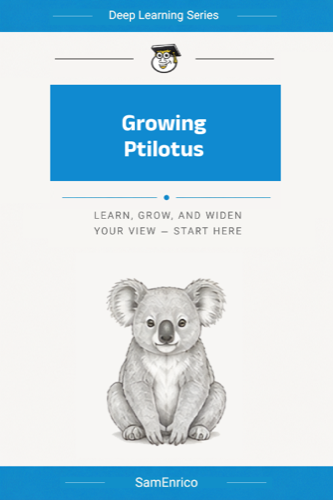
Growing Ptilotus eBook
This publication, published by SamEnrico, covers G
This publication, published by SamEnrico, covers Growing Ptilotus
Formats
Free sample
Chapter 1: The Taproot Secret--– In the summer of 2017, I stood over a wilting Ptilotus ‘Joey’ that I had watered, fertilized, and coddled with the devotion of a new parent. Its once-plump silver-green leaves had turned a sickly yellow. The infamous pink bottlebrush plumes, the very reason I had bought the plant, had shriveled into brown husks before they ever fully opened. I was baffled. Every gardening instinct I possessed—every lesson learned from years of growing tomatoes, roses, and lavender—had led me to this moment of failure.
I had given it rich compost, regular drinks of water, and a spot in my best garden soil. The plant rewarded me by dying slowly and miserably.That evening, I pulled the ‘Joey’ from its pot to inspect the damage. What I found changed everything I understood about this genus. Instead of the fibrous, branching root ball I expected—the kind you see on any healthy perennial—there was a single, thick, carrot-like taproot, brown and mushy at the tip. The few side roots that had tried to emerge were blackened and lifeless.
I had not overwatered a plant. I had drowned a desert survivor. And in that moment of horticultural humiliation, I realized that everything I thought I knew about growing Ptilotus was wrong.The road from that dead plant to this book took seven more failures, three trips to Central Australia, and dozens of conversations with commercial growers, tissue culture lab technicians, and indigenous plant experts. What I learned can be summarized in a single, deceptively simple sentence: Ptilotus is not a normal plant, and it does not want to be treated like one.This chapter is the foundation upon which every successful Ptilotus grower builds their practice. Before we talk about seed starting, watering schedules, or pruning techniques, we must understand what this plant is at its most fundamental level.
We must unlearn the assumptions we bring from growing petunias, succulents, or even other Australian natives. And we must embrace a botanical truth that will save you from the same string of failures I endured: Ptilotus is a taproot plant, and its entire existence revolves around that single, dominant root.The Taxonomy Trap: Why Naming Matters Let us begin where all botanical understanding begins: with the name. Ptilotus (pronounced TILL-oh-tus, with a silent P that confounds beginners and delights botanists) belongs to the family Amaranthaceae, a diverse clan that includes familiar garden plants like Gomphrena (globe amaranth), Celosia (cockscomb), and the edible Amaranthus (amaranth grain). This family connection explains some of Ptilotus’s most desirable traits: the long-lasting, papery flower texture, the tolerance for lean soils, and the remarkable ability to thrive where other plants languish.But here is where the taxonomy trap snaps shut. Because Ptilotus is an amaranth relative, many gardeners assume it can be treated like one.
They plant it in rich soil, water it regularly, and fertilize it with the same balanced formula they use for their celosia. This is a catastrophic mistake. While Ptilotus shares a family tree with these garden staples, it evolved on a completely different branch—one shaped by the brutal, unpredictable climate of ancient Australia.The genus Ptilotus contains over 100 described species, and new ones are still being discovered in remote parts of the continent. Here is the astonishing fact that should be tattooed on the forearm of every aspiring grower: ninety-nine percent of all Ptilotus species are endemic to Australia. You will not find them growing wild in Africa, Asia, or the Americas.
They belong to the oldest, driest, most nutrient-depleted continent on Earth, and they have spent millions of years adapting to conditions that would kill most ornamental plants within weeks.This endemism is not an accident. Australia’s isolation, combined with its ancient, weathered soils and erratic rainfall patterns, created a crucible for plant evolution. The Amaranthaceae family arrived on the continent millions of years ago, likely via long-distance dispersal from Asia or Africa. Once there, it encountered a landscape that rewarded drought tolerance, deep rooting, and rapid flowering after rain. The result was a radiation of species so diverse that botanists are still untangling their relationships.
Some Ptilotus species are prostrate groundcovers that hug the soil like living carpets. Others are woody subshrubs that persist for years. And still others, like the beloved ‘Joey’, are upright annuals or short-lived perennials that explode into flower at the first sign of moisture.Understanding this taxonomy is not an academic exercise. It is the key that unlocks every other chapter in this book. When you know that your Ptilotus ‘Joey’ descends from plants that evolved in the sandy, low-phosphorus soils of Central Australia, you stop reaching for the bag of fertilizer.
When you know that its ancestors survived months-long dry spells by retreating into metabolic semi-dormancy, you stop watering on a calendar schedule. And when you know that its taproot is designed to plunge deep into the earth in search of moisture, you stop leaving it in small pots where that root can spiral into a death knot.Anatomy of a Survivor: The Taproot Let us now examine the part of the plant that most gardeners never see, yet it is the single most important organ for successful cultivation. I am speaking, of course, of the root system—specifically, the taproot.A taproot is a dominant, central root that grows vertically downward, with smaller lateral roots branching off from it. This is distinct from a fibrous root system, in which many similarly sized roots spread outward in a diffuse network. Carrots, dandelions, and oaks have taproots.
Grasses, daylilies, and most bedding annuals have fibrous roots. And Ptilotus, throughout its life cycle, is fundamentally a taproot plant.Here is where previous guides have caused confusion, and I want to be absolutely clear. In its early stages—from germination through the first 8 to 10 weeks—Ptilotus produces a single, thick, unbranched taproot that plunges downward with singular determination. This root can reach depths of 12 inches or more in favorable soil, far outpacing the plant’s above-ground growth. As the plant matures, secondary lateral roots do emerge from this taproot, creating a more complex system.
Some growers have mistakenly described the mature root system as “fibrous” because they see these laterals and assume the taproot has been replaced. This is incorrect. The taproot remains the central axis, and the lateral roots are merely its branches. The plant’s architecture, its water-seeking strategy, and its vulnerability to transplant shock all derive from this taproot-dominant design.Why does this matter? Because a taproot behaves very differently from a fibrous root system in three critical ways.First, a taproot does not like to be confined.
When a taproot reaches the bottom of a pot, it does not stop growing. It turns. It circles. And as it circles, it begins to girdle itself, strangling its own vascular tissue. This is the mechanism behind what I call “root bound shock,” which we will explore in detail in Chapter 5.
A fibrous-rooted plant can often be rescued from a bound pot with careful teasing and repotting. A taprooted plant, once bound, is usually doomed. The damage is structural and permanent.Second, a taproot determines watering depth. Most gardeners are taught to…
This is the end of the free sample. Get the eBook to keep going. Buy now
About this book
Details
- Author
- Singleton Ada
- Publisher
- SamEnrico
- Language
- English
- Genre
- Non-Fiction, Informative, Educational
- Released
- 2026-05-09
- Pages (approx.)
- 157
- Available as
- eBook, Audiobook

Read better in the ZLOADR app
Your eBooks on your phone or tablet. Sign in with your SamEnrico account and start reading.
More by Singleton Ada
 PTSD Therapy For Conflict Zones ManualSingleton Ada$11.99
 Evidence Log for Self DoubtSingleton Ada$11.99
 Chunking Apps GuideSingleton Ada$11.99
 Time Pressure Driving GuideSingleton Ada$11.99
 The Sobriety Sleep HygieneSingleton Ada$11.99
 Empowerment HandbookSingleton Ada$11.99
 FCPA Successor Liability CasesSingleton Ada$11.99
 TM For AsthmaSingleton Ada$11.99
 Self Talk For Layoff SurvivorsSingleton Ada$11.99
 The Phantom Heist of the Century: The Great Train Robbery of 1963Singleton Ada$11.99
 The Lion of Karkemish: Sennacherib's Defeat at the Euphrates (691 BC)Singleton Ada$11.99
 The World Carved from Bone: The Inuit Cosmic ForgeSingleton Ada$11.99