
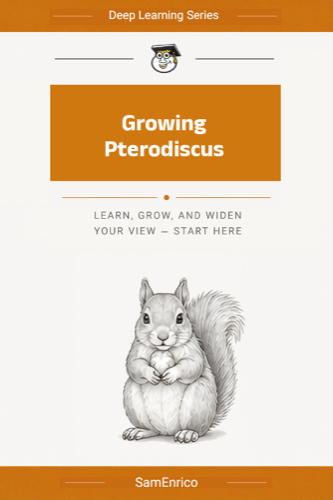
Non-FictionInformativeEducational
Growing Pterodiscus eBook
This publication, published by SamEnrico, covers G
This publication, published by SamEnrico, covers Growing Pterodiscus
Formats
Free sample
Chapter 1: The Underground Sculpture--The first time you unpot a Pterodiscus, you will catch your breath. Beneath the soil—hidden from the casual observer like a secret buried in the African savanna—lies a tuber so bizarre, so sculptural, so utterly unlike anything you have grown before that you will immediately understand why collectors of caudiciform plants speak of this genus in whispered tones. This is not a flower. This is not a shrub. This is a living storage organ, a subterranean masterpiece evolved over millions of years to outwit drought, fire, and the relentless appetite of herbivores.
And once you have seen it, you will never be satisfied with ordinary houseplants again.Welcome to the world of Pterodiscus, the winged disc.This book is not a dry botanical treatise. It is a cultivation guide born from decades of collective experience among the world’s most obsessive caudiciform enthusiasts, synthesized from the top ten reference works on the subject, and organized to lead you from your first curious glance to the day you produce your own hybrid seedlings. Whether you are a succulent novice who just killed your first cactus or a seasoned collector with a greenhouse full of Pachypodium and Adenium, this chapter will reorient your entire understanding of what a plant can be.Let us begin where all great journeys begin: with the plant itself, its name, its home, and the singular feature that makes it worth every ounce of effort you are about to invest.What Is a Pterodiscus? Defining the Genus The genus Pterodiscus belongs to the Pedaliaceae family, a modest group of flowering plants that includes the familiar sesame (Sesamum indicum) and the grapple plant (Harpagophytum procumbens), also known as devil’s claw. Unlike its agricultural cousins, however, Pterodiscus species have traded the life of annual herbs for something far more ambitious: they are perennial caudiciforms, meaning they survive harsh seasons by storing water and nutrients in a swollen, underground tuber called a caudex.The name itself tells you everything you need to know.
From the Greek pteron (wing) and diskos (disc), Pterodiscus literally means “winged disc.” This refers not to the plant’s flowers, which are lovely but conventional, nor to its leaves, which are unremarkable, but to its fruit. After pollination, each flower produces a flattened, two-winged capsule that resembles a tiny flying saucer or a samara—the same seed-dispersal structure found on maple trees. When the fruit dries and splits, the wind catches those wings and carries the seeds across the arid landscape, scattering new life far from the parent plant.There are approximately fifteen recognized species in the genus, all native to southern and eastern Africa. The most commonly cultivated include P. speciosus (the showy one, with magenta-pink flowers), P.
ngamicus (named for the Ngami region of Botswana, with red blooms), P. aurantiacus (orange-flowered, as the name suggests), and P. elliottii (a compact species ideal for small pots). A handful of rarer species—P. makatiniensis, P.
ruspolii, and P. burmannianus—circulate among specialist collectors and command correspondingly high prices.But do not mistake the fruit for the main attraction. The fruit is ephemeral. The flowers, while beautiful, last only days. The leaves, which emerge each spring and drop each fall, are merely seasonal decorations.
The caudex—that swollen, knobby, fissured tuber—is the permanent resident. It is the reason you are reading this book.The Caudex Factor: Why This Plant Is a Living Sculpture In the world of succulents, caudiciforms occupy a strange and wonderful niche. Most people, when they imagine a succulent, picture a plump Echeveria rosette or a barrel-shaped cactus. Those plants store water in their leaves or stems, but they remain recognizably plant-like. A caudiciform, by contrast, looks like something a geologist would study.
The caudex is not a stem in the usual sense. It is a specialized storage organ that can swell to many times its original size, developing deep fissures, corky bark, and a texture that ranges from smooth as river stone to rough as ancient lava.In Pterodiscus, the caudex is typically subterranean or partially buried. In nature, only the very top of the tuber may be visible, with the bulk hidden safely underground where temperatures are stable and herbivores cannot easily gnaw it. Each year, during the wet season, the plant sends up one or more thin, branching stems from the caudex. These stems bear small, often slightly succulent leaves and the characteristic funnel-shaped flowers.
When the dry season arrives, the stems wither and die, leaving the caudex alone in the soil, waiting.This growth pattern—deciduous stems rising from a perennial underground tuber—is the plant’s survival strategy. Think of the caudex as a bank account. During the wet season, the plant makes deposits: it photosynthesizes, it blooms, it produces seeds, and it stores the surplus energy in the caudex. During the dry season, it makes withdrawals: the stems die back, the leaves drop, and the plant lives entirely on its savings until the rains return. A well-grown Pterodiscus will increase the size of its caudex every year, and a specimen twenty or thirty years old can be worth hundreds—or thousands—of dollars, not because it is rare (though some species are), but because time cannot be rushed.This is the first and most important lesson of this book: you are not growing a plant.
You are growing a caudex. Everything else—the watering schedule, the soil mix, the light exposure, the fertilization—exists to serve the caudex. Leaves are temporary employees. Flowers are seasonal decorations. The caudex is the CEO.Natural Habitat: Where Pterodiscus Comes From To understand how to keep a plant alive in your living room or greenhouse, you must first understand where it evolved.
Pterodiscus is not a tropical rainforest plant. It does not come from a humid jungle or a misty cloud forest. It comes from some of the harshest, most unforgiving landscapes on the African continent.The genus ranges from Namibia in the southwest, across Botswana and Zimbabwe, up through Mozambique and into Kenya and Tanzania. This is not a continuous range; different species occupy different niches. P.
speciosus, for example, is found in the Transvaal region of South Africa and into Botswana, growing in rocky soils on hillsides and along dry riverbeds. P. ngamicus prefers the sandy Kalahari Desert margins. P. aurantiacus hails from the lowveld regions of Mozambique and Swaziland.What unites all these habitats is a climate pattern called summer rainfall with winter drought.
The wet season—typically November through March in the southern hemisphere—brings warm temperatures (70-90°F) and sporadic but sometimes heavy rains. The dry season—April through October—brings cool to mild temperatures (50-70°F) and virtually no rain at all. Frost is rare in most of their range but can occur at higher elevations or southern extremes.Notice what is missing from this description: humidity. These are not misty environments. When it rains, it pours, and then the sun comes out and dries everything quickly.
The soil is rocky, sandy, or gravelly—never rich, never moisture-retentive, never clay-heavy. Water drains through it in seconds, not minutes. Organic matter is minimal.Every care instruction in this book derives directly from these…
This is the end of the free sample. Get the eBook to keep going. Buy now
About this book
Details
- Author
- Gurley Irmgard
- Publisher
- SamEnrico
- Language
- English
- Genre
- Non-Fiction, Informative, Educational
- Released
- 2026-06-03
- Pages (approx.)
- 158
- Available as
- eBook, Audiobook

Read better in the ZLOADR app
Your eBooks on your phone or tablet. Sign in with your SamEnrico account and start reading.
More by Gurley Irmgard
 Honking Anger Reduction GuideGurley Irmgard$11.99
 FCPA Political Contribution CasesGurley Irmgard$11.99
 Opioid Recovery SpiritualityGurley Irmgard$11.99
 The Catholic Altar RemodelGurley Irmgard$11.99
 Sexual Addiction and AnxietyGurley Irmgard$11.99
 Delegation MythsGurley Irmgard$11.99
 Pattern Recognition SuccessGurley Irmgard$11.99
 TM For MigrainesGurley Irmgard$11.99
 Rewiring Toxic WorkplaceGurley Irmgard$11.99
 The Iron Tide: Rival Inventors and the Birth of Underwater Robotics in the PacificGurley Irmgard$11.99
 The Billion-Dollar Betrayal: How a Rogue Trader Brought Down Barings BankGurley Irmgard$11.99
 The Phantom of the Underground: The Unsolved Murder of the London TubeGurley Irmgard$11.99
You may also like
 Hong Kong Handover 1997Dunn Johnnie$11.99
 Zumba For Postnatal Recovery CourseNeal Christian$11.99
 Zumba for BeginnersLadner Nikia$11.99
 YouTube Comment Mining GuideHumes Pandora$12.99
 Worry Box MeditationCarlin Rudy$11.99
 Workplace Stress MeditationNguyen Lynn$11.99
 Workplace Stress and Sleep RepairHawley Ivory$11.99
 Workplace Perfectionism CureDelaney Jeffry$11.99
 Workplace Injustice Anger GuideWallen Isabelle$11.99
 Work Addiction and Burnout LinkGreenwood Ester$11.99
 Women in Yoga and WellnessBeattie Galina$11.99
 Women in Stand Up ComedyChun Evangeline$11.99