
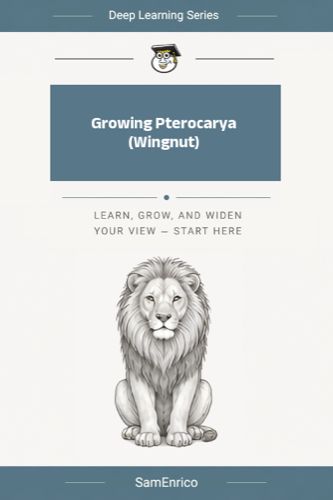
Non-FictionInformativeEducational
Growing Pterocarya (Wingnut) Audiobook
This publication, published by SamEnrico, covers G
by Gagne Genny
This publication, published by SamEnrico, covers Growing Pterocarya (Wingnut)
Formats
Free sample
Chapter 1: The Forgotten Giant...–- On a damp autumn morning in the Caucasus foothills, a mature Wingnut stretches its limbs across a forgotten riverbank, its pendant catkins—each the length of a child’s arm—swaying in the mist. Passersby rarely stop to admire it. They do not know that this tree, with its emerald, fern-like leaves and chandeliers of green-gold flowers, belongs to a lineage that predates the Himalayas, that survived the last ice age, and that now languishes in botanical obscurity while lesser trees fill every nursery row. This book exists to change that.Every generation of gardeners rediscovers a handful of overlooked plants—trees that offer speed, structure, drama, and resilience, yet remain absent from the commercial mainstream. The Wingnut (Pterocarya) stands near the top of that list.
It is a tree for the bold, for the patient, for anyone with a wet corner of the yard, a streambank to stabilize, or a desire to grow something genuinely different. Within these pages, you will learn not only how to cultivate this magnificent genus, but why it deserves a place in the twenty-first-century landscape.A Relic from the Cretaceous To understand the Wingnut, you must first travel backward—way backward. The genus Pterocarya belongs to the walnut family (Juglandaceae), a lineage that flourished alongside dinosaurs during the Cretaceous period, roughly 100 to 66 million years ago. Fossil evidence places ancestral Wingnuts across vast swaths of the Northern Hemisphere, from the Arctic archipelago to the temperate forests of what is now Europe. They were survivors then, and they remain survivors now.Today, the genus survives as a relict lineage—a living fossil, much like the ginkgo or the dawn redwood, but without the same horticultural fame.
The modern species cluster in three main regions: the Caucasus (specifically P. fraxinifolia), China (P. stenoptera and others), and Japan (P. rhoifolia). These scattered populations tell a story of ancient climatic shifts—of glaciers advancing and retreating, of continents drifting, of forests contracting to refugia where Wingnuts clung to existence.Why does this evolutionary history matter to a gardener planting a tree next Tuesday?
Because the Wingnut’s deep ancestry has gifted it with an extraordinary suite of survival traits: tolerance of both flood and moderate drought (once established), resistance to juglone toxicity, rapid juvenile growth, and a root system that stabilizes soil rather than surrendering to erosion. This is not a fragile aristocrat requiring coddling.…
This is the end of the free sample. Get the Audiobook to keep going. Buy now
About this book
Details
- Author
- Gagne Genny
- Publisher
- SamEnrico
- Language
- English
- Genre
- Non-Fiction, Informative, Educational
- Released
- 2026-06-02
- Pages (approx.)
- 147
- Available as
- eBook, Audiobook

Listen in the VoxFlicks app
Audiobooks and audio dramas wherever you go. Sign in with your SamEnrico account and press play.
More by Gagne Genny
 Empowerment AssessmentGagne Genny$11.99
 The Gacy Copycat KillersGagne Genny$11.99
 Benzo and Alcohol ComboGagne Genny$11.99
 The Sobriety Mindfulness PracticeGagne Genny$11.99
 The Protestant Fortress CitiesGagne Genny$11.99
 FCPA Charitable Donation CasesGagne Genny$11.99
 TM For Chronic FatigueGagne Genny$11.99
 Chunking Cheat SheetGagne Genny$11.99
 Workplace People Pleaser RecoveryGagne Genny$11.99
 The Last Stand of the Keystone RebelsGagne Genny$11.99
 The Forgotten War: The 1967 Six-Day War and the Birth of Modern Middle EastGagne Genny$11.99
 The Forgotten Pioneers of the Ice: Antarctica’s Ancient SpacekeepersGagne Genny$11.99
You may also like
 Hong Kong Handover 1997Dunn Johnnie$11.99
 Zumba For Postnatal Recovery CourseNeal Christian$11.99
 Zumba for BeginnersLadner Nikia$11.99
 YouTube Comment Mining GuideHumes Pandora$12.99
 Worry Box MeditationCarlin Rudy$11.99
 Workplace Stress MeditationNguyen Lynn$11.99
 Workplace Stress and Sleep RepairHawley Ivory$11.99
 Workplace Perfectionism CureDelaney Jeffry$11.99
 Workplace Injustice Anger GuideWallen Isabelle$11.99
 Work Addiction and Burnout LinkGreenwood Ester$11.99
 Women in Yoga and WellnessBeattie Galina$11.99
 Women in Stand Up ComedyChun Evangeline$11.99