
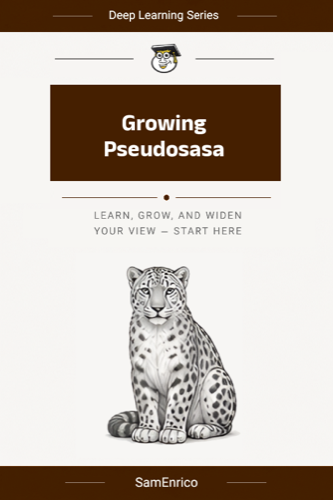
Non-FictionInformativeEducational
Growing Pseudosasa eBook
This publication, published by SamEnrico, covers G
This publication, published by SamEnrico, covers Growing Pseudosasa
Formats
Free sample
Chapter 1: The Bamboo That Bites Back--–- It arrived in a brown nursery pot, innocuous as a houseplant. Seventy-two months later, it had eaten my driveway, colonized the neighbor’s garden, and cost me four weekends with a mattock and a vocabulary my mother would not have approved. That was my first bamboo. It was not Pseudosasa.What I didn’t know then—what I wish someone had told me before I planted that first golden runner—is that bamboos are not interchangeable. Some are marauders.
Some are gentle giants. And one, Pseudosasa japonica, sits in a category all its own: vigorous enough to give you the privacy wall you crave, yet manageable enough to keep you out of court, out of therapy, and out of the excavation business.This book exists because I made every mistake so you don’t have to. Over the next twelve chapters, you will learn exactly how to cultivate, contain, and care for Arrow Bamboo—the most underappreciated, overdelivering screening plant in temperate horticulture. But first, you need to understand what Pseudosasa actually is, why it behaves differently from every other running bamboo, and whether it belongs in your life at all.If you are reading this because you want an instant, living, evergreen wall that blocks your neighbor’s second-story deck, muffles road noise, and does so without turning into a botanical horror story—welcome. You have found the right plant.
And now, the right book.The Plant That Refuses to Be Ordinary Let us begin with a confession: Pseudosasa japonica is not showy. It will not give you golden canes or black culms or zigzagging branches that make plant collectors weep. What it will give you is something arguably more valuable in a residential setting: density, discretion, and durability.Botanically, Pseudosasa japonica belongs to the grass family (Poaceae), subfamily Bambusoideae. It is a temperate running bamboo, meaning it spreads via leptomorph rhizomes—underground stems that travel horizontally, sending up new shoots at intervals. But unlike its more aggressive cousins in the genus Phyllostachys, which can send rhizomes twenty feet in a single season, Pseudosasa moves with measured deliberation.In practical terms: you are not planting a monster.
You are planting a manageable screen, provided you treat it with respect.The Mature Profile at a Glance Before you dig a single hole, you need to know what you are signing up for. Mature Pseudosasa japonica, grown under good conditions, reaches:Height: 15 to 18 feet (occasionally 20 feet in protected microclimates)Culm diameter: 0.5 to 0.75 inches (about the thickness of a broom handle)Culm color: Dull green to olive, sometimes with a powdery white bloom when young Leaf length: 8 to 12 inches (exceptionally large for a bamboo of this height)Leaf width: 1.5 to 2 inches Hardiness: USDA zones 6 through 9 (zone 5b possible with heavy winter mulch and snow cover)Growth habit: Upright, open, non-weeping (does not arch under its own weight)Evergreen status: Fully evergreen in zones 7–9; semi-evergreen to deciduous in zone 6 during harsh winters The leaves are the signature feature. Where most bamboos display small, narrow, almost grassy foliage, Pseudosasa unfurls broad, tropical-looking leaves that catch light and move audibly in wind. From a distance of twenty feet, a mature grove of Pseudosasa does not look like bamboo at all. It looks like a lush, impenetrable hedge—which is precisely the point.Running Versus Clumping: A Critical Distinction You Cannot Ignore Bamboo growers divide the world into two tribes: those who grow clumping bamboos (pachymorph) and those who grow running bamboos (leptomorph).
The distinction is not academic. It is the single most important decision you will make as a bamboo gardener.Clumping bamboos (genus Fargesia, Bambusa, and others) send up new shoots immediately adjacent to the parent plant. They expand outward at a pace that would embarrass a tortoise—typically a few inches per year. You can plant a clumping bamboo and largely forget about containment. The downside?
Many clumpers are less cold-hardy, and most do not achieve the height or density of a good runner.Running bamboos (Phyllostachys, Pleioblastus, Pseudosasa) send their rhizomes outward horizontally. New shoots can emerge ten, twenty, even thirty feet from the original plant. This is how bamboo gets its reputation as invasive. But here is the nuance that most books get wrong: not all runners run at the same speed or with the same determination.The Running Bamboo Spectrum Think of running bamboos on a spectrum from “casual stroller” to “Olympic sprinter.”At the slow end: Pleioblastus species (dwarf bamboos) and Sasa species (low-growing groundcovers). These spread, but you can usually manage them with annual root pruning.In the middle: Pseudosasa japonica.
Under ideal conditions, its rhizomes travel 10 to 15 feet from the parent plant over several years. Under average garden conditions, expect 6 to 10 feet of spread before you feel the need to intervene.At the aggressive end: Phyllostachys aurea (golden bamboo), Phyllostachys nigra (black bamboo), and—most notoriously—Phyllostachys bambusoides (giant timber bamboo). These species can send rhizomes twenty feet in a single season, crack foundation walls, punch through asphalt, and colonize a quarter-acre lot within five years.I planted golden bamboo once. Once.Pseudosasa sits in the moderate zone. It will spread, yes.
It requires containment, absolutely. But it will not terrorize your neighborhood. That moderation is its superpower.A Brief and Honorable History: Why “Arrow Bamboo”?The common name “Arrow Bamboo” is not marketing. It is earned. In Japan, where Pseudosasa japonica is native (specifically to the southern islands of Kyushu and Shikoku), the straight, uniform culms were traditionally cut, dried, and fashioned into arrows for yumi (Japanese longbows) and ya (arrows used in kyudo, the martial art of archery).The reasons are simple and elegant: Pseudosasa culms are naturally straight, uniformly thick, and relatively lightweight for their strength.
When seasoned properly, they hold a point, flex under tension, and release with consistency. Samurai did not use random bamboo for their arrows. They used Pseudosasa.This history matters for two reasons. First, it tells you something about the plant’s structural integrity. If it was good enough for arrows meant to pierce armor, it is good enough for your garden stakes, trellises, and handrails.
Second, it connects you to a lineage. You are not just planting a screen. You are cultivating a plant with a thousand years of human partnership.What Pseudosasa Will Do for You (The Functional Benefits)Let us leave poetry aside and talk about performance. A well-established grove of Pseudosasa japonica delivers five measurable benefits that explain why people go to the trouble of growing it.Year-Round Evergreen Screening Deciduous hedges like arborvitae, privet, and boxwood are green for half the year and bare for the other half. Pseudosasa keeps its leaves through winter in zones 7 through 9.
In zone 6, it may thin or drop leaves in a hard freeze, but it rebounds quickly in spring. The result: privacy when you need it most. That includes February, when your neighbor’s patio and your bedroom window line up without a leaf in between.Noise Attenuation (Soundproofing)Bamboo reduces noise through three mechanisms: absorption, deflection, and scattering. Pseudosasa’s large, broad leaves absorb sound waves. The dense network of culms deflects noise upward and sideways.
And the irregular surface of a bamboo grove scatters sound rather than reflecting it cleanly.In practical terms: a single row…
This is the end of the free sample. Get the eBook to keep going. Buy now
About this book
Details
- Author
- Worthington Yee
- Publisher
- SamEnrico
- Language
- English
- Genre
- Non-Fiction, Informative, Educational
- Released
- 2026-05-07
- Pages (approx.)
- 148
- Available as
- eBook, Audiobook

Read better in the ZLOADR app
Your eBooks on your phone or tablet. Sign in with your SamEnrico account and start reading.
More by Worthington Yee
 LTC Insurance For Farmers GuideWorthington Yee$11.99
 The Catholic Index CensorsWorthington Yee$11.99
 Gacy's Relationship with His FatherWorthington Yee$11.99
 Cocaine and Pregnancy GuideWorthington Yee$11.99
 Pattern Recognition in NatureWorthington Yee$11.99
 ADHD Workplace Focus GuideWorthington Yee$11.99
 THC and Memory SleepWorthington Yee$11.99
 Sexual Addiction Faith RecoveryWorthington Yee$11.99
 TM Consistency ChallengeWorthington Yee$11.99
 The Unseen Playbook: How Vince Lombardi's Leadership Transformed a Team and a NationWorthington Yee$11.99
 The Hollow Hill: Where the Tuatha Dé Danann SleptWorthington Yee$11.99
 Napoleon's March: The Maestro of War and MusicWorthington Yee$11.99
You may also like
 Hong Kong Handover 1997Dunn Johnnie$11.99
 Zumba For Postnatal Recovery CourseNeal Christian$11.99
 Zumba for BeginnersLadner Nikia$11.99
 YouTube Comment Mining GuideHumes Pandora$12.99
 Worry Box MeditationCarlin Rudy$11.99
 Workplace Stress MeditationNguyen Lynn$11.99
 Workplace Stress and Sleep RepairHawley Ivory$11.99
 Workplace Perfectionism CureDelaney Jeffry$11.99
 Workplace Injustice Anger GuideWallen Isabelle$11.99
 Work Addiction and Burnout LinkGreenwood Ester$11.99
 Women in Yoga and WellnessBeattie Galina$11.99
 Women in Stand Up ComedyChun Evangeline$11.99