
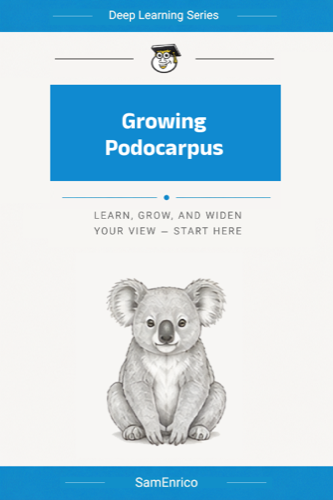
Growing Podocarpus
This publication, published by SamEnrico, covers G
This publication, published by SamEnrico, covers Growing Podocarpus
Formats
About this book
Free sample
Chapter 1: The Hidden Identity...--–- Walk into any nursery, and you will find them languishing in the corner of the evergreen section, mislabeled as "Buddhist pine" or "Japanese yew" or simply "podocarpus – hedge plant." The well-meaning nursery tag might tell you it needs "full sun to part shade" and "moderate water," which is about as useful as saying a dog needs food and shelter. It is technically correct but practically useless. This chapter exists to correct the record, to strip away the common names that conceal more than they reveal, and to introduce you to the true identity of one of the most misunderstood, underappreciated, yet remarkably resilient conifers in cultivation. By the time you finish these pages, you will see Podocarpus not as a generic hedge plant but as a living fossil, a botanical survivor, and the single most versatile evergreen for solving real landscape problems.The trouble with common names is that they lie. "Buddhist pine" suggests a relationship to true pines – Pinus – which could not be more wrong.
Pines produce dry, woody cones that crack open to release winged seeds. Podocarpus produces fleshy, berry-like structures that are technically cones but look and feel like fruit. "Japanese yew" implies kinship with Taxus, the poisonous yew of English churchyards. Again, false. True yews have flat needles arranged in two ranks and produce red, cup-like arils surrounding a toxic seed.
Podocarpus needles are flatter and broader than pine needles but lack the yew's distinctive arrangement. Even the common name "podocarpus" – simply the genus name repeated – tells you nothing about what this plant is or why you should care.Here is what you need to know instead: Podocarpus belongs to the family Podocarpaceae, an ancient lineage of conifers that originated more than 200 million years ago, when dinosaurs roamed and the continents were still rearranging themselves. This family once dominated the southern hemisphere's forests. Today, Podocarpus species survive in scattered pockets from New Zealand to Japan, from Chile to the cloud forests of Central America. They are survivors.
They have endured ice ages, continental drift, and the rise and fall of countless other plant families. And they have…
This is the end of the free sample. Get the eBook to keep going. Buy now
Contents
- Chapter 1
- Chapter 2
- Chapter 3
- Chapter 4
- Chapter 5
- Chapter 6
- Chapter 7
- Chapter 8
- Chapter 9
- Chapter 10
- Chapter 11
- Chapter 12
Details
- Author
- Hardesty Asuncion
- Publisher
- SamEnrico
- Language
- English
- Genre
- Non-Fiction, Informative, Educational
- Released
- 2026-06-02
- Pages (approx.)
- 160
- Available as
- eBook, Audiobook

Read better in the ZLOADR app
Your eBooks on your phone or tablet. Sign in with your SamEnrico account and start reading.
More by Hardesty Asuncion
 WHO Mental Health Gap Action GuideHardesty Asuncion$11.99
 Parent Time Tips GuideHardesty Asuncion$11.99
 Five Minute Breath Reset GuideHardesty Asuncion$11.99
 Imposter Body Confidence LinkHardesty Asuncion$11.99
 Memory Care LTC Coverage GuideHardesty Asuncion$11.99
 Sacred Tattoo Ceremony GuideHardesty Asuncion$11.99
 Individual FCPA ProsecutionsHardesty Asuncion$11.99
 Hiroshima SurvivorHardesty Asuncion$11.99
 Self Talk For Musician NervesHardesty Asuncion$11.99
 The Last Flight of the Hindenburg: A Symphony of Fire and IceHardesty Asuncion$11.99
 The Lion and the Rose: Shah Abbas and the Safavid Empire's Golden AgeHardesty Asuncion$11.99
 Ghosts of the Golden Mile: The 1989 Hong Kong Hostage CrisisHardesty Asuncion$11.99