
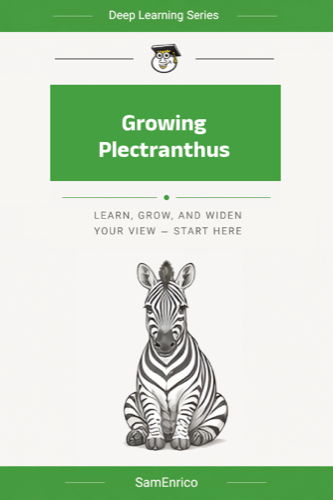
Non-FictionInformativeEducational
Growing Plectranthus eBook
This publication, published by SamEnrico, covers G
by Villa Noelia
This publication, published by SamEnrico, covers Growing Plectranthus
Formats
Free sample
Chapter 1: The Mint You Never Knew...--What if I told you that the plant you have been killing for years—the one that arrived as a “small green thing” from a friend, turned leggy in your dim living room, then collapsed from what you assumed was your own black thumb—was never actually difficult? What if the problem was not you, but a fundamental misunderstanding of what this plant needs? And what if the same genus that forgives your forgetfulness also produces fragrant oils, medicinally active compounds, and flowers that can transform a shaded porch into a pollinator sanctuary for six months straight?This is the quiet power of Plectranthus.You have likely seen it a hundred times without recognizing the name. At a grandmother’s house, trailing from a macrame hanger by a frosted window. At a botanical garden, labeled merely “Swedish Ivy” with no mention of its African origins.
At a big-box garden center in autumn, where racks of purple-flowered ‘Mona Lavender’ sit ignored between the dying annuals and the overpriced mums. The plant world has a strange habit of overlooking its own workhorses. Orchids receive entire books. Monsteras dominate Instagram. Succulents have become a merchandising empire.
Meanwhile, Plectranthus—a genus of roughly 350 species spanning three continents—quietly does the jobs that other plants refuse: thriving in the awkward strip of shade beneath a neighbor’s fence, filling a hanging basket that faces north, surviving the dry winter air of a radiator-heated apartment, and blooming when almost everything else has gone to sleep.Before we can grow a plant well, we must understand where it came from. This is not botanical trivia. This is the difference between watering on a schedule (disaster) and watering according to the plant’s evolutionary memory (success). So let us begin not with a potting mix recipe or a fertilizer ratio, but with the story of how a humble African understory plant became one of the most forgiving and versatile genera in cultivation.The Forgotten Genus: Why Plectranthus Deserves Your Attention Most gardeners discover Plectranthus by accident. They receive a cutting from a neighbor who calls it “Swedish Ivy” despite the fact that it is neither Swedish nor an ivy.
They buy a ‘Mona Lavender’ on clearance because the tag promises purple flowers and shade tolerance. They inherit a Cuban oregano plant from a friend who was moving and had no idea what to do with it. And then, after months of neglect or mismanagement, they are surprised to find the plant still alive.This accidental relationship is both a blessing and a curse. The blessing is that Plectranthus is extraordinarily forgiving. The curse is that its reputation as a “survivor” leads growers to treat it as indestructible, which in turn leads to the very problems that cause it to fail: too little light, too much water, and a complete misunderstanding of its seasonal cycles.Let me be clear from the outset: Plectranthus is not difficult, but it is specific.
It will not thrive in a dark corner. It will not appreciate being watered every Tuesday whether it needs it or not. It will not bloom under artificial light that runs sixteen hours a day. These are not failures of the plant. They are failures of our assumptions.The genus name Plectranthus comes from the Greek words plectron (spur) and anthos (flower), referring to the spur-shaped tube at the base of the flower.
This botanical detail matters less than the family it belongs to: Lamiaceae, the mint family. If you have ever grown mint, you already understand the most important traits of Plectranthus. Square stems. Opposite leaves. A tendency to root wherever a stem node touches soil.
Aromatic oils that range from pleasant to pungent. And a growth habit that can become invasive if ignored but stays perfectly manageable with occasional attention.Yet unlike true mint (Mentha), which spreads aggressively via underground runners and can take over a garden bed in a single season, Plectranthus is remarkably civilized. It spreads by above-ground stems that root at nodes when they contact moist soil. This means you control it simply by trimming back the stems that wander where they should not. No subterranean surprises.
No mint-apocalypse.The Taxonomic Shuffle: What You Need to Know About Coleus If you have been gardening for more than a few years, you may have noticed something strange. The plant you once called Coleus blumei—the classic shade garden annual with outrageously colored leaves in chartreuse, burgundy, pink, and orange—is now being sold under a different name. Some nurseries call it Plectranthus scutellarioides. Others have given up and simply label it “Coleus” with no scientific name at all.This is not horticultural chaos. It is science doing its job.In the 1990s and early 2000s, genetic analysis began to reveal that the old genus Coleus was not a natural grouping.
Many plants traditionally placed in Coleus were more closely related to Plectranthus than to other Coleus species. The result, published in 2019 after years of debate, was a formal reclassification: most of the old Coleus species (including the common garden coleus) were moved into Plectranthus. A smaller group was moved into a resurrected genus Coleus that now contains only a handful of African species.For the home gardener, what does this mean practically?First, do not panic. The nursery trade is slow to change labels. You will still see “Coleus” for sale, and you can still buy it.
Nothing has changed about how you grow it. The plant does not care what name is on the tag.Second, understand that many plants labeled “Plectranthus” in your local garden center are not the subject of this book. The reclassified coleus (now Plectranthus scutellarioides) has different care requirements than the species we focus on here. It wants more water, more fertilizer, and brighter light. It is a bedding annual, not a forgiving houseplant.
This book covers the traditional Plectranthus species: the trailing Swedish ivies, the upright ‘Mona Lavender’, the succulent P. ernstii, and the edible P. amboinicus.Third, use this confusion as a learning opportunity. When you buy a plant labeled only “Plectranthus” or “Coleus,” ask questions. Look at the leaves.
Feel the stems. If the leaves are thin and large (the size of your palm or bigger) with intensely saturated colors, you likely have a reclassified coleus. If the leaves are smaller, fleshier, slightly fuzzy, or aromatic when rubbed, you have a traditional Plectranthus. The difference matters for care, as we will explore throughout this book.Native Habitat: Reading the Plant’s Memory Every plant carries the memory of its homeland. A cactus from the Sonoran Desert remembers drought in its very cells.
A fern from the cloud forest remembers mist. And Plectranthus—depending on which species you grow—remembers the shaded forest floors of South Africa, the dry woodlands of Madagascar, or the humid slopes of the Himalayas.Understanding these origins is not an academic exercise. It is the key to unlocking the plant’s needs without memorizing a list of rules.The South African Connection The majority of cultivated Plectranthus species trace their ancestry to the eastern regions of South Africa, particularly the provinces of Kwa Zulu-Natal and the Eastern Cape. Here, the plants…
This is the end of the free sample. Get the eBook to keep going. Buy now
About this book
Details
- Author
- Villa Noelia
- Publisher
- SamEnrico
- Language
- English
- Genre
- Non-Fiction, Informative, Educational
- Released
- 2026-05-11
- Pages (approx.)
- 156
- Available as
- eBook, Audiobook

Read better in the ZLOADR app
Your eBooks on your phone or tablet. Sign in with your SamEnrico account and start reading.
More by Villa Noelia
 India FCPA Violation LogVilla Noelia$11.99
 Transcendental Meditation PostureVilla Noelia$11.99
 Therapy Without Borders Access GuideVilla Noelia$11.99
 Party Planning ShortcutVilla Noelia$11.99
 Imposter OCD Doubt LoopVilla Noelia$11.99
 Single Person LTC GuideVilla Noelia$11.99
 The Midnight Couriers: China's Forgotten Underground RailroadVilla Noelia$11.99
 Breath and Mental States ConnectionVilla Noelia$11.99
 Indigenous Grief Rituals ManualVilla Noelia$11.99
 Whispers of the Sky: The Vanishing City of the CloudsVilla Noelia$11.99
 Silent No More: The Unfinished Fight for the 19th AmendmentVilla Noelia$11.99
 Sixty Second Nervous System ResetVilla Noelia$12.99
You may also like
 Hong Kong Handover 1997Dunn Johnnie$11.99
 Zumba For Postnatal Recovery CourseNeal Christian$11.99
 Zumba for BeginnersLadner Nikia$11.99
 YouTube Comment Mining GuideHumes Pandora$12.99
 Worry Box MeditationCarlin Rudy$11.99
 Workplace Stress MeditationNguyen Lynn$11.99
 Workplace Stress and Sleep RepairHawley Ivory$11.99
 Workplace Perfectionism CureDelaney Jeffry$11.99
 Workplace Injustice Anger GuideWallen Isabelle$11.99
 Work Addiction and Burnout LinkGreenwood Ester$11.99
 Women in Yoga and WellnessBeattie Galina$11.99
 Women in Stand Up ComedyChun Evangeline$11.99