
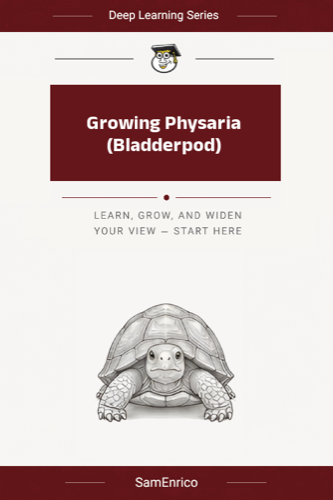
Growing Physaria (Bladderpod) eBook
This publication, published by SamEnrico, covers G
This publication, published by SamEnrico, covers Growing Physaria (Bladderpod)
Formats
Free sample
Chapter 1: The Desert’s Silver Secret–- It began, as most obsessions do, with a single plant growing where no plant had any right to grow.The summer of 2021 had been merciless. In the high desert of northern New Mexico, where I had staked my claim as a fourth-generation farmer on land my great-grandfather had homesteaded in 1912, the rain had simply stopped coming in May. By July, the creek that had never run dry in living memory was a cracked ribbon of dust. By August, my well—drilled 280 feet deep, pumping from an aquifer my grandfather said would last forever—was pulling up more sand than water. My corn was dead by the Fourth of July.
My alfalfa had been baled once, a third of a normal cutting, and then turned brown. The bank was calling every week. My wife had stopped asking about the future; she just watched the sky, the way sailors watch a dead calm when they know a storm is coming but can’t see it yet.On an August afternoon when the temperature touched 104 degrees, I walked the back forty—what we still called the back forty, though forty acres of sagebrush and caliche had never produced anything but tumbleweeds and regret. I was looking for something. I didn’t know what.
Maybe just an excuse to be outside instead of at the kitchen table with spreadsheets that turned every number red.And then I saw it.A single plant, maybe eighteen inches tall, growing out of a gravelly wash where nothing else green existed. Not just surviving—thriving. Its leaves were silvery-gray, almost white, covered in what looked like a fine fur. Its stems branched low to the ground, spreading wide like it was daring the sun to try harder. And its seed pods—I stopped walking when I saw the seed pods.
They were small, inflated, papery spheres, like tiny Japanese lanterns, each one packed tight with something that rattled when I touched them.I knew mustard plants. I had spent twenty years fighting wild mustards along my fence lines. This was not a mustard. Its flowers, what remained of them, were yellow but not the aggressive yellow of invasive brassicas. The leaves were lobed differently, softer somehow.
And those pods—I had never seen pods like that on any weed in my fields.I pulled out my phone, took a photo, and sent it to the county extension agent, a patient woman named Elena who had answered a hundred of my desperate questions over the years. Her response came back in eleven minutes.That’s Physaria. Used to be called Lesquerella. Bladderpod. Native.
Why are you sending me a picture of a weed?I wrote back: Because it’s the only thing green on my farm.She called me fifteen seconds later.That phone call changed my life. Over the next hour, Elena told me about a plant I had never heard of, growing on land I had assumed was worthless, producing an oil that chemical companies had been quietly studying for thirty years. She told me that Physaria—this unremarkable silver weed—contained lesquerolic acid, a hydroxy fatty acid that mimicked castor oil without the toxicity. She told me that the USDA had spent millions breeding high-yield varieties. She told me that farmers in Arizona and West Texas were beginning to plant it as a dryland rotation crop, and that some of them were making more money per acre on bladderpod than they ever had on cotton.Then she told me something that stopped my heart.“Sam,” she said, “that plant you’re looking at?
It’s growing in pure gravel. No irrigation. No fertilizer. No nothing. And it’s covered in seed pods.
Have you ever seen anything else do that on your place?”I looked around at the cracked earth, the dead sagebrush, the skeletons of my corn crop. “No,” I said. “Never.”“Then maybe,” she said, “you should plant more of it.”The Blind Spot on the American Farm Here is a confession that shames me: I had walked past Physaria a thousand times before that August afternoon. It grows wild across the western United States—from the high plains of Wyoming to the Sonoran Desert of Arizona, from the scrublands of west Texas to the canyon country of Utah. It is not rare.
It is not endangered. It is, in the truest sense, a native success story, adapted over millennia to the most punishing growing conditions on the continent.And I had never seen it.That is the first lesson of this book, and I want you to sit with it for a moment. We spend so much time looking at what we want to grow—corn, soy, wheat, cotton—that we become blind to what is actually willing to grow. The agricultural system we inherited treats the land as an enemy to be conquered, a problem to be solved with more fertilizer, more irrigation, more pesticides. We have been taught that the only good plant is one that demands everything from the soil and gives back only when we force it.Physaria demands nothing.
It offers everything. And we have ignored it for generations.The story of bladderpod is a story of willful blindness. The first botanical description of the genus Physaria was published in 1821, based on specimens collected during the Lewis and Clark expedition. Native Americans had been using it for centuries—the seeds ground into flour during famine years, the leaves brewed into tea for stomach ailments, the oil applied to leather as a waterproofing agent. But when European settlers arrived, they brought their own crops, their own seeds, their own assumptions about what a farm should look like.
A low-growing silver weed with inflated pods? That was a weed. That was something to be sprayed, plowed under, ignored.And so it was. For two hundred years, Physaria grew in the margins—along fence lines, in gravel pits, on land too poor to plow, in places where nothing else would survive. It persisted because persistence was its evolutionary strategy.
It didn't need us to notice it. It just needed us to leave it alone.But the world has changed. The water that sustained our grandfathers' farms is gone. The topsoil that took ten thousand years to accumulate is blowing away. The fossil-fueled agricultural system that produced cheap food for a century is cracking under the weight of its own contradictions.
And suddenly, the plant that grew in the gravel is looking less like a weed and more like a lifeline.What Exactly Is Physaria? (And Why Should You Care?)Let me be precise. Physaria (pronounced fye-SAR-ee-uh) is a genus of flowering plants in the Brassicaceae family—the same family as mustard, cabbage, broccoli, and canola. But while its domesticated cousins demand rich soil, abundant water, and chemical protection, Physaria evolved to do the opposite. Its native range spans the driest, poorest, most punishing landscapes of North America.
It has adapted to:Extreme temperature swings: From below zero in the Great Basin winters to 110 degrees in the Sonoran summers.Minimal rainfall: Many Physaria species complete their life cycle on less than twelve inches of annual precipitation.Alkaline…
This is the end of the free sample. Get the eBook to keep going. Buy now
About this book
Details
- Author
- Tucker Lawrence
- Publisher
- SamEnrico
- Language
- English
- Genre
- Non-Fiction, Informative, Educational
- Released
- 2026-06-02
- Pages (approx.)
- 128
- Available as
- eBook, Audiobook

Read better in the ZLOADR app
Your eBooks on your phone or tablet. Sign in with your SamEnrico account and start reading.
More by Tucker Lawrence
 Startup Founder Stress HandbookTucker Lawrence$11.99
 Social Media Imposter ComparisonTucker Lawrence$11.99
 King DreamTucker Lawrence$11.99
 The Council of Trent SessionsTucker Lawrence$11.99
 Breath Visualization GuideTucker Lawrence$11.99
 Corn Mother Spiritual TeachingsTucker Lawrence$11.99
 Nigeria Fashion Grant GuideTucker Lawrence$11.99
 IBS Constipation GuideTucker Lawrence$11.99
 Therapeutic Listening SkillsTucker Lawrence$11.99
 The Pythagorean Theorem: The Harmony of NumbersTucker Lawrence$11.99
 The Puppet Masters of Wall Street: How the Fed’s Shadow Rulers Shaped the 2008 CrisisTucker Lawrence$11.99
 Frostborn and Firebound: The Djinn’s Oath to OdinTucker Lawrence$11.99