
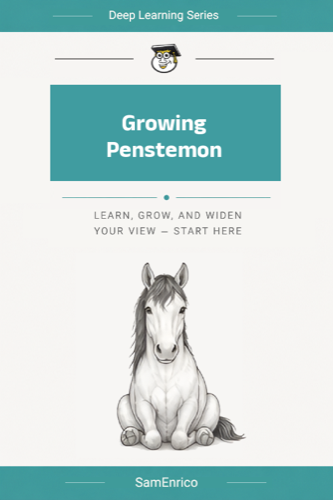
Growing Penstemon eBook
This publication, published by SamEnrico, covers G
This publication, published by SamEnrico, covers Growing Penstemon
Formats
Free sample
Chapter 1: The Hidden Truth--The first Penstemon I ever planted died within six weeks. I had followed every instruction on the nursery tag—full sun, well-drained soil, moderate water—and the plant still turned from a healthy green rosette into a black, collapsed mess that smelled like a swamp. I assumed I was the problem. I bought another one, planted it in a different spot, watered it less, and watched it die faster. A third attempt produced the same result, this time with the added humiliation of my neighbor—a man who waters his lawn at 2 PM in July—asking why my "weed garden" wasn't working out.What I didn't know then, and what thousands of gardeners discover every year through expensive trial and error, is that Penstemon has been hiding a secret.
Not a secret kept deliberately—plants don't conspire against us, despite how it feels—but a secret buried in the plant's evolutionary history, in the soils it adapted to over millions of years, and in the assumptions we bring from growing almost everything else in our gardens.The secret is this: almost everything you know about watering, feeding, and mulching perennials is wrong for Penstemon.The Lawn Brain and Its Consequences We have been trained by the lawn. The American lawn—that vast, thirsty, chemically dependent carpet of non-native grass—has shaped our gardening instincts more deeply than most of us realize. When a lawn turns yellow, we water it. When it grows slowly, we fertilize it. When weeds appear, we spray them.
These responses are so deeply ingrained that we apply them automatically to everything else in our gardens, including plants that evolved to thrive under conditions that would kill a lawn in a week.Penstemon is one of those plants.The genus Penstemon—comprising over 250 species native almost exclusively to North America—evolved in environments that would challenge even the toughest garden plants. Alpine Penstemons grow in pure rock scree at 12,000 feet in the Rocky Mountains, where soil is nothing more than crushed stone and winter lasts eight months. Desert Penstemons thrive in the Grand Canyon's inner gorge, where summer temperatures exceed 110 degrees Fahrenheit and rain falls perhaps twice a year. Prairie Penstemons anchor their roots in the deep, wind-scoured soils of the Great Plains, where drought is the rule, not the exception, and where fires once swept through every few years, clearing away competing vegetation.In none of these environments do Penstemons find compost-enriched soil, drip irrigation, or wood chip mulch. They find hardship.
They find scarcity. And they respond to that scarcity not despite it, but because of it.The Three Converging Crises That Made Penstemon Essential Something changed in the last decade. Penstemon began moving from the margins of horticulture—from rock garden societies and native plant nerds—into the mainstream. Garden centers that once carried one or two varieties now devote entire tables to them. Landscape architects who specified only non-native perennials now reach for Penstemon first.
Homeowners who never considered planting anything but hydrangeas and daylilies are now asking for "those purple spikes that the hummingbirds like."Three converging trends explain this shift, and understanding them helps explain why this book exists.The Water Crisis The first trend is water—or rather, the lack of it. From 2020 to 2024, record drought across the western United States forced unprecedented water restrictions. Las Vegas banned grass. Los Angeles ripped out miles of lawn. Entire neighborhoods in Utah watched their decorative fountains dry to dust.
Even in the traditionally wet East Coast, groundwater levels dropped and municipalities began charging premium rates for irrigation water.The cost of maintaining a traditional garden skyrocketed. A 1,000-square-foot flower border planted with standard nursery perennials (hydrangeas, rhododendrons, hybrid tea roses) requires approximately 15,000 gallons of water per growing season in a temperate climate, according to Colorado State University Extension data. In arid regions, that number triples. The water bill alone for such a garden can exceed $1,000 annually in many areas, not counting the cost of fertilizers, pest controls, and replacement plants for those that fail to survive the summer.Penstemon offers a radical alternative. Once established, most Penstemons need water only every ten to fourteen days, and some species survive on natural rainfall alone in all but the most extreme climates.
A Penstemon border of the same 1,000 square feet requires approximately 3,000 gallons per season—an 80% reduction. Over a decade, that single change saves a homeowner nearly $8,000 in water costs.The Pollinator Collapse The second trend is the accelerating decline of native pollinators. The rusty patched bumblebee, once common across twenty-eight states, is now listed as endangered. The monarch butterfly population has fallen by 90% in two decades. Seventy percent of native bee species are in decline, according to the Center for Biological Diversity.
The causes are complex—habitat loss, pesticides, disease, climate change—but the solution begins with a simple observation: native insects need native plants.Penstemon is a keystone genus for North American pollinators. The flowers produce nectar with precisely the sugar concentration that native bees require. The tubular corolla is shaped to admit bumblebees and long-tongued solitary bees while excluding honeybees (which are European imports and have different nutritional needs). The bloom time of various Penstemon species spans from April to October, providing continuous forage across the entire growing season.One study from the University of California, Davis, counted 112 insect species visiting a single patch of Penstemon heterophyllus over the course of a summer. Among them were eight species of native bees, three species of butterflies, two species of hummingbirds, and dozens of predatory and parasitic wasps that control garden pests.
Remove the Penstemon, and that entire food web collapses.The Low-Maintenance Revolution The third trend is demographic. The average age of American gardeners is fifty-five and rising. Retirees want gardens that don't require pushing a heavy mower or kneeling for hours of weeding. Younger homeowners, many of whom have never gardened before, want instant results without a steep learning curve. Both groups want plants that survive benign neglect.Penstemon delivers.
These plants don't need deadheading to rebloom. They don't need staking (most varieties, anyway). They don't need winter protection in most climates. They don't need division every three years like daylilies and irises. They don't need spraying for Japanese beetles or black spot or powdery mildew.
Plant them in the right place with the right soil, ignore them most of the time, and they reward you with five months of flowers.This is not laziness. This is intelligent gardening—working with the plant's evolutionary adaptations rather than fighting them.Why Penstemon Has Been Overlooked Given all these virtues, you might wonder why Penstemon isn't already the most popular perennial in America. The answer lies in the plant's history and in the horticultural industry's orientation toward European and Asian plants.American gardening has long suffered from what the botanist John Smith called "horticultural xenophilia"—the preference for exotic plants over native ones. Our gardens are filled with English roses, Chinese hydrangeas, Japanese maples, and Mediterranean lavenders. These plants are beautiful, yes, but they evolved in different climates, different soils, and different ecological communities than the ones we plant them in.
They require constant intervention to survive.Penstemon, by contrast, evolved here. On this continent. In your region, or one very much…
This is the end of the free sample. Get the eBook to keep going. Buy now
About this book
Details
- Author
- Stegall Serita
- Publisher
- SamEnrico
- Language
- English
- Genre
- Non-Fiction, Informative, Educational
- Released
- 2026-05-06
- Pages (approx.)
- 135
- Available as
- eBook, Audiobook

Read better in the ZLOADR app
Your eBooks on your phone or tablet. Sign in with your SamEnrico account and start reading.
More by Stegall Serita
 Self Esteem with Chronic IllnessStegall Serita$11.99
 Mindfulness of EmotionsStegall Serita$11.99
 Philae Temple IsisStegall Serita$11.99
 The Long Breath Short BreathStegall Serita$11.99
 Employment Contract AI ParsingStegall Serita$11.99
 Bathyscaphe Descent StoriesStegall Serita$11.99
 Anger Management for ADHD at WorkStegall Serita$11.99
 Philosophy Concept PalaceStegall Serita$11.99
 Meditation For BurnoutStegall Serita$11.99
 The Puppet Masters of Silicon Valley: How a Handful of CEOs Secretly Shaped Global PolicyStegall Serita$11.99
 Florence Unleashed: The Sneaker Renaissance of the Medici DynastyStegall Serita$11.99
 The Silent Deep: AI’s First Oceanic AwakeningStegall Serita$11.99